To Clip or not to Clip..

Joined
Nov 8, 2005
Messages
103
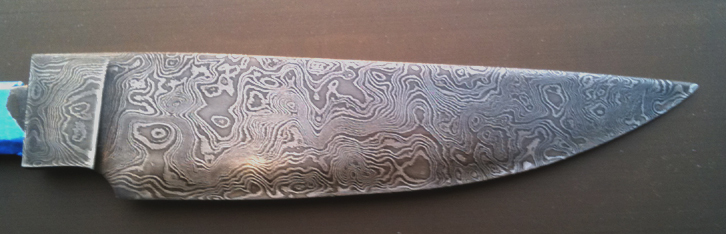
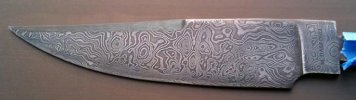
I'm working on my first true pattern welded blade (non-cable) and need some help deciding whether to add bowie-type clip to the blade.

The blade is 6" long, made from Aldo's 1080 and 15N20.

I'm also undecided on the handle shape: either a super stark bog oak coffin handle with stainless frame, guard and pins; or a hidden tang in redwood burl with stainless guard and mozaic pin.

Here's the blade.
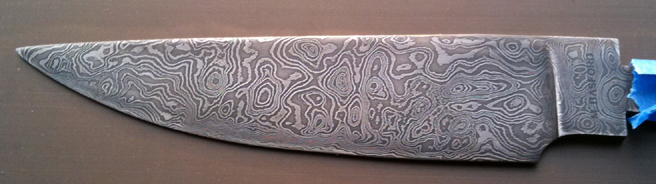
w201158984.jpg


and

w201158982.jpg


thanks,
 
This is just my personal taste, but I don't like clips on shorter blades. To me a subtle clip looks absolutely great on a big, long, slim bowie blade, but my opinion is that they make shorter blades look souviner-ish or cheap.

How about instead of a true clip, just swedge the last 1/3 of the blade and see how it looks. If you decide to add a clip, you can always do it after the swedge.

Take all of that with a grain of salt, because that's just me, and it's your knife.

--nathan
 
Personally im not usually a fan of clipped blades but i think i might like it on this one. Whatever you do im sure its still going to be a nice knife.
 
Maybe I should clarify a bit. When I think of a clip, the first thing that comes to mind is the obvious curved clips you see in the old Jim Bowie themed bowies (though no one really knows what Jim's knife looked like).

I'm much more of a fan of the straight clips that are long and subtle. A straight sublte clip might look good on this knife. It's hard to know without the knife in hand. Trace the blade on some cardboard and cut out two profiles of it. On one, leave it the same, on the the other, add a clip. Hang them up side by side with a bright background and look at the dark profiles and see which speaks to you.

Kind of like this:

IMG_0086.jpg


--nathan
 
I wouldn't clip that particular blade. If it were wider and the tip would be in the same place with the same edge shape after clipping, a clip might have worked.
 
I think there's a break in the language here.

I am probably wrong, but I assumed he meant simply adding a clip grind.... not actually changing the profile with a radiused clip.


If you just mean a clip grind (a small bevel added to the blade shape you already have) then I say almost any knife looks better with that because it adds dimension and technical difficulty to the blade.

You need to plan it out though, as a clip grind can make or break the look of a knife.

:)
 
Thanks, Ken. :) I've had this sitting on my work bench now for 3-4 months. It needs to be reworked a little to remove a slight wave in the edge from heat treating. I just haven't got the umph up to do it yet. I've got to head to the shop tonight for some work, but this one will have to wait as it's just for fun and not a customer order.

--nathan
 
I played with photoshop a bit. I liked it a lot with a clip, but it is great as it is...
 

Attachments

  • w201158984 copy.jpg
    w201158984 copy.jpg
    20.7 KB · Views: 41
Is this a clip, false edge or swedge? Please educate me on this. What I consider a swedge or false edge is what what galadduin posted. :confused::confused:

Edit: It seems like both after reviewing the pics. Again, Im confused...
 
Last edited:
Thanks to everyone for there comments. I'll work without the clip/swedge until the handle is on, then repost to get opinions of the full piece.

Special thanks to emre for his Photoshop work.

All of the comments bring up the question: what exactly is a "clip"? And what is a "swedge"?

Using the profile of nathan's blade as a base (since it's so clean). I've put together a diagram to help in discussion

w201233066.jpg


assuming the clipped portion of the above profiles were sharpened:
A) Control - straight spine profile for reference;
B) Traditional - tip is dropped to blade center using a curved profile;
C) Modern 1 - tip is dropped to blade center using a straight profile, less than half the blade length;
D) Modern 2 - tip is dropped to blade center using a straight profile, more than half the blade length.

So which profile(s) are Bowie profiles, which are clips, which are swedges?
 
I'd say anything that "clips" off a distal portion of the spine in a blade profile, be it straight or curved (traditional) would be a clip. So all the profiles below "A" you posted would be clips.

Now, you have the issue of what is done to the clip. If it is left alone and full thickness, it would just be a clip.

I'd call a bevel that is ground to nearly sharp (maybe 1/32" at the edge) along the distal spine a "false edge". So you could have a clip that was ground to a false edge (a false edged clip).

I'd call a rather obtuse bevel along the spine a "swedge". So you could also have a swedged clip.

The bowie profile I posted has a long, straight clip and is swedged along the entire spine. I guess it's technically a swedged clip:

IMG_0094.jpg

(this pic is early on in grinding, so it's a little rough but shows the swedge well)

That's how my mind sees it.

--nathan
 
NATHAN ---- as you seem to have captured an elegant line in the creating of this particular blade, I'd urge you to give considerable thought to the design of the guard, handle/etc. This piece could develop into a unique & handsome bowir --- a real dressed up classic.
 
I think that your naming convention seems to reflect my understanding with the exception of the term "false edge".

which, I believe, is a fencing term for the back edge of a knife or sword.

When holding a double edged blade naturally, the "true edge" is the on the knuckle side and the "false edge" is on the reverse. Daggers, cross-hilted swords, etc. don't have true or false edges in form, but they certainly do in funtion where a true edge cut is very different from a false edge cut.
 
The knife that most experts agree is the "original" Bowie (the Edwin Forrest knife) did not have a clip. It looked much as your blade does now, except bigger.
 
Back
Top