
-
The BladeForums.com 2024 Traditional Knife is available! Price is $250 ea (shipped within CONUS).
Order here: https://www.bladeforums.com/help/2024-traditional/
You are using an out of date browser. It may not display this or other websites correctly.
You should upgrade or use an alternative browser.
You should upgrade or use an alternative browser.
to convex or not to convex
- Thread starter jimwalter
- Start date


Buzzbait
Gold Member
- Joined
- Feb 25, 2001
- Messages
- 6,810
It depends on how far from the edge you want the convex to begin, and how much you plan to thin things out. If you're just convexing the edge bevel, 600 or 800 grit should do fine for starters. But if you want the convex to start quite a bit behind the edge, prepare for A LOT of hand work, and start with 100 or 200 grit. Better yet, go slow and easy with a belt grinder.
Here's an Endura4 I did years ago.

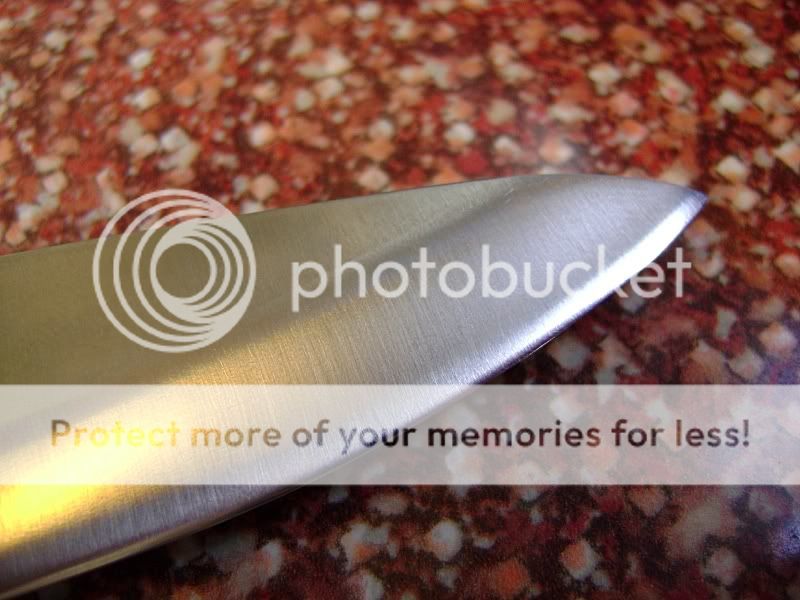
Here's an Endura4 I did years ago.
Buzzbait is right. Start way lower. 200, 600, 1000, 1500, 2000, strop works pretty well for me for the intial regrinding. Once you have established the edge, 1000, 1500, 2000, strop works well to bring it back if you let it get really dull. If you strop it often, you may never have to hit the sandpaper again.
Just like the last couple guys said, start low and go slow. Figure out your plan before you start. Patients is a must if you want to do as good of a job as buzzbait posted. Rounding just the shoulders on the bevel shouldnt be too hard though. The whole knife is a bit tougher and longer.
you might want to start out with a coarser grit to make the job go a little faster. i would start out with a 280 grit to work the shoulder down and once you do that go to the next finer grit. i never go over 400 grit on any knife i sharpen. taking an edge too fine is just like having a wire thin edge. if you need to cut something like a seat belt the edge will just slide. i have put edges on knives with an 80 grit belt and had them treetop hairs before but i finished the edge off with the slotted paper wheel.
you can see some blades i convexed in this thread http://www.bladeforums.com/forums/showthread.php?t=585019
you can see some blades i convexed in this thread http://www.bladeforums.com/forums/showthread.php?t=585019

- Joined
- Sep 24, 2007
- Messages
- 146
Richard, how is going up in grit making the edge too fine? I've heard the arguments about whether the micro serration is better with the lower grits but never that putting a mirror polish on with a 10K or 15K stone makes for a weaker edge. Much of what I've heard/seen is that the polished edge actually has better retention.
Love your thoughts as I really respect your sharpening opinion (and you're the reason a paperwheel system is sitting on my workbench )
)
Love your thoughts as I really respect your sharpening opinion (and you're the reason a paperwheel system is sitting on my workbench
)going too fine is similar to a wire edge. i have talked to quite a few other knifemakers and sharpening service owners who say the same thing. sure the knife will cut soft material but when you really need it to cut (harder items) the edge will either roll or slide (like seat belts or certain kinds of rope) depending on what you are cutting. since you have the wheels give this a try. work up a burr with an 80 grit abrasive and remove it with the slotted wheel. that edge will shave and be real toothy too. i have been meaning to work up a burr on a concrete block and then go to the slotted wheel and see what that edge is like just for fun (on a junk knife of course  ).
).
).I pretty much convex everything now. The only ones I don't are the ones I think I'll sell or those which do not benefit from it, such as my Leatherman Squirt (single bevel). I even zero-convexed my SAK! If you're starting out with convexing, do it to a cheap blade first, such as a Mora or something, so you'll get the hang of it. I've gotten some ugly grind marks on some premium blades due to my previous ignorance.

- Joined
- Sep 24, 2007
- Messages
- 146
Thanks Richard. I'll give it a try and I certainly trust/respect what you say. That said, I guess I'm still struggling with the science behind the statement that the grit finish makes an edge roll more/less than the profile If I have a 25% bevel on one of my hard use knives, how would a 10K grit finish make that roll easier than a 400 grit finish? As an use example, I put a convex edge on a Busse ASH-1 (actually on all my Busse's ), take it down to a 9 micron belt on my Kalamazoo, go thru 3 strope belts (green, white, straight leather) so the thing is shinning like a polished mirror. Was out hunting the other weekend and did some pretty rigorous chopping. Was still super sharp at the end of the weekend. Touched it up of course when I got home but didn't need much work to get back to what I consider perfect state.
Stoffi, I'm pretty much in convex camp although I do have mood swings I've put convex edges on all of my hunting/camp knives. However, most of my folders I've kept with the v grind. I recently added an Edge Pro to my sharpening tool collection and I have to say there is just something about pulling out a knife and seeing the glare off the mirror finish that makes me happy. Just did my first kitchen knife on the EP (8" Henckel), took it to the 800 stone then stroped and it was carving thru paper like it was its job. Really happy with the ease and performance of the EP.
If I have a 25% bevel on one of my hard use knives, how would a 10K grit finish make that roll easier than a 400 grit finish? As an use example, I put a convex edge on a Busse ASH-1 (actually on all my Busse's ), take it down to a 9 micron belt on my Kalamazoo, go thru 3 strope belts (green, white, straight leather) so the thing is shinning like a polished mirror. Was out hunting the other weekend and did some pretty rigorous chopping. Was still super sharp at the end of the weekend. Touched it up of course when I got home but didn't need much work to get back to what I consider perfect state. Stoffi, I'm pretty much in convex camp although I do have mood swings
I've put convex edges on all of my hunting/camp knives. However, most of my folders I've kept with the v grind. I recently added an Edge Pro to my sharpening tool collection and I have to say there is just something about pulling out a knife and seeing the glare off the mirror finish that makes me happy. Just did my first kitchen knife on the EP (8" Henckel), took it to the 800 stone then stroped and it was carving thru paper like it was its job. Really happy with the ease and performance of the EP.
- Joined
- Jun 4, 2010
- Messages
- 6,642
Its not so much ambiguity, as there's several ways to get the job done. Basically all you're doing is grinding the shoulder off of a regular V grind to reduce resistance behind the cutting edge without making it too weak. FWIW I convex all my knives, machetes, and hatchets, but do it with a stone (I did my first two on sandpaper/beltsander). Multiple passes on a stone elevating and lowering the spine is all that's required. Folks have been convexing edges long before they started doing it with sandpaper. Hell, I was watching a special about that "IceMan" and his axe looked to be convexed - 5000+ years ago.
If you have a coarse DMT stone, or a combination Sic stone you can do a fine job - after a few passes on a strop it looks every bit as nice as one done on sandpaper and you get to control every element of the convex curve instead of guessing and having to balance multiple variables of pressure, density of backing, tendency of sandpaper to be cut on an edgeleading stroke, tendency for burrs to cling when an edgetrailing stroke is used...
My two cents, if you're going to use sandpaper get a few 3" SIC bonded belts from Supergrit or similar, cut the splice out, and mount them to a backing. They do a better job IMHO than the wet/dry sheets and they won't cut when used edgeleading. Another issue if using sandpaper or belts, get some crepe rubber (commercially available for just this purpose, sold in block form) to unclog the paper frequently - that'll keep it cutting a lot better - even a little clogging will dramatically slow down the rate of stock removal.
Or just get a few stones, clean them frequently and do it with benchstones. The coarse waterstones work great for this type of job as the abrasive always stays fresh and the abundant swarf can be rinsed away as you go with a quick flick in a bath.
Do your first attempt on a cheap knife, no matter what technique you go with - you might not even feel the need to totally finish it, but you'll want to get a handle on what can go wrong early without gouging up a favored knife.
If you have a coarse DMT stone, or a combination Sic stone you can do a fine job - after a few passes on a strop it looks every bit as nice as one done on sandpaper and you get to control every element of the convex curve instead of guessing and having to balance multiple variables of pressure, density of backing, tendency of sandpaper to be cut on an edgeleading stroke, tendency for burrs to cling when an edgetrailing stroke is used...
My two cents, if you're going to use sandpaper get a few 3" SIC bonded belts from Supergrit or similar, cut the splice out, and mount them to a backing. They do a better job IMHO than the wet/dry sheets and they won't cut when used edgeleading. Another issue if using sandpaper or belts, get some crepe rubber (commercially available for just this purpose, sold in block form) to unclog the paper frequently - that'll keep it cutting a lot better - even a little clogging will dramatically slow down the rate of stock removal.
Or just get a few stones, clean them frequently and do it with benchstones. The coarse waterstones work great for this type of job as the abrasive always stays fresh and the abundant swarf can be rinsed away as you go with a quick flick in a bath.
Do your first attempt on a cheap knife, no matter what technique you go with - you might not even feel the need to totally finish it, but you'll want to get a handle on what can go wrong early without gouging up a favored knife.
- Joined
- Jun 4, 2010
- Messages
- 6,642
Here's a pic of the stock TOPS knife - last one I convexed. Did the job entirely with stones, and that's how its been maintained for many months now. Its a lot of work to do a full convex conversion. This is now my favorite beater knife

And this how it looks today (apologies for the crappy photo)
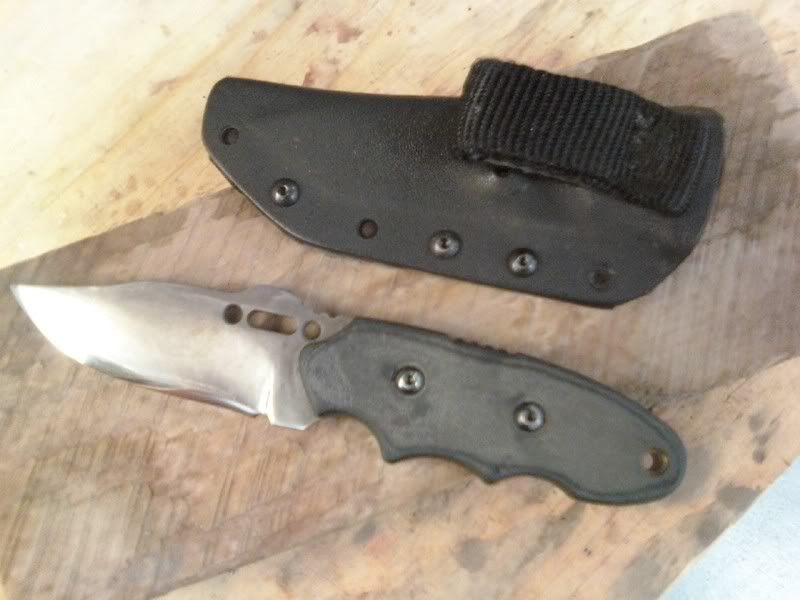
Its not complicated, just a bunch of elbow grease and a lot of patience. The performance improvement can be considerable, especially on thicker blades - this one started out 5/32" and it wouldn't surprise me if it was a bit thicker than that.
And this how it looks today (apologies for the crappy photo)
Its not complicated, just a bunch of elbow grease and a lot of patience. The performance improvement can be considerable, especially on thicker blades - this one started out 5/32" and it wouldn't surprise me if it was a bit thicker than that.
Buzzbait
Gold Member
- Joined
- Feb 25, 2001
- Messages
- 6,810
I could see a high grit convex edge being an issue under certain situations. Because of the high level of polish on the edge, the edge might just slide along certain substrates. Push cuts might not be an issue, but slicing could be hampered by a high level of polish.
A high polish could also theoretically lead to an edge that dies quickly. The more you strop and edge, the more you're deforming the very edge of the steel, back and forth on each strop stroke. This is at a very tiny level, but it's there. If the edge is extremely thin, the amount of effected steel could be great enough to create a wire edge.
There's obviously a lot more to this. The type of steel, the heat treatment and the grind all play a major factor.
I convex most of my edge bevels, and use many full convex grinds for outdoor use. By I keep some flat v-grind edge bevels at a coarse level of polish for some of my dedicated slicing knives.
A high polish could also theoretically lead to an edge that dies quickly. The more you strop and edge, the more you're deforming the very edge of the steel, back and forth on each strop stroke. This is at a very tiny level, but it's there. If the edge is extremely thin, the amount of effected steel could be great enough to create a wire edge.
There's obviously a lot more to this. The type of steel, the heat treatment and the grind all play a major factor.
I convex most of my edge bevels, and use many full convex grinds for outdoor use. By I keep some flat v-grind edge bevels at a coarse level of polish for some of my dedicated slicing knives.

Jason B.
Knifemaker / Craftsman / Service Provider
- Joined
- Jun 13, 2007
- Messages
- 11,196
That's not how it works.You are not deforming or bending any part of the edge with a strop. Burrs happen as a result of abrasive contact and amount of pressure exerted on the bevel. A abrasive choice of coarse or fine does not change toughness, wear resistance, or edge stability. It's also up to the user to use proper cutting technique with each edge type, if not you may think that edge type is inferior.A high polish could also theoretically lead to an edge that dies quickly. The more you strop and edge, the more you're deforming the very edge of the steel, back and forth on each strop stroke. This is at a very tiny level, but it's there. If the edge is extremely thin, the amount of effected steel could be great enough to create a wire edge
Buzzbait
Gold Member
- Joined
- Feb 25, 2001
- Messages
- 6,810
That's not how it works.You are not deforming or bending any part of the edge with a strop. Burrs happen as a result of abrasive contact and amount of pressure exerted on the bevel. A abrasive choice of coarse or fine does not change toughness, wear resistance, or edge stability. It's also up to the user to use proper cutting technique with each edge type, if not you may think that edge type is inferior.
I'm sorry, but I disagree. I'm not talking about the creation of a burr, but actually weakening the very edge. It happens rather easily when polishing the edge on something like Talonite. I talked at length with Rob Simonich on this very issue. I don't see it as being such a stretch to extend the theory to steel, if the edge is thin enough. Especially if large chunks of carbide are involved.
I'm not particularly enamored with convex edges. I do like the look of full convex grinds, but haven't found an advantage in use. I use convex edges, and don't go out of my way to avoid them, but the advantages in cutting that I could attribute to the convexing are more due to the thinning of metal at and near the edge than the actual shape.
If you want to fully convex a knife, you might try using a coarse sanding belt hooked over a vice or something solid. Stretch it tight and go at it. Use progressively finer belts to get the finish you want. This is how I convexed the blades on my Schrade Peanut. 80 grit, 120 grit, 220 grit, then switched to strips of sandpaper stretched tight, all the way down to 1200 grit and stropped. When I say stretched tight, I mean I used a large C-clamp for a handle and leaned all my weight back against the belt for tension with the belt hooked over the corner of my vice.
On another note, good to see Buzzbait back around. Haven't seen you post in a long time.
If you want to fully convex a knife, you might try using a coarse sanding belt hooked over a vice or something solid. Stretch it tight and go at it. Use progressively finer belts to get the finish you want. This is how I convexed the blades on my Schrade Peanut. 80 grit, 120 grit, 220 grit, then switched to strips of sandpaper stretched tight, all the way down to 1200 grit and stropped. When I say stretched tight, I mean I used a large C-clamp for a handle and leaned all my weight back against the belt for tension with the belt hooked over the corner of my vice.
On another note, good to see Buzzbait back around. Haven't seen you post in a long time.