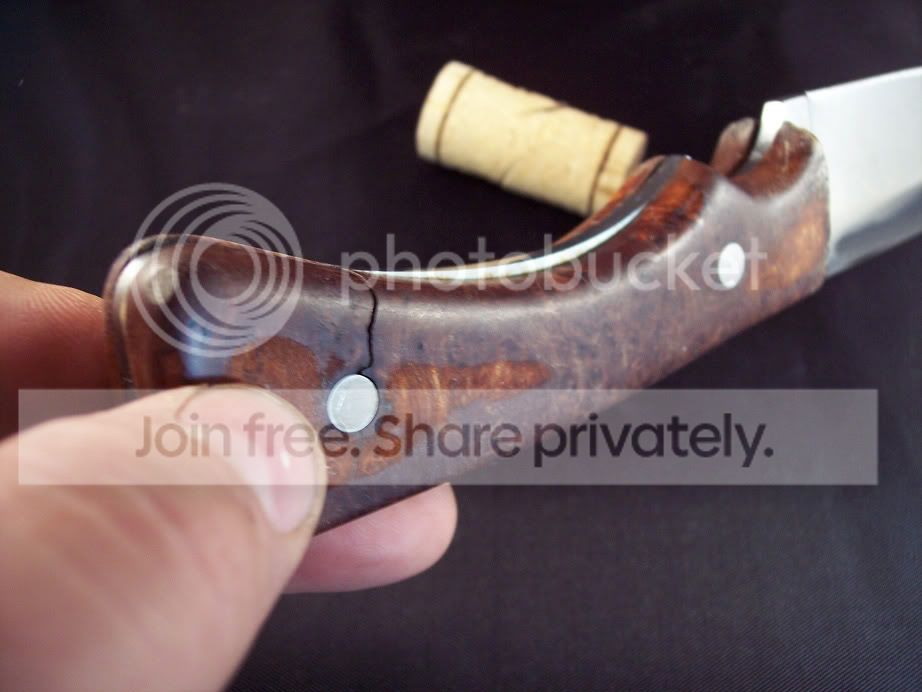
To Stabilize or Not?

Joined
Jul 23, 2006
Messages
1,231
Hey Folks,

I've been wondering lately, about which wood/organic species of handle materials benefit the most from the various stabilizing processes available today. I've really heard good things about K & G and their stabilizing services. As a matter of fact, I'm planning on sending out a batch of blocks to them shortly.

What processes do you folks like to use to stabilize handle materials? I've heard about plastic impregnation, is this a viable procedure? Is their a particular handle material, (wood or other) that benefits little from the stabilization process? To my understanding, stabilizing takes place within the "cell structures" of the material? Is their a list of handle materials benefiting from stabilization/impregnation that we could compile in the "Sticky Threads" section?

Thanks for any responses....enjoy your weekend,

Bobby:)
 
I asked the same question a while back, I will see if I can find a link to the thread. If I can't find it, I copied the list so I will repost it here.
 
Well I couldn't find it, and I wasn't smart enough to write down who gave me the list so I can't give proper credit:o So who ever gave me this list please speak up and take credit for it.

Woods That Stabilize


Wood was used for centuries before stabilization. In my opinion, not all woods can or should be stabilized.
We've learned a little about which woods react well to being stabilized.

When I write about stabilization I'm referring to professional stabilization by companies like K&G and WSSI.
Immersing wood under vacuum in Minwax Wood Hardener, tung oil, linseed oil or polyurethane is not the same as
professional stabilizing. The chemicals are different and more importantly the results are different.
If you choose to do your own stabilizing you should tell your customers. Letting customers think wood has been
professionally stabilized is the same as buying damascus and letting your customer think you made it. If you
do your own stabilizing buy a good moisture meter. We've found wood responds better to stabilizing when the
moisture content is 6% or less.

Woods Than Responded Well To Stabilizing:
- Acacia
- Afzelia
- Alder
- Amboyna
- Black Ash
- Bamboo
- Beech
- Beefwood
- Birch
- African Blackwood
- Box Elder
- Bubinga
- Buckeye
- Canary Wood
- Carob
- Chechen
- Cherry
- Coolibah
- Cottonwood
- Carpathian Elm
- Elm
- Eucalyptus
- Gum
- Jarrah
- Koa
- Locust
- Madrone
- Santos Mahogany
- Maidou
- Brown Mallee
- Red Mallee
- Mango
- Maple
- Masur Birch
- Mesquite
- Mulberry
- Oregon Myrtle
- Tasmanian Myrtle
- Needlewood
- Australian Oak
- Oak
- Olive
- Tasmanian Olive
- Osage Orange
- Paduak
- Black Palm
- Red Palm
- Pecan
- Pink Ivory
- Pistachio
- Purpleheart
- Redwood
- Russian Olive
- Sandalwood
- Sapele
- Sheoak
- Sycamore
- Tambootie
- Teak
- Tulipwood
- Vitex
- Black Walnut
- English Walnut
- Wenge
- Woody Pear
- York Gum
- Zebrawood

Woods With Limitations:
- Bocote - May Weep Stabilant
- Ebony - Scales Only
- Asian Ebony - Scales Only
- Striped Ebony - Scales Only
- Juniper - May Weep Stabilant
- Snakewood - Scales Only
- Thuya - May Weep Stabilant
- Claro Walnut - May Turn Black
- Pacific Yew - May Weep Stabilant
- Ziricote - May Weep Stabilant

Woods Where Stabilizing Did Not Work:
- Cedar - Stabilant Did Not Polymerize
- Curly Ipe - Stabilant Did Not Penetrate
- Lacewood - Wood Turned Black
- Limba - Wood Turned Ugly
- Merbau - Stabilant Did Not Penetrate

Woods We Have Not Tested:
- Cocobolo
- Desert Ironwood
- Kingwood
- Lignum Vitae
- Bolivian Rosewood
- Honduran Rosewood
- Indian Rosewood
- Verawood


Hope it's useful.

As a very general rule of thumb, I've found that most tropical woods (cocobolo, rosewood, amboyna, teak, mahogany, etc.) Have a high enough natural oil content that they don't need to be stabilized. Different story when you get into the temperate-climate woods.
 
Thanks I wanted to give credit where credit was due:thumbup: I actually have it on my desktop for quick reference:p
 
Just to add my 2 cents worth.
Striped Ebony stabilized very well
B&W Ebony stabilized well but takes on an amber color
Madrone stabilizes well but not much weight gain. Spalted lot of weight gain.
Myrtlewood stabilizes well but not much weight gain. Spalted lot of weight gain.
Redwood stabilizes well with variations.
Curly lot of weight gain
2nd growth lot of weight gain
Old growth medium weight gain
Heavily mineralized light to medium weight gain
Amboyna Burl stabilizes well.
Afzelia Xylay stabilizes well turns a little darker.
Oregon Ash stabilizes very well.
Big leaf Maple stabilizes very well.
California Buckeye Burl stabilizes very well.

These are based on my results with K&G.

Something that is very very critical is moisture content.
Wood that is not dry enough will move and crack a lot during the heat cure of the stabilizing.

These days a lot of the knife makers are wanting anything that can be stabilized to be stabilized.
Kind of like an insurance policy (if stabilizing is done correctly by a professional stabilizer).
 
I'm going to be the contrarian here. People have gotten way too carried away about stabilizing - thanks in large part to the professional stabilizers marketing their service as "essential." Mankind has been using wood in one form or another for thousands of years, without stabilizing it, and most of those pieces have held up just fine.

Stabilizing is a wonderful tool in the toolbox. It enables us to use things like the spalted and rotten woods that could never have been used back in the olden days. But you don't need to stabilize the tropical woods with a high oil content. You don't need to stabilize walnut. Sure, you can - but you're largely wasting your money. They'll be just fine without it.
 
I have a lot of Desert Ironwood logs, when cut to scales I find hair line cracks in most. Will stabilizing help these flaws. It's killing me to junk these.
 
That list would be a great sticky. There are so many trigger words that a search would yeild overwhelming results.
Sticky or not, this thread is going in my favorites. I've been waiting for a long time for this subject to resurface.
 
Everybody has their own preferences, but I'm a big fan of oil myself. It works well on most (but not necessarily all) woods. I wouldny use it on madrona, for example, because it darkens the wood in a funky way. Try it on a scrap first if you can.
 
Thanks for the great and enlightening discussion folks...this is what I was after. Information that is useful!!!:thumbup:
 
xyz.jpg
 
Two questions.

1) Although "average" can be a very elusive concept, what could you expect for an average weight gain during stabilization (let's say maple at 6% for example)?

2) Does stabilization allow you to safely use crosscut sections that you may not be comfortable with if not stabilized?

Thanks.
 
Dashrawder,

I am very new to stabilized products...so new in fact that I am currently having my first batch stabilized just now. WSSI stabilizers informed me it is not uncommon to see a double in weight gain after stabilization. I am not sure about your second question though?

Bobby
 
Back
Top