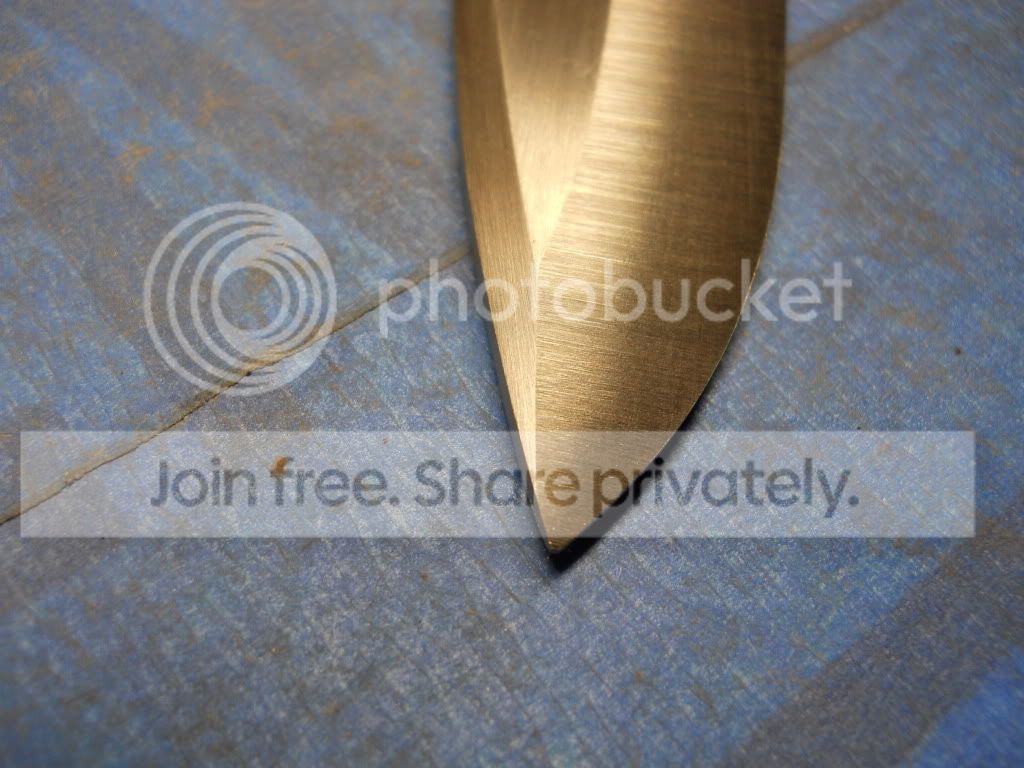
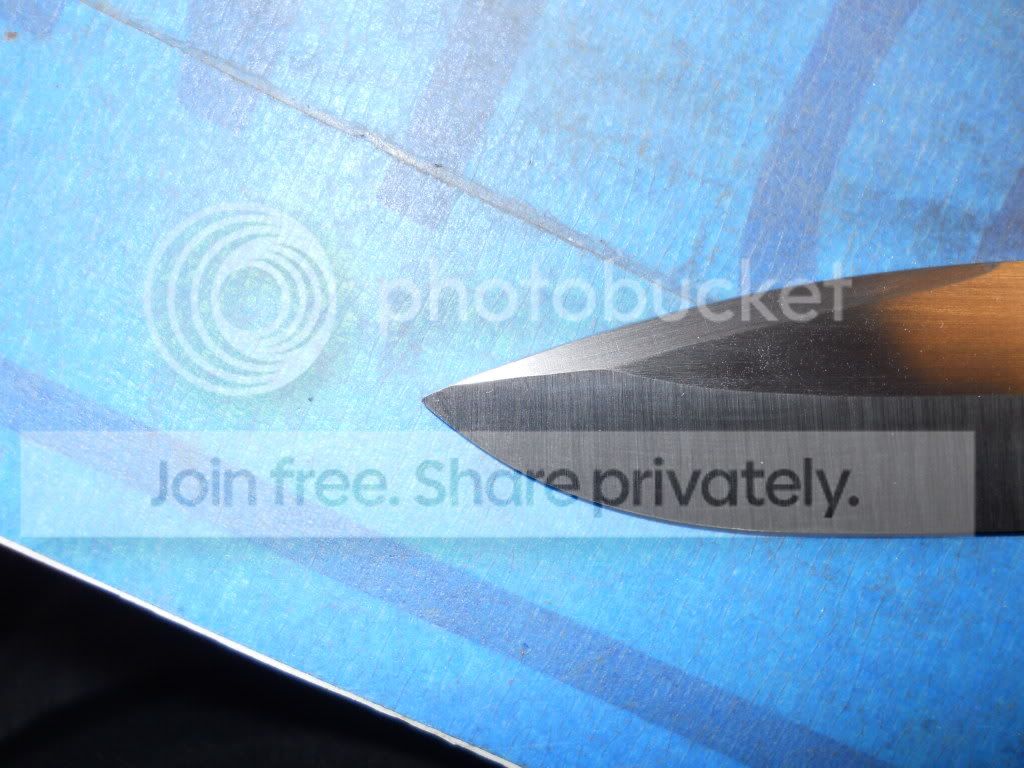
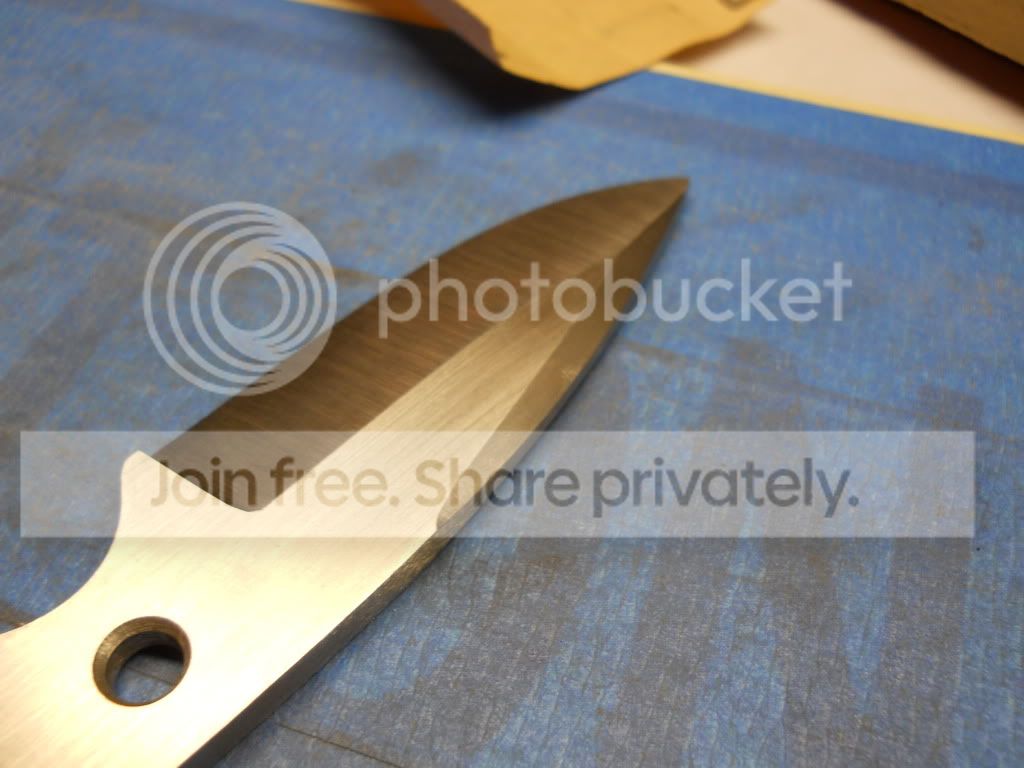
Today's grinding session, does this swedge need changing??

Joined
Sep 27, 2007
Messages
7,680
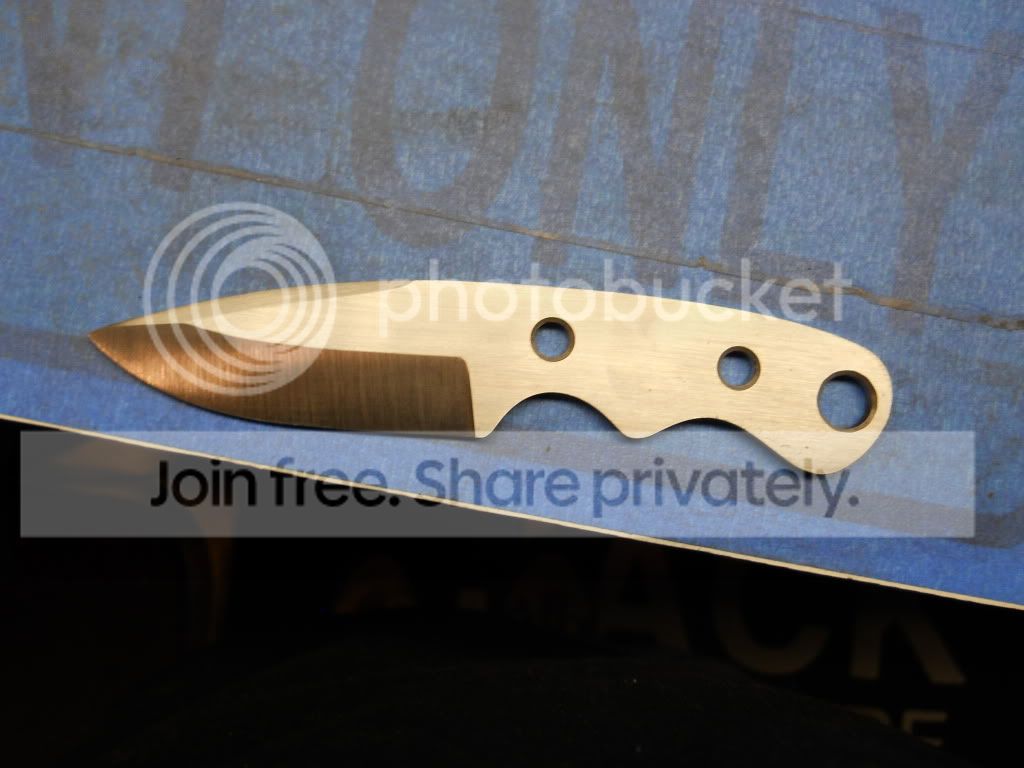
Well, I got a chance to spend some time in the shop today and ground out this blade using Fred's Bubble Jig. It's my Mini Drop Point model, just under six inches overall length, Bohler D2, .178" stock.

Anyway, I've had a bit of trouble with swedges, so I decided to grind the swedge first on this one before the primary bevel, so that if I screwed up really badly at least I wouldn't have all that bevel grinding time go to waste. Using the Bubble Jig may have solved my swedge problems. This one turned out nice and even and it went really smoothly:thumbup:

Here's the question: In the pics you can see that since I ground the swedge first, my rough estimate was off and the primary grind goes up high enough that the swedge stops short of the tip of the blade. Is it bad form to have the swedge stop early like this? Should I go back to the grinder and bring the swedge down so it meets the primary grind and the tip at the same spot? It looks okay to me as is, but I was just curious what you all think.....

Thanks!
DSCN2875.jpg


DSCN2878.jpg


DSCN2876.jpg


DSCN2880.jpg
 
I think it looks great. As the maker you have the right to artistic liberties... :D
 
Last edited:
Thanks guys. Right now I'm leaning toward leaving it as is. The lines all meet up nicely and everything is even. Why mess with a good thing?:D
 
Leave it, bro. i think it look's great just like that!! It'll leave a stronger tip, too.:thumbup:
 
I am going to go against the grain here and say to grind it to the tip. It is actually a lot easier and wont really change the layout of the knife as it is right now, if you are careful. Just get it flat against the platen, (which is the part I always screw up on such a small bevel), and as you are drawing it through the grind towards the tip, you pull the handle end of the knife away from the platen so the tip stays in contact. Probably one or two passes on some fairly high grit belts would make the bevel reach the tip. I have seen knives that had the false edge not reach the tip, but generally it was done intentionally and was obviously that way, it looked like it had 2 plunge cuts on each bevel. When the false edge does not reach the tip and just kind of peters out a couple centimeters from the tip, it doesnt look right to me.

Just my opinion though. I think with the grinder control you are showing in your other bevels, you should have no problem matching them up.
 
Totally up to you. I'd go ahead and ease that swedge down so it meets at the tip. Looks like you already have the angles set right so it shouldn't take much. Nice blade regardless :)
 
I go with Mr. Bailey's suggestions; the intersecting grinds will make the knife more useful and improve the overall look "balance" of the blade.

If you are using one of my jigs: Grinding the main bevels first, followed by the swedge, is the better way to schedule the grinds.
When you finish the primary bevel, you don't need the jig to complete the blade, after its heat treated. When you finish the grind at the swedge, keep the swedge angle set on the B.J.; after the heat treat put the bubble back on and descale the swedge in one or two passes with a 320 belt. Right on the money.

I would add, the point of the blade is set relative to the main bevel, the swede needs to intersect that point.

Nice blade, Jon:thumbup:

Fred
 
Last edited:
Very nice looking grinds!!:thumbup:
 
Ok, now we've got some differing opinions, all of which sound good!:D It's late and we just got home with the kids after a night out, so no shop time tonight. Tomorrow is a new day and I'll decide which way to go:thumbup: Thanks for the input guys.
 
Personally, I would take the swedge to the tip, but that's just my personal preference. It looks really good as-is...
 
We are proud to announce after years of research and feedback from the world's top operators our newest grind.

The JMK Bush Operators Wedge.

This grind has a subtle break from the laser sharp edge to the leading edge of the swedge. This was discovered when we recovered our field testing blades and discovered that operators worldwide were using stones in the field to grind the very leading edge off the blade swedges.

Our field operators explained that this subtle change to the swedge geometry allowed for far faster tactical deanimations under grueling conditions. This subtle break imparts massive kineto-hydraulic forces upon impact that have never been nailed down in a blade geometry, until now.

See, now all you need to do is phosphate that blade black and mark it up $400. Whatever you do, don't sell it in leather, it will totally ruin the back story.

:-)
 
Thanks, that one made me chuckle:D

We are proud to announce after years of research and feedback from the world's top operators our newest grind.

The JMK Bush Operators Wedge.

This grind has a subtle break from the laser sharp edge to the leading edge of the swedge. This was discovered when we recovered our field testing blades and discovered that operators worldwide were using stones in the field to grind the very leading edge off the blade swedges.

Our field operators explained that this subtle change to the swedge geometry allowed for far faster tactical deanimations under grueling conditions. This subtle break imparts massive kineto-hydraulic forces upon impact that have never been nailed down in a blade geometry, until now.

See, now all you need to do is phosphate that blade black and mark it up $400. Whatever you do, don't sell it in leather, it will totally ruin the back story.

:-)
 
I am on the side of grind it to the tip. Yes its your knife and I totally understand the worry of messing something up, but it speaks to your level of quality to have it meet up unless you have a real reason why it should not do that and make that part of your future designs. You owe it to yourself to do it how you think is right not just easy.
 
Back
Top