Too Much strop?

Fred.Rowe

Knifemaker / Craftsman / Service Provider
Joined
May 2, 2004
Messages
6,848
In trying to remove the wire edge, don't make the mistake of overstroping.
There is a sweet spot in sharpening a knife.
Remove the wire edge by snapping it off, instead of wearing it away is how I go about it. How do you remove a wire edge?

Fred
 
Don't know if I'm doing it right, but I get some pretty sharp knives this way.

I'll thin the bur out to 800 grit edge down on a slack belt for a couple of passes, then I polish with white compound on a buffing wheel. I'll make 5 passes on one side, then 5 on the other. Then I'll do 4 or one side, then 4 on the other, etc. counting down to 1 pass on each side. I do all of this at a very shallow angle to draw it out a bit, then I make 2 passes on each side at a higher angle into the edge of the wheel (like I'm trying to do a draw cut into the edge of the wheel) to remove the remaining bur. Then I check the edge and see where I'm at and repeat steps if necessary.

--nathan
 
There is no right or wrong way; As long as it works.

Fred
 
Sam Salvati showed me a trick. You can break the wire edge very nicely by stopping it on your pants. It seems like it doesn't over do it. After I break the edge, I strop it on a 2000 grit belt with white compound very briefly, just to clean it up, at a slightly steeper angle than the one that I was sharpening at.:thumbup:
- Mitch
 
One thing I have noticed is how the wire edge forms and breaks off in relation to the rockwell hardness of the steel. I predominantly use 52100 and I find that at 59Rc , the wire edge forms easily on a slack belt, takes a lot of stropping (traditional leather strop) to break away, when this happens I know I have it just right. I do not seem to be able to get the same performance with 52100 when the hardness is above 60.
 
I have a 4x10 multi grit diamond stone that I use to get the wire edge to "stand up". I hone one side at a time until I can feel the edge roll up; I turn the blade over and hone until I feel the edge bend back the other direction.
I know the joint at the edge is getting really thin when this happens.
Stand the blade at a 30 degree angle to the stone and make a brushing action, away from you across the stone. The edge is left lying on the surface of the abrasive. Just a couple of strokes on the ceramic sticks and you have a very aggressive working edge.
Fred
 
I've pretty much stopped hand sharpening but when I did I was able to remove the burr on a leather strop with 600 grit aluminum oxide compound. On the grinder I use a coarse scotchbrite, then a fine scotchbrite loaded with the same compound or jewlers rouge.
Scott
 
If you break a course burr off you wind up with more of a toothy fractured edge, as opposed to a fine abraded edge. The abraded edge is potentially a smoother edge. For a smooth abraded edge you need to hone it down on a very fine stone like a black hard Arkansas and raise a very fine burr, and then strop it with a fine stropping compound or powder.

Not that one is better than the other, just two different kinds of edges. It just depends what you are trying to cut,... and what the circumstances and preferences are.
 
If heat treating is what makes a chunk of steel a knife, I think putting the right edge on it is what makes a knife a useful tool. In the last couple years of not making knives, I've given these two things a great deal of thought. (:jerkit:)

What psyches me about this post is that alternative I'd never really considered - stroping the wire off. Hm.

I've always just buffed the wire edge off on pink or white compound, at a moderately steeper angle than the edge. The relative "toothiness" of the edge grind isn't effected if I do this right and I (hopefully) end up with a shaving edge that will do its assigned work.

Stroping though - that seems like an even better way to retain the "tooth." Guess I'm going to have to give this a try. That being said, what's a good material to use? Will veg tanned leather work? Or do I need to find an actual strop? What if anything, do you use on it? Using an old grinding belt might be okay too if I could keep from screwing up my finish...

(Fred, I'm going to have to stay away from stones - I am absolutely the worst honing person you will ever know...)

 
On a new blade with no real edge, I establish an edge using a 6x48 table sander with a worn 100 grit belt. I hold the blade with the edge into the belt direction just as it were on a stone. Once the edge is established, I go to the Norton fine grit stone. Then to a medium Arkansas. Then to a hard Arkansas. Then strop with a real strop that is charged with green chrome rouge. Very sharp! This does not take as long as it sounds.
 
am i right or wrong? if you sharpen a blade continuiosly on one side till a burr forms,then flip it over and it only takes a few strokes to form the burr on the other side the edges meet to form a single edge. but it is probably off-center and asymetrical. to make the edge centered and symetrical you should count the strokes it takes to form the first burr and repeat the same number on the other side. is this correct? or am i missing something? thanks....willy:)
 
For leather strops get "stropping leather". You can also get a variety of watercolor and art quality papers that do a great job. There are a variety of compounds, pastes and powders you can use to charge them with. I like to use an 1/8 inch sheet cork backing over wood for either.

The toothy edge and the smooth edge each have their advantages and disadvantages. The main advantage of the smooth edge is that it lasts longer. It will also make certain specialized cuts better than the toothy edge and some specialized cuts that the toothy edge won't make at all. The super sharp smooth "surgical edge" is a more impressive and versatile edge in the long run. However, it is a harder edge to achieve, and impractical for certain applications and in certain situations.
 
There's really a wide variety, if not infinite, number of "edges" you can use depending on what you want to cut and how. However, you can break it down into a toothy edge, a smooth (polished) edge, an edge with just a rolled burr, or any combination or variation of the three.

The three main variables in sharpening, are the "angle", the "grit" and the "burr".

The angle of the edge is the degree of sharpness or "acuteness" from a cross section.

The grit has to do with the "texture" of the edge lengthwise.

The burr is mainly a point of reference to the completion or incompletion of angle and/or abrasion in sharpening.

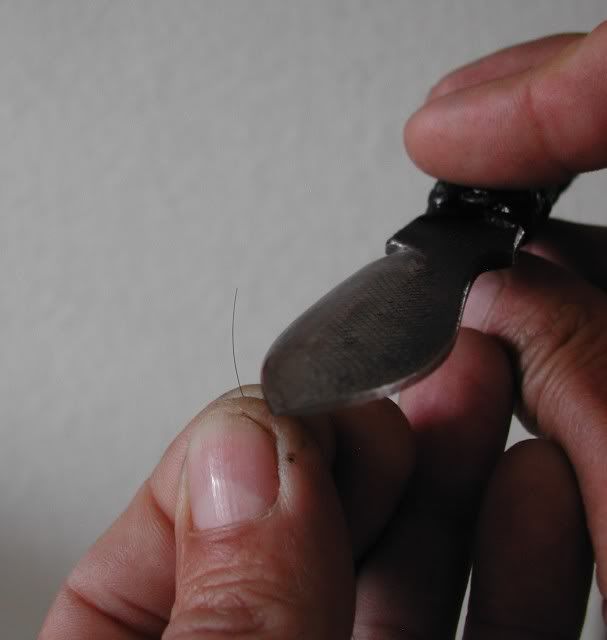
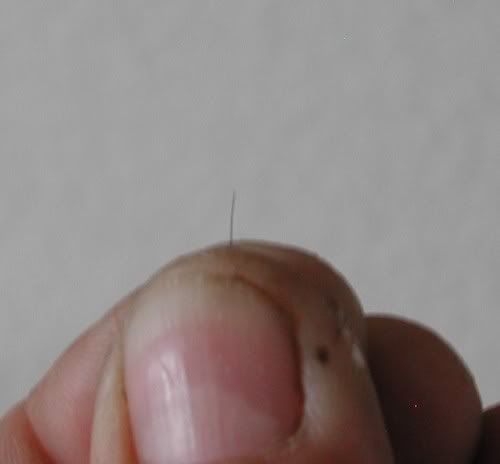
Tree topping a standing human hair:
haircut001a.jpg


haircut002a.jpg


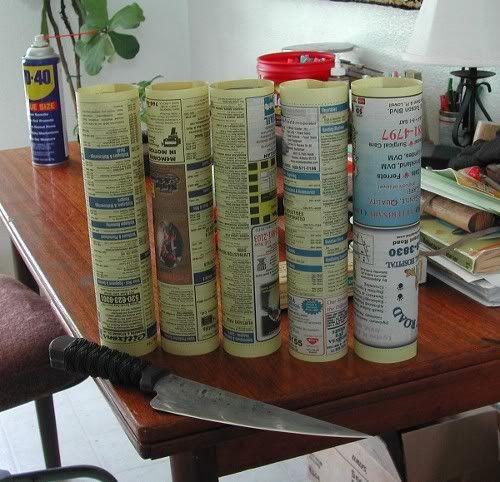
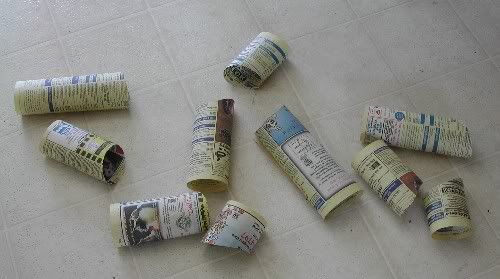
Five free standing rolled tubes of phone book paper (newsprint) with a single swipe:
5tubecut002.jpg


5tubecut003.jpg


Record for hair splitting:
"The greatest reported achievement in hair splitting has been that of Britains's Alfred West. who succeeded in splitting a human hair 17 times into 18 parts on eight occasions. All the divisions were made from the same point.

Alfred was born in 1901 and passed away in 1985 at the age of 85 in London, UK. During World War I, he worked on wood component parts on aircraft, which is where he learnt how to "set" a razor – that is, grinding or honing the edge of the blade to get it really sharp. In 1929 he represented Britain in the World Championship Road Race in Zurich, Switzerland and was awarded a special gold medal and watch for being the fasted British Empire cyclist. At the age of 70 he won the 203-mile Bath Road Club veterans race. West had exhibits of his razor setting work on show around the world, including New York and Australia. Examples of West’s work included: the crossed swords, a boa constrictor, the Epping Forest and a monarch’s crown – all made from split hair." http://www.ukhairdressers.com/records.asp
 
Record for hair splitting:
"The greatest reported achievement in hair splitting has been that of Britains's Alfred West. who succeeded in splitting a human hair 17 times into 18 parts on eight occasions. All the divisions were made from the same point.

Alfred was born in 1901 and passed away in 1985 at the age of 85 in London, UK. During World War I, he worked on wood component parts on aircraft, which is where he learnt how to "set" a razor – that is, grinding or honing the edge of the blade to get it really sharp. In 1929 he represented Britain in the World Championship Road Race in Zurich, Switzerland and was awarded a special gold medal and watch for being the fasted British Empire cyclist. At the age of 70 he won the 203-mile Bath Road Club veterans race. West had exhibits of his razor setting work on show around the world, including New York and Australia. Examples of West’s work included: the crossed swords, a boa constrictor, the Epping Forest and a monarch’s crown – all made from split hair." http://www.ukhairdressers.com/records.asp

SWEET. 18 splits, that's something to work toward!
 
If heat treating is what makes a chunk of steel a knife, I think putting the right edge on it is what makes a knife a useful tool. In the last couple years of not making knives, I've given these two things a great deal of thought. (:jerkit:)

What psyches me about this post is that alternative I'd never really considered - stroping the wire off. Hm.

I've always just buffed the wire edge off on pink or white compound, at a moderately steeper angle than the edge. The relative "toothiness" of the edge grind isn't effected if I do this right and I (hopefully) end up with a shaving edge that will do its assigned work.

Stroping though - that seems like an even better way to retain the "tooth." Guess I'm going to have to give this a try. That being said, what's a good material to use? Will veg tanned leather work? Or do I need to find an actual strop? What if anything, do you use on it? Using an old grinding belt might be okay too if I could keep from screwing up my finish...

(Fred, I'm going to have to stay away from stones - I am absolutely the worst honing person you will ever know...)

Yeah, heat treating is very important, but it won't make a dull piece of steel cut.

.... Geometry is what defines the blade, and heat treating is what supports the geometry.
 
Nice table, Tai! We have exactly the same table; bought it in ~1978. The pattern on the veneer looks like it could have come from the next turn of the cutting lathe. Small world.

Nice small knife, too. ;) Same size as the one I bought from Paul V. Great edge. I use it all the time, and keep it stropped on my pad of post-it notes or a piece of cardboard.
 
Back
Top