Torch for silver brazing?

Thanks for the link Mr Burke, Gillette would be a 14hr round trip for me but will definitely look closer.
 
this is the current project,


And this is what i've been attempting it with, it does work good on smaller project's I should say.

 
I would recommend you get a decent sized propane tank and a large Oxygen tank. Propane and oxygen can do all the cutting and brazing temperatures you need. A good rosebud tip will really help heat things up to temp and won't create a hot spot likes using a cutting tip will. Also this works well for aluminum brazing and soldering. My personal set up is a 330cubic ft o2 tank and a 100# propane tank with a small victor torch look alike from china... With this setup and the right tips you could cut up to 2" steel. I chose to avoid acetylene because it's much more volatile and higher cost. If you go the CL route make sure the hose is multi fuel as propane can deteriorate some rubber on acetylene only hose...
 
Those look like respectable bottles for quick work. But that knife looks big, and has a ton of heat sinking material attached to it.

I have always had a question about where in the process of "building", makers solder their tangs. I haven't reached those heights myself yet, so the process I envision, is probably not the one being used by most people.

35% is usually used for larger capillary gaps. You might want to try 45% if your guard is a tight fit. I would ditch the heat paste, and either submerge most of the blade in a bucket of water using vice grips to hold the tang out above water, and or point the torch heat away from the blade around the guard. Solder runs off when it is dirty, and when it is too cold to melt and hold the solder. Heating just the part you are working on takes much longer than warming up the entire work area. and the upper side of the guard should be bright clean too.

It doesn't look too bad to me, I think you are holding the heat too far down the tang worried about the blade.
 
In this picture the gaurd is brazed and im attempting to braze the copper back.
 
I've done brazing stainless(rings on fish hooks and lures) for a tackle store for about 10 yrs. Just finished 1600 rings on hooks. use silver solder but also use bronze rods for bigger lures. I've used nothing but the Smith Little torch and use bottle of ox and propane i buy at home depot. The one bottle of ox did about 2000 hook rings. Propane bottle lasts about as long as 3 ox bottles. Orig bought regulators to use with refillable bottles but ended up selling them when I got used to using the throwaway bottles.
 
Rock if I were doing this I would first make a solid bar that fit the spine and tin it with my silver brazing. Then clamp it in place and with a little more flux and heat to melt the brazing. start at one end and work to the other. Then fit the guard and soft solder it in place. I personally would use the brownells solder or the easy solder. brazing rod flo temp is too close to the melting temp of the copper or brass back and has the potential for problems.
 
Rock-here are pic's of my torch set-ups. The first is a propane/oxygen tanks and regulators and the acetylene/air 'b' tank and regulators.


This is a small acetylene/oxygen set up I use for casting.


This is a picture of the torch heads for the propane/oxy (the small one) and the acetylene/air (the large one)


A torch is a tool. Each of these units produce a different flame for different jobs. If I were to have only one set up, it would be propane/oxy. While acetylene is hotter, propayne is much 'cleaner'.

Get good quality regulators like Smiths, Uni-weld, or the like and equip each with a flash-back arrestor for safety reasons. Each of these units have different sized 'tips' producing different volumes of heat. Keep your tanks in a carrier or chained to a wall for safety reasons.
 
I also want to point out that the "heat Shield" material you have on the blade will basically do nothing to protect the edge if you are silver brazing ( silver soldering) the brass on.

Those type of shielding gels and pastes are to keep a stray flame off the metal when doing hot work near something that will be damaged or colored by the heat. They won't stop heat from conducting through the metal to the edge and ruining the temper and hardening. If you have access to a hardness tester, do an experiment. Take a piece of 3/16" bar stock and harden/temper it. Test the hardness along the edge and see what it is. Now use that gel along the edge and braze on a brass spine. Test the edge hardness again. I bet it is much, much softer.

I would make the brass back a snug fit and use silver bearing solder ( low temp). That will not damage the edge any at all. The gel will be fine in that case.

If you are silver soldering with the low temperature solders, the enemy isn't to little heat...it is too much heat. Those torches you have are many times the amount of heat needed to get the brass and the spine up to about 400°F. A good heat gun will do that just fine.

Cleanliness of the joint is what is absolutely required whichever way you are attacking the brass back.
 
I also want to point out that the "heat Shield" material you have on the blade will basically do nothing to protect the edge if you are silver brazing ( silver soldering) the brass on.

Those type of shielding gels and pastes are to keep a stray flame off the metal when doing hot work near something that will be damaged or colored by the heat. They won't stop heat from conducting through the metal to the edge .[/B]

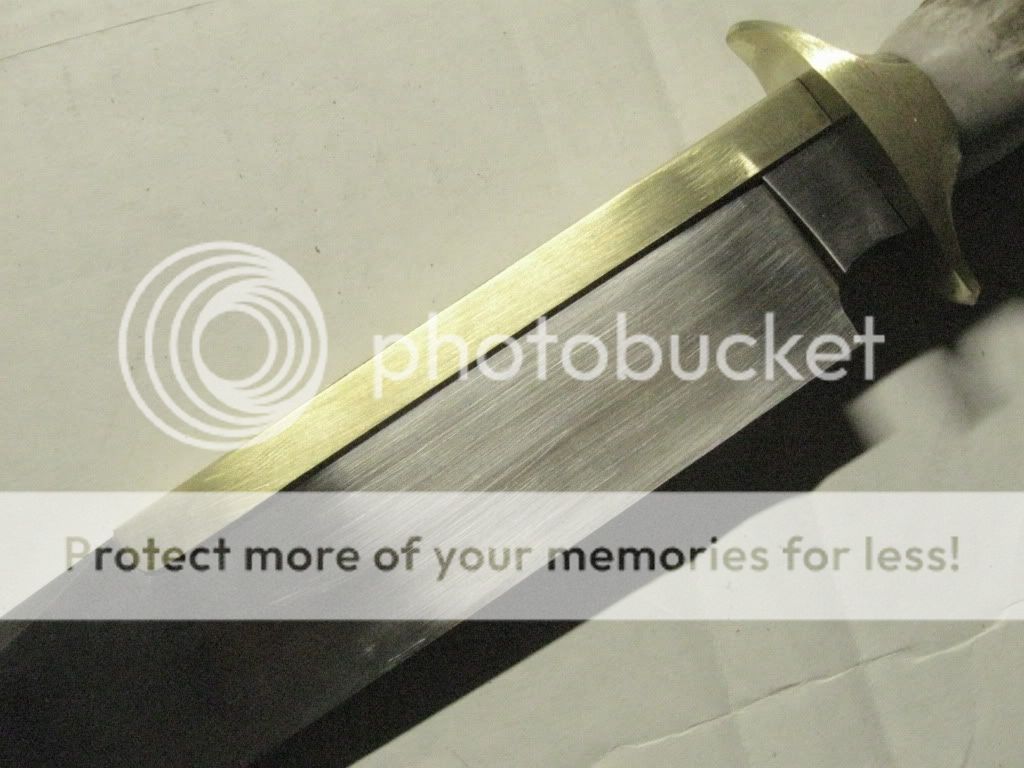
Incorrect, I can (and have) used this many times with situations where the steel is orange and I'm holding it with my bare hands on the downside of the gel, it is designed to stop (and it does) heat migration. The product is Mechanics Time Savers Hot STOP paste, make no mistake this stuff works.


Smithy, and others thank you for posts, i will continue the search much more educated.
 
Here's an in progress shot of one I did a few years ago. I used stay-brite lo temp solder, with stay-clean flux and a propane plumbing type torch. I never got the blade over the existing temper temp. It went well, I trimmed the excess solder off with a small elliptical-point brass chisel. Brazing seems excessive for this, to me.

IMG_5527.jpg
 
Back
Top
