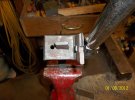
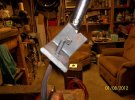
torque wrench blade breaker

Joined
Jul 8, 2008
Messages
1,079
I finaly rememberd to make a jig to attach a torque wrench to a blade when testing for flex, and to see exactly what it takes to bend/break the test blades. Man, I should have made this thing when I started making knives!

I used a piece of 1/4" leaf spring, cut a slot to fit narrow tangs, bent it 90 degrees, and then drilled and filed a 3/8" square hole for the torqe wrench. really simple.

I tested one of the blades from my current batch that I wasnt happy with out of 1095, it came out way too thin. it took 15 ftlbs for the blade to take a set, then broke with 19ftlbs at about 80 degrees. tested an 8" nicholson mill file. took 20lbs and broke into 3 pieces at 10-15 degrees. took 70ftlbs to take a set with a 5/8" by 1/4" piece of normalized leaf spring. some of my old test knives of leaf spring and 52100 took between 35-50 ftlbs. to bend to 90 degrees, and never did break.

Ive noticed that some of my diff treated blades seemed to be "wimpy" would take a set too easily during testing. Now I can measure them!

anybody else ever done this?
 
Ed Fowler talks about using a torque wrench for such testing.

It sure would give you some good feedback.

I posted some video links on Ed in this forum the other day where he talks about it. Check it out.
 
avigil, thanks for posting that link, that is what reminded me to make it! he talks about liking to see 70 ftlbs in his blades, Im guessing that is for a full sixed pronghorn. that is alot of torque! if I grab the wrench close to the end that the jig is on I cant make the wrench click, just slide myself along the slick, concrete floor, and I weigh about 210 lbs. I think id have problems doing 70 ftlbs on a regular sized knife unless I was braced on what I was working on, and was able to really crank on it.
 
Just be careful that what you see/measure is actually what you see/measure. This can be a very deceptive test if you don't look at it very carefully.
 
I destroyed 100's of blades before I started using the torque wrench, simply noting strong vs weak. Like you I wish I would have started using that torque wrench much sooner, a lot of information was lost. Joe Szilaski suggested its use and I again thank him for the idea.

I sincerely appreciate your giving it a try, lateral strength is one of the most significant variables when it comes to blade failure especially in exigent circumstances.
 
me2 what do you mean by make sure what you see is really what you see?

ed, when you do that test, do you log into your shop book thickness, width, depth of quench? What is your minimum expectations for different sized blades? where do you attach your wrench? I was putting mine so that the force started acting on the blade at about 1" back from where the rearmost portion of the guard would be.
 
My tangs are designed to bend - not break, they are unhardened. When I clamp a torque wrench on a blade it is the area ahead of the ricasso I wish to test, therefore I clamp the torque wrench jig on the back part of the ricasso.

All of our grind are convex, how to measure the volume of the area of the blade we are testing is beyond a physical description for my mathematical ability. When we grind a test blade we decide what the test is to evaluate and go from there. By the grind I can predict where the blade will bend.
With that in mind we make several blades of varying thicknesses and test them to destruction.

We may be interested in the best location for the first transition zone and several blades of similar geometry but different locations of that zone created when hardening will be tested and now we can predict the performance of a future similar blade.

We do measure the thickness and depth of the blade and now can fairly accurately predict the ft lbs of torque required to flex it to 90 degrees.

There are many variables, for example if we try several flexes to determine how much force will be required for the blade to take a set, but this part of the experiment will change the nature of the results on the full flex test.

You seem interested, I will recommend a book: Prevention of the Failure of Metals Under Repeated Stress" by the Battelle Memorial Institute. I have purchased copies for under $20.00 from abebooks, who deal in used books. This book and some of the references stated spends most of its time on the night stand next to my bed. It an excellent resource.

Good Luck and Cheyenne is not too far from Riverton, stop by some time.
 
I'm referring mainly to the huge influence geometry has on what is measured by this test. It is deceptive sometimes to see 2 full flat ground knives of the same stock thickness give different numbers. However, if some sloppy grinding has accidentally removed an extra 1/64" from each side of one, then the thicker one will take noticably more torque to bend or flex to a certain degree. If you have one blade that is wider, even though they are the same thickness, the wider one will take more torque.

If all you want to measure is ultimate torque to get to a certain degree of flex, then this will tell you that. If you want to use that number to reach conclusions about other knives or other variables, you have to be very careful to make sure the difference is really dependent on whatever variable you want to test. This is all probably pretty obvious to you, or you wouldn't be doing it. I'm mainly putting it out there for anyone who is not as familiar with torque and wants to try it. Also be aware of the difference between flex and bend. Bend stays, flex does not. The two are often used interchangably.
 
If all you want to measure is ultimate torque to get to a certain degree of flex, then this will tell you that.

I like the torque wrench idea and plan to make one, soon. I would use it for the purpose that me2 states above. Some of my blades are sharpened prybars with a purpose. I would like to be able to put a value to that attribute for my own testing. Check out Young's Modulus of Elasticity... it has some great info that would have saved me some time if I had known about it from the beginning.
 
rick, here is a couple pics of the one I built, took about 30 minutes to make, and is really simple. it doesnt have the ability to clamp onto the blade, but the corners of the slot are rounded off, and it grips the knife pretty good. here it is on another piece of leafspring.
100_0034resized.jpg100_0035resized.jpg

me2, that makes more sense, that is why I test the blades. and why im excited about this new tool. I love the idea of having a diff treated blade, that wont break, but some of the early ones were wimpier than I wanted, this will let me get the bugs worked out so that I can the blades better.

Ed, just ordered that book. it should be here is a few days. I havent made it up that way in a few years, but the next time I know Ill be in that part of the state I will get ahold of you and arange a visit. you are also welcome to stop by if you are in cheyenne.
 
Basically what I'm getting at is that you shouldn't really compare values of your "wimpy" blades to values of your stronger blades if the stronger blades are thicker. Going from say 1/8" to 1/4" in thickness of a rectangular bar will increase the stiffness by 8 times. By the same token, decreasing thickness will result in an equally fast decrease in stiffness. Going from a blade that is say 1/16" thick to a blade that is 3/16" thick results in an increase in stiffness of 27 times the original stiffness. Just going from 3/32" to 1/8" will more than double the stiffness of a rectangular bar. Anyway, it's just a friendly piece of advice to not compare a blade you ground too thin to a blade that is the least bit thicker. It's unfair to the wimpy blade, and you can drive yourself nuts trying to figure out what happened.

For background purposes, my experiments in blade flexing are limited to flexing a fully hardened (no soft spine) blade that was quite thin (less than 1/16"). This blade had very high hardness (64 HRc plus). It flexed to 90 degrees multiple times with no damage and no bend. The effort required to flex it steadily increased from 0 to 90 degrees. Once a blade starts to bend, the torque values will either level off or increase very slowyly compared to before bending. I discussed with Mr. Fowler in another thread that he could get more bends/flexes with thinner blades and higher hardness. However, his goals are geared toward higher absolute lateral strength, and a thinner blade will not meet them. One day I'll do the design for a blade that will meet his desired goal of 70 ft-lbs, but be assured the one mentioned above will not come close.
 
me2,

where on earth did you find a formula about the difference in thickness, and the resulting resistance to bending? do you have one that compares the different grinds? say full convex to full flat?

the only designing ive done is to make a rough knife, put a handle, gurad and sheath on it, and go abuse it. then change what i felt wasnt good about it, and make another. after a couple dozen, things started coming together and the rough blades usually only needed little things fixed. now I have a good idea about how thick a certain sized blade needs to be for what I want to use it for, and how much it will take to destroy it, but I dont have a formula or anything to be able to explain it.
 
I'm an engineer. The formula is basically the same as that used for beams, but it's a little simpler than that, since rectangles and triangles are simpler shapes than I-beams and other structural shapes. A convex blade will have higher stiffness than one that is full flat ground with the same spine thickness. That's not the whole formula, just a drastic oversimplification. There are forumlas for those different blade cross sections, especially the full flat and saber flat grinds. The one for convex is out there somewhere, or you'd have to derrive it from the basic formula. I can't do that easily any more. It'd take a day or so probably. There's a Purdue grad on here somewhere that posted the basic formula, but I can't remember the username.
 
me2,

where on earth did you find a formula about the difference in thickness, and the resulting resistance to bending? do you have one that compares the different grinds? say full convex to full flat?

I made reference to it in my first post .... "Modulus of Elasticity"
 
After thinking about it more, what I said was not entirely true. If you want raw torque values for a given amount of flex, you have to use the value off the torque wrench to back calculate the force you're putting on the handle of the wrench. Then you use the full length of the lever and this force to give you the actual torque on the blade. The full length of the lever includes the portion of blade between the vice and the wrench. Every one else may be just saying "well, yea, that's what we've always done." I just figured that part out. Also, I had assumed everyone used the same distance from the vice jaws to the wrench attachment, but that is not the case it seems. For my own sanity, I think, should I ever do any of these tests, I'll just use a heavy fishing scale or something hooked to the blade, then calculate the torque. That seems simpler to me. Thanks everyone for making me think.
 
i was wondering about that also. when I was testing just the piece of leaf spring, witht the torque wrench, it clicked at 70lbs to take a set. but just grabbing the end of the bar, all I did was slide myself across the floor. I know I was putting more than 70lbs on it. so torque wrenches must be made so that you are putting 70lbs at the handle, which means that there is more than that at the workpiece, alot more.

Still, it is a basis for testing knives against each other. which is what Im going to do until I can make sense of the modulus of elasticity that rick mentioned {yahoo'd it, and from all the formulas, I'll need some scotch to wash it down with}, and really go over this thread a few more times.

as long as I use the numbers I get as a reference for testing against blades that I can bend by hand, then i should be able to get what I want out of the tool.
 
The torque wrench is only a tool to help you evaluate your blades. You will know their lateral strength and come to understand the influence of blade volume and geometry.

The interesting aspect is that when using differential hardening you will find blades that break or tear (metallurgical terms - either through or between grain boundaries), but it will take a metallurgist to tell you which happened. Your goal is to have the hard portion fail and the crack stop at the top of the hard zone and bifurcate into a Y running parallel to the hard zone. Thus the hard portion can separate and the user canstraighten the blade and still have a useful knife.

Inspect each failure carefully and try to figure why, learn all you can from each blade.

Good Luck
 
Modulus of elasticity is easier to understand if you just think of a bar of steel in tension as a VERY stiff spring. The MoE shows that, until you stretch the spring permanently, the force pulling on the bar stretches the bar a given distance, and when released, it all goes back to where it started. For normal coil springs, 10 pounds may stretch the spring 1 inch (just an example). 20 pounds will go 2 inches, 30 goes 3 inches and so on. The "MoE" of that spring is 10/1, or just 10. For a steel bar, it works the same, but the numbers are much larger for force and much smaller for the stretch you get. 100,000 pounds may only get you a stretch of 0.0001 inches or something along those lines. For this example, the MoE is 100,000/0.0001, which equals 1,000,000,000. Like I said, MUCH larger numbers, but the principle is the same, and they are still proportional in the same way, i.e. 200,000 lbs gives 0.0002 inches of stretch and so on. The only difference that I haven't addressed yet is that MoE is measured in pounds per square inch, not just pounds. That means the MoE is the same for a bar of any cross sectional size. For my example above, it would be more correct to say that 100,000 pounds per square inch will give a stretch of 0.0001 inch. This will give a MoE of 1,000,000,000 pounds per square inch. These are just example numbers. The MoE of steel is not actually 1,000,000,000. It's actually around 30,000,000 psi., but for examples I like numbers with a 1 at the front and a few zeros to keep things simpler.
 
i was wondering about that also. when I was testing just the piece of leaf spring, witht the torque wrench, it clicked at 70lbs to take a set. but just grabbing the end of the bar, all I did was slide myself across the floor. I know I was putting more than 70lbs on it. so torque wrenches must be made so that you are putting 70lbs at the handle, which means that there is more than that at the workpiece, alot more.

Still, it is a basis for testing knives against each other. which is what Im going to do until I can make sense of the modulus of elasticity that rick mentioned {yahoo'd it, and from all the formulas, I'll need some scotch to wash it down with}, and really go over this thread a few more times.

as long as I use the numbers I get as a reference for testing against blades that I can bend by hand, then i should be able to get what I want out of the tool.

Can you set up your leaf spring again and take some measurements of the distances between the handle of the wrench, length of the wrench, and between the vice and the wrench?
 
i was wondering about that also. when I was testing just the piece of leaf spring, witht the torque wrench, it clicked at 70lbs to take a set. but just grabbing the end of the bar, all I did was slide myself across the floor. I know I was putting more than 70lbs on it. so torque wrenches must be made so that you are putting 70lbs at the handle, which means that there is more than that at the workpiece, alot more.
.


Joe, the 70# of torque measured is the amount of force equal to 70# at the end of a 1ft bar. IE weight time length of bar.
a 2 ft bar would only need 35# of force to make 70ftlb. At say 2 inches you would need 420# of force to generate 70ftlb
 
Back
Top