
torque wrench blade breaker

Really good info guys..... seems there are MANY variables to get a consistant reading with a torque wrench.

What I need is a method to measure "Prying Strength" or the force I can transfer from my tool into a prying application. Yes I know knives aren't for prying.... humor me. So what if my measuring device was the base/fixture of the testing aparatus? A sort of torque wrench in reverse. With this I could assign a "Pry'em Number" to any knife, no matter what size it is.
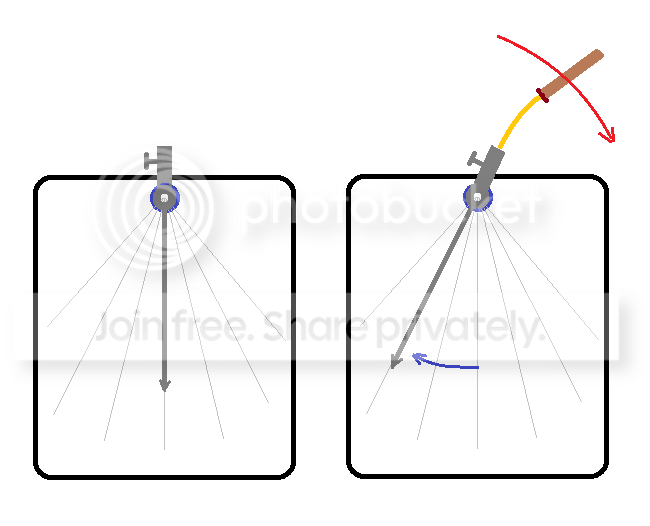
PryemNumbers.png
 
Very good engineering, Rick. The device would read the force applied at the tip with the handle being pulled. It could show what force is needed to bend the blade 90 degrees. As you said, it would read as repeatable value for a variety of knife geometries.
 
If you already have a torque wrench, you could just clamp it into the vise by the handle then cut a slot in a large socket and blammo, instant bendy meter :)


You can also use a small refrigerator magnet on the indicator to record the maximum torque without needing someone else to watch. Put the magnet on the gauge and the needle will push it along, leaving it at the high mark. Just make sure it's a really crappy magnet so it doesn't throw off the measurements.
 
Last edited:
My torque wrench has a red needle that stays ab the highest force applied.
Also, why wouldn't the magnet follow the needle back down, or fall off if the needle returns without it.
 
Lol I need to get with the times. The one I used was super old and had no such sticking needle so I used a magnet the one time I tried breaking anything with it. The magnet was stuck to the steel plate with the markings on it and pushed along by the needle. It was an "I" from one of those cheap alphabet refrigerator magnet sets. The plastic kept it from sticking to the indicator needle.
 
Gadgets like Rick mentioned are commercially available. We used them to calibrate our torque wrenches. They come in different sizes to fit different socket drives (1/2", 3/4", 1":eek:). Just bolt/fasten them to something SOLID, and insert your torque wrench drive. Pull to desired torque and see if the gauge reads the same on both wrench and calibrator. Check calibration every 6 months.

It wouldn't be too tuff for someone to make a blade holder that would fit the drive slot, then you could just slide your blade in and pull. Ours was for 1" drive torque wrenches and went to about 650 ft-lbs. For your own sake, try to find a smaller one.
 
Do you remember what they were called or what company you got them from, me2?
 
Hey Ed, can you provide some measurements of one of your blade's thickness at several points from edge to spine? Maybe I can work out the stiffness calculations. I cant make any assumptions about the measurements since everyones convex grinds will be slightly different.
 
Me2-Sorry for the delay, had to find the blade.
Length of blade tip to ricasso - 5 1/4 inches.
Depth, spine to tip in area of the flex - 1.223
spine thickness -.190
thickness top 1/3 of blade 0.184
thickness at center of blade 0.167
thickness bottom third of blade 0.132

Blade required a little over 70 ft lbs of torque to complete 5 180 degree flexes. (90 degrees each way). Blade did not break or remain bent but straightened to about a 30 degree bend, after a few days had returned to about a 25 degree bend.
The blade did not edge chip and made over 800 cuts on our rope before flex tests, it is on my table every year at Blade Show.
If you want more measurements let me know. If you want to see a photo of the blade I see I can email them to you.
 
Ill take as many as I can get. One place that would be really good to have a thickness measure of is just behind the edge bevel, or at 1/16 up from the edge, since a convex may not have a defined edge.
 
These measurements were taken from the same area as stated above.
1/32" from the edge -0.024
1/8 0.052
3/8---------------- 0.0525
1/4 0.12
1/2 0.150
3/4" from edge 0.173
all carefully blended convex shape.
 
Last edited:
Awesome. Thanks Ed. I'll start working on it this week. It will take a couple of days of review. There are programs to do this type of thing for you, I just don't have any. It's been 13 years since I've done anything like this with paper and pencil.

Anyone here that wants, look over the variables so I know I've got everything covered.

Blade thickness
Blade Width
Distance from vice to ricasso
Blade profile/cross section
Steel type
Hardness as a function of distance from the edge
Length of torque wrench
Torque reading on wrench

Looking at the list, I will need a couple more things. Ed, do you have any estimate or actual measurements of hardness from edge to spine? You've posted before the edge is about 61 HRc, while the spine is in the mid to high 20's HRc. I can assume a smooth decrease, but since you're edge quenching, I doubt that's the case. Also, an estimate on the length of the torque wrench, and how much of the tip is locked in the vice? I'll still be making some assumptions, but this will get me started.
 
The steel is 52100, forged down from a 5 1/2" round bar, calculated rate of reduction over 99 points, all at temperatures no higher than 1725 f. The temperature for the last 40 or more heats was no higher than 1625f.

The torque wrench went to a little over 70 foot pounds and remained that high through all flexes.

The first transition line is 3/8" up from the edge.
The second transition zone is 5/8ths from the edge.
The 3rd Transition zone is about 3/4" up from the edge.
From there to the spine is dead soft.

No Rockwell tests have been done on this blade. I could send the blade to Rex if you like.

The last Rockwell tests Rex did he stated that the spine was very soft then as he shot Rockwells down the blade from the spine it started getting harder quick. I can't remember his exact readings, they are in a file somewhere.

The torque wrench is 20 inches long from end to end.indicator length is 14 inches long and fits a 1/2 inch socket.

The tip of the blade was clamped 1 1/2 inches into the post vice.

The torque wrench plates were attached to the ricasso.

The flex area of the blade is about 3 1/2 inches long. The flexing was over about 3 1/2 inches of the blade, it took a set in a smooth bend over this area. (distance from vice to ricasso).

Cross section of the blade is a complex convex shape.

I believe that the transition zones are influenced by the steel structures that lay beneath the surface of the blade. Another blade that we tested broke in increments, first a little crack in the cutting edge, then with more flex it cracked again and continued to do so in increments until there were 5 distinct fracture zones, the spine held together.

After her performance we decided to quit flexing the blade and kept her as an example of one of our champions. I traced her bend and left it laying on the bench while we worked on other projects. After a few hours I noticed she had straightened a few degrees more just laying on the bench.
 
Awesome. Thanks Ed. I'll start working on it this week. It will take a couple of days of review. There are programs to do this type of thing for you, I just don't have any. It's been 13 years since I've done anything like this with paper and pencil.

Anyone here that wants, look over the variables so I know I've got everything covered.

Blade thickness at spine - 0.19"
Blade Width - 1.223"
Distance from vice to ricasso: 5.25" (tip to ricasso)-1.5" (length in vice) = 3.75" Wrench clamps located at ricasso
Blade profile/cross section: will be plotted in excell for best fit trendlines
Steel type: 52100
Hardness as a function of distance from the edge: Will assume ~25 HRc to ~61 HRc from spine to tip.
Length of torque wrench: 20"
Torque reading on wrench: 70 ft-lbs

Looking at the list, I will need a couple more things. Ed, do you have any estimate or actual measurements of hardness from edge to spine? You've posted before the edge is about 61 HRc, while the spine is in the mid to high 20's HRc. I can assume a smooth decrease, but since you're edge quenching, I doubt that's the case. Also, an estimate on the length of the torque wrench, and how much of the tip is locked in the vice? I'll still be making some assumptions, but this will get me started.

The variables are filled in above. I plan to do this for a rectangular flat bar, full flat grind, then the convex. If anyone would like to do a hollow grind, just submit some thickness measurements in frequent intervals from just behind the edge to the spine. I make no guarantees about accuracy. It's been a long time since I've done this, but I've been meaning to do it for a while, so this is good motivation.
 
Back
Top