Tough Stick Tang designs?

Joined
Nov 23, 2005
Messages
1,841
Gents, I need some advice. I've gotten a few requests lately for some bigger bowies with antler or wood handles, and I've regrettably had to turn them down:grumpy: All of the bigger knives I've made have full tang designs-even the forged ones-because I know how tough they are. However, I would really like to take on some of these other projects, but I'm at a loss of how to secure the handles on them. I'm not comfortable welding or brazing threaded rod on the tang, due to my own lack of skills in those departments. Does anyone here peen the end of the tang, or draw out and thread it? Do you know of any good tutorials? What other possibilities do I have, or should I just stick with slab handles and call it good:o:foot::D

Thanks in advance:thumbup:
 
You can do it multiple ways really. One of the easiest ways I saw was by Brian Lyttle last year at Ashokan. He cut a t-slot in the stub tang and then just used a bolt with the sides of the hex head ground flat on either side. Then the ground head (now a T) just slips into the slot and allow slight wiggle for the butt cap to center on the handle. The way I am doing a sword was just to round out the tang on the end and thread it, but that's because I had plenty of length on it.
 
You can thread the tang, weld or braze on a threaded extension, pein the end, or put pins through it, or any combination of the above... I like to thread the end of the tang to accept a nut, then drill a few holes through the tang for pins if I'm overbuilding. A mortised/rabbited type handle is also (fairly) easy to make, and it allows for an over-sized tang.

If made correctly, a hidden tang can be quite strong. One thing to remember is the base of the tang that fits against the guard, you want a radius, not a sharp corner. I try to leave as much material in this area as possible for maximum strength. If the tang does not pass through the butt of the handle, have it at least 2/3rds the length of the handle.

With very few exceptions, swords were made with hidden tangs peined over a pommel until the industrial revolution made threading them efficient.
 
I almost always draw out the tang, grind it to size and thread it. I like corby bolts and counter-bore the pommel plate.
 
I did it like this on a Mora:

Round the end of the tang;
BILD0500.jpg


Thread it;
BILD0523.jpg


Here we go;
BILD0523.jpg


Hope the pictures make it clear. Good luck with your blades.

Tom
 
Thanks, all! I really do appreciate the input:thumbup:

Bruce, I don't suppose you've got any pictures around of your process? I think I understand what you mean, but I've been wrong before:D Do you just use the female side of the Corby bolt?
 
I've done a few that I have peened but apparently peening is a faux pas unless you're making a period piece.

A couple I did used a heavy brass rear bolster and I brazed a piece of 3/16" brass rod to the tang that I notched, so it matched up quite well.

One other one that I peened is the big bowie in my sig pic.
 
I think edge thickness/geometry is a LOT more critical than tang style. Unless you grind your blades like an axe, and plan on beating on the handle with a hammer, the edge will go before the tang will. (IMHO) :)

I made about 100 blade blanks for a group of guys that were scandi ground, full tang blades. They wanted something "stronger than the hidden tang mora type blades." What I tried to point out, is that the edge would fail long before either tang style. :)

As was pointed out, swords have been around for thousands of years with hidden tangs... it's sort of odd that people in the last 30 years have decided a hidden tang is somehow sub-par.

I've made several dozen test blades over the years that were hidden tang and have NEVER had one fail at the tang.

Hidden tangs are more than just passable, they allow a maker to shape a handle in just about any manner he/she chooses.

Good luck with it :)
 
Nick, what I'm actually more worried about it any type of handle failure that would allow the blade to come free. Strength-wise, I can't imagine anything short of intentional destruction really breaking a knife that's 3/16" or 1/4" at the blade/tang junction. However, what I don't want is 20-30 years from now, a brass pin has corroded and the epoxy has failed and my buyer's kid gets injured out in the woods somewhere (I know, not necessarily realistic, but I'd rather be safe than sorry!) With a full tang, you know if there's any failure at the handle-which is very reassuring to me when I'm out in the woods, especially since I like carrying a knife big enough to take down a (small) tree, baton my kindling, scare off a bear:D, etc.

That said, I've been carrying a Greco Scagel style or Sog bowie lately in the woods, and I'm not worried about them at all, it's more when I get into the 10" blades that I'm looking for something stronger. I'm not opposed to stick tangs, I just want to make the best knife I can within my abilities:thumbup:

Thanks again, guys!
 
Thanks, all! I really do appreciate the input:thumbup:

Bruce, I don't suppose you've got any pictures around of your process? I think I understand what you mean, but I've been wrong before:D Do you just use the female side of the Corby bolt?

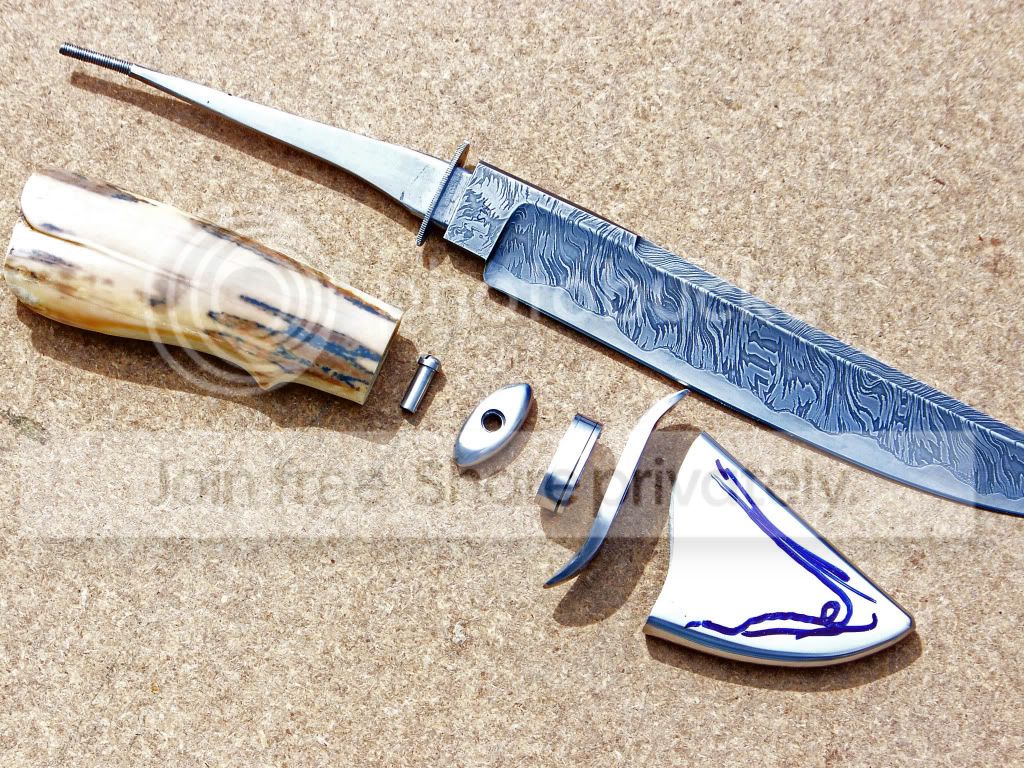
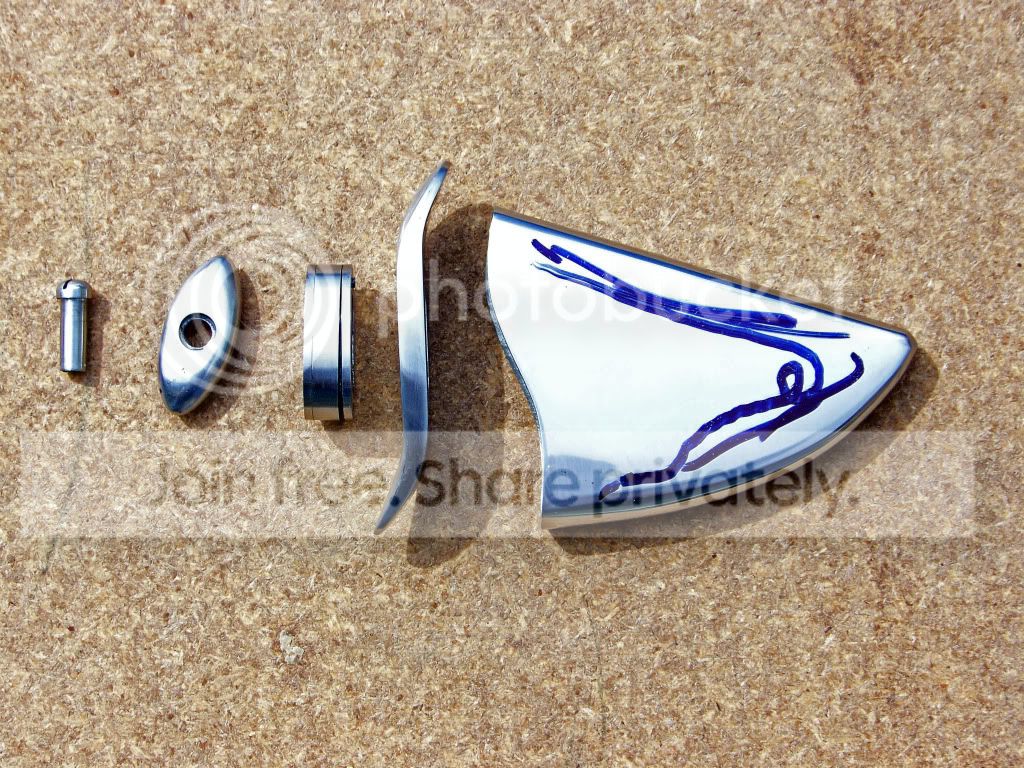
Yes I just use the female part of the bolt. Here is a couple pictures I took for engraving purposes but it shows what you need to know. BTW this is a "take down" knife but I use the same method on all Through tangs if I use a butt cap.
100_2889_edited.jpg

100_2886_edited.jpg
 
Thanks, Bruce:thumbup: That's pretty much what I was envisioning, though what I had in mind wasn't quite that nice;) I do appreciate the pics, and that's one heck of a nice knife, too!
 
Walter... okay, I see where you're coming from now. That is a worthy concern. On my forged, carbon steel blades I think the blades will be long gone before that happens... but I can't say for sure.

On my real hard use pieces I will often use a corby bolt through the handle/tang rather than just a pin... not much chance of that coming out.

I also do many in the same manner as what Bruce posted (beautiful piece Bruce!!! :thumbup: :cool:).

I hope you show us what you come up with Walter :)
 
Now that Walter has seemed to have gotten his original question answered quite well, I have a similar question that has been bothering me for several days . . . and I'm hoping that someone can give me some guidance.

I am in the process of making the following knife. The only way that I know to secure the handle is to secure it with 2 pins, and epoxy of course. This will be a stock removal blade with S30V steel, so I won't be able to leave the tang in an annealed state.

Therefore, I expect to shape the guard and handle and get everything fitted prior to heat treating. Just before sending to heat treat, I will simultaneously drill the handle and tang for the two pins.

Will this hold up well, and is this the most typical way of assembling a stock removal, partial tang knife? I realize that I will have to get my fitment perfect before heat treat, because there will be no way to drill the tang afterwards.

scan0002.jpg


Thanks in advance,

Mike L.
 
Now that Walter has seemed to have gotten his original question answered quite well, I have a similar question that has been bothering me for several days . . . and I'm hoping that someone can give me some guidance.

I am in the process of making the following knife. The only way that I know to secure the handle is to secure it with 2 pins, and epoxy of course. This will be a stock removal blade with S30V steel, so I won't be able to leave the tang in an annealed state.

Therefore, I expect to shape the guard and handle and get everything fitted prior to heat treating. Just before sending to heat treat, I will simultaneously drill the handle and tang for the two pins.

Will this hold up well, and is this the most typical way of assembling a stock removal, partial tang knife? I realize that I will have to get my fitment perfect before heat treat, because there will be no way to drill the tang afterwards.

Mike,

I think that will be fine. However, be aware that when you HT it, the pin holes will shrink slightly. I usually try to oversize (oval) the pin holes slight (on the tang, not the handle material) so that when they come back I can do a little clean up on them and when the pins go through, they will "pull" the handle to the guard. This is done by having a slight offset on the tang holes so when the pins are tapped in the slightly hit the edge of the tang hole (bottom of hole away from the guard / ricasso). Also, you can anneal the tang only by heating it with a torch and wrapping a wet rag around blade / ricasso to keep it cool. Use cement / concrete drill bits also and they will usually cut the steel after hardening.
 
Other than the threaded section of the tang; I'd want the tang to be at spring temper and not annealed.
I use clay as the control agent on most blades and coat the blade accordingly. The weakest area of a hidden tang blade, is the area at the ricasso, where the blade transitions through the shoulders and then along the tang. If this area is at spring temper the blade will take a lot more lateral stress.
This is especially true if the tang is getting on the thin side.

As you move toward the end of the tang the stresses become less, having the softened threaded area is not critical.

Fred
 
Does that blade have a core steel in it, Bruce? Nice look whatever the process.
The pattern in the damascus is really bold; I like it a lot.

Fred
 
Will this hold up well, and is this the most typical way of assembling a stock removal, partial tang knife?

Mike, yes. Your design and process seems like a very good one.

The only thing I would add to your design is to radius the shoulders where the tang meets the ricasso, to prevent stress-risers. In my experience with tools and dies, if a piece of steel is going to fail, it WILL fail where there's a sharp inside corner. Even a small 1/8" radius makes a big difference. On a knife that size, even that may not be entirely necessary. (Still worthwhile for peace of mind, though.)

I have finished/modded factory-made blades of less-than-optimal steel very much like your diagram, and have beaten the living snot out of them. I've yet to break one at the tang.
 
Last edited:
Yes, Logem. that will do JUST fine. :) If the holes seem to get smaller and sticky, then hand file the pins a wee bit smaller, or roll them on some abrasive paper to thin a bit. A couple of "thousanths" makes a big dif. Adjust things as you go along, after all you are a craftsman and knifemaker, not a mass production engineer. This is hand work for the skilled craftsman. :D
 
Back
Top