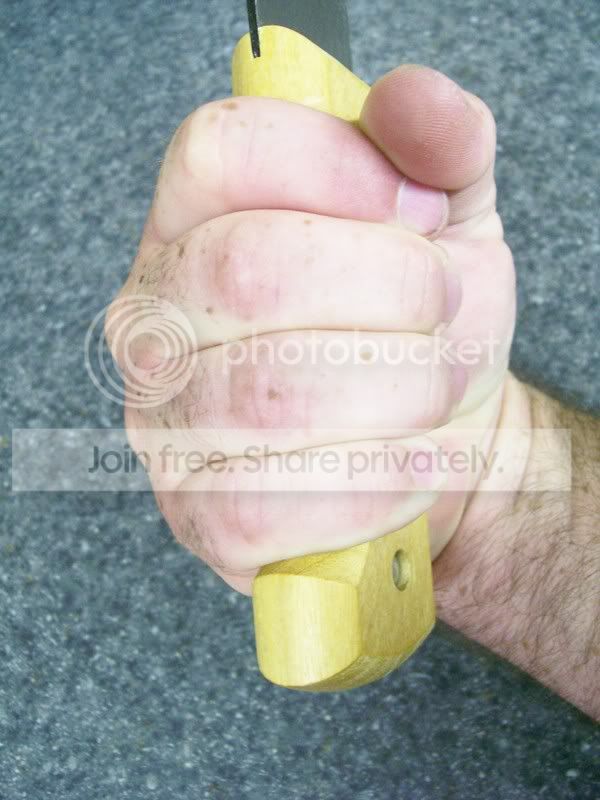
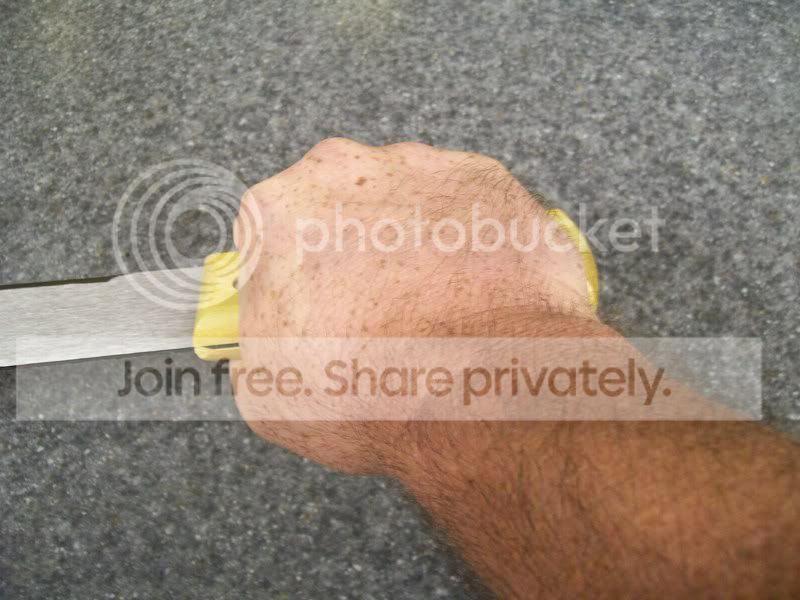
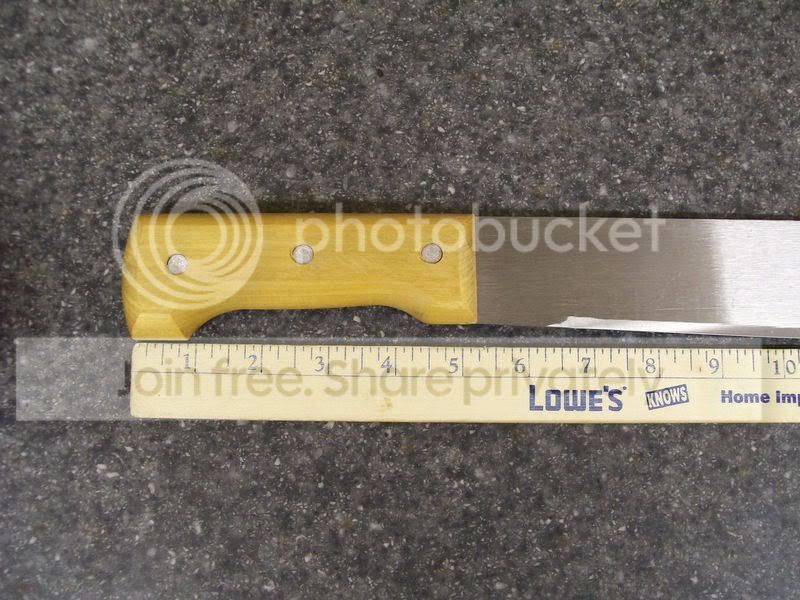
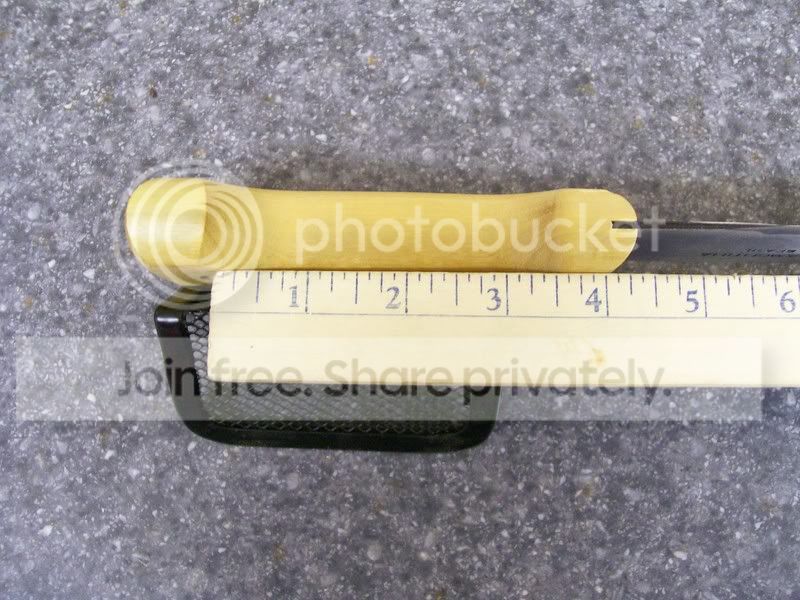
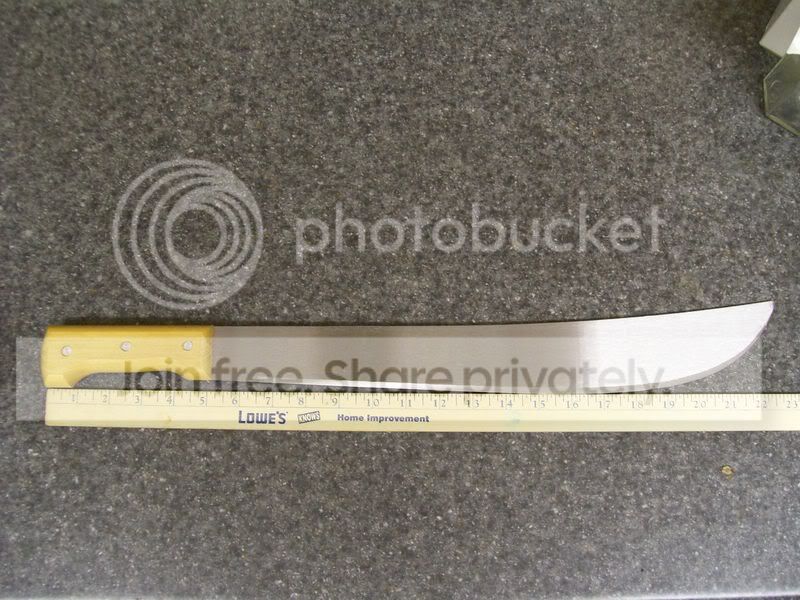
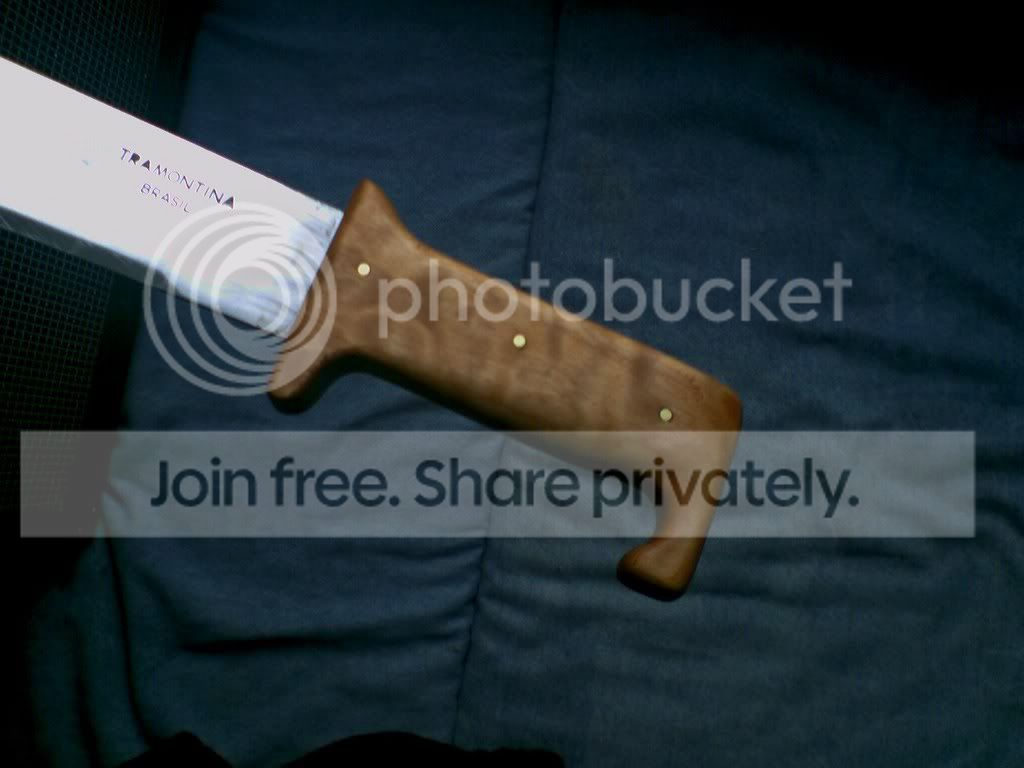
Thanks for the boost, guys.
As far as the sheaths go, they are pretty simple to do. I'll try to lay out my process (3 so far - bolo is next !) the way I did the cherry one above:
Materials:
Hardwood of choice
1) 3 3/4" X 20" X 1/2" - this is the outer piece that will be contoured, so select the best looking wood you can find. This is the cherry on the one above.
2) Same size but 1/4" thick - this is the back, or body side, of the sheath. I used teak in this one.
3) 3 3/4" X 3/16" X 20" - this forms the what would be the welt in a leather sheath. Most of the center gets cut away and used elsewhere. I used yellow cedar on this one.
4) Waterproof wood glue, varnish and sundries (or whatever finish you want), and some time.
The first thing I did was lay out a template on the welt. Lay the blade on the welt and mark the widest point on the spine (tip) and the widest point on the edge (belly). Carry these lines parallel right up to what will be the top of the sheath. Freehand the bottom curve to follow the contour of the blade tip plus a bit, or cut straight across for an ambidextrous sheath. You'll need to remove the center section of the welt that's this wide plus a little extra (2 3/4 IIRC), which will leave you with a U-shaped piece.
Now sand the mating edges on all three pieces (to 150 grit), glue, & clamp. Use the center piece you cut out, along with some water, to ensure there's no glue squeezing out on the inside of the sheath. That would really ruin your day !
After leaving the assembly clamped overnight, I started the shaping. The best thing I've found for this is a piece of 40 grit paper (used for floor sanders) glued onto a strip of 1/2" ply with a full roundover along one edge. This gives you one safe edge (like a file), two flat surfaces and a radiussed surface for curves. I use this for probably 90% of the shaping.
When I was happy with that, I cut two strips 5/8" wide and 3" long and laminated them into a cleat on the back of the sheath as an attachment point . Another strip cut from the center piece at 1" X 3 1/2" forms the cap on the top opening of the sheath. Contour this part as desired, then slot the middle for the blade to slide into and glue it on. Now sand everything down to the finish you want. Because I was finishing it bright, I sanded it down to 220. For painting or wrapping, 150 should be lots.
It's important to note here, don't make the sheath backwards as I did...As you can see, this is meant to be worn on the left hip and cross-drawn with the right hand - too bad I'm a lefty...

Doh!! (I think I really said that!)
For a belt loop, I made a leather frog that laces up on the back side. It's important to make the belt loops tall because the sheath needs to be able to swing back and forth to get the blade in an out. You also want it to swing so it doesn't hang up, as the bottom is about knee-level. The other advantage of using a frog is that you can untie it and easily slide it up and down, which I do when I mount it on my pack.
The sheath I'm working on now (for the maple one) is quite a bit lighter. Basically the same procedure, except that the only wood was 1/8" mahogany ply and a little bit of yellow cedar. The whole thing was then laid up with glass cloth and epoxy. It's getting a formed kydex belt loop pivotting on a short 1/2-20 stainless bolt. Super light, super tough. I'll put up a pic if it works.