- Joined
- Jan 8, 2016
- Messages
- 94
I just received a surface grinder from Travis Wuertz to aid in my builds. I'm a stock removal guy right now, and one thing I've learned is most if not all the flat stock is pretty rough, and worse, not that flat at all... In fact most of it has torsional bends and while I could get it sort of flat using the platen and the proper belts ( engineered Norax's) it's still almost impossible to get things flat by hand - at least for me. The twists found in flat stock can cause problems with stiffer handle materials and grinding to the actual center of the stock when making plunges. Also, hand SG'ing creates a ton of heat fast and takes a long, long time on this steel at least.
A used SG was dismissed as there just aren't any around that I could find for one, and two, anything else I found had to be shipped from several states away and being used I would've had no idea what I was really getting. Time is of the essence for me and while I can rebuild a SG, I really didn't want to waste the time. Neither did I want to convert a new unit to belts. I like the idea of belts vs stones for many reasons already discussed here.
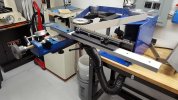
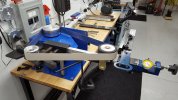
One of my grinders is an Esteem unit that tilts like Travis's TW90 and it also happens to use a 1.25" tool arm so the SG slid right in. I opted for the longer base and am glad I did. I prefer to have more area available than less.
Initial setup and facing took approx 30 minutes, with most of that being the facing task. The neodymium magnet table must be hardened as it took awhile even with a new Norax A65 belt.
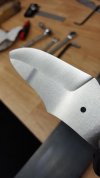
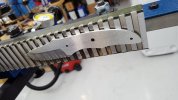
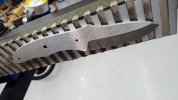
The first test was with a an already hardened and mostly ground test blade that didn't make the QC cut. It is 1/8 CPM154 ht'd to 61 RC and approx 7" long. Now I had already tried to flatten it with the platen and a large angle welding magnet that I use as a handle while trying to perform this task. Needless to say it wasn't close to flat which made it a perfect test subject.
Getting it to a thousandth or less across the whole blade took approx 30 minutes. I used a new, A65 grit Norax for the test.
Now, there are a bunch of variables to consider while SG'ing. Is the face exactly 90 degrees to the face of the contact wheel? Is the wheel even? is there any tilt whether due to tolerance stacking or induced by the use (you shouldn't lean on the unit while grinding as you will change the relationship of the two faces). It simply isn't as robust or steady as a dedicated SG unit.
Also be aware of the belts chosen. I used a new, flat Norax belt. If the belt has any use, you could potentially carve nice grove the length of the blade. But the same thing is possible with a non maintained stone.
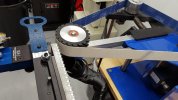
I can also see why Travis recommends a 90 durometer contact wheel face hardness. A softer wheel will conform to the edges of the blade and wrap the belt with it and cause cutting of the spine and belly. Honestly, I'd like to try a larger diameter sold aluminum wheel. This would "flatten" or enlarge the cutting surface a bit and maybe promote smoother cuts.
That being said, I'm not sure I care for the serrated wheel right now. I think they induce chatter like cuts vs a solid wheel. But then again, I'm really new to this and I may be drawing the wrong conclusion.
Grinding was pretty easy once I got the feel for it. Be careful not to get carried away with the movement dial as even a half thousandth with this steel and the belt I used can be an overly aggressive cut. I can see where this will save me a bunch of time vs hand flattening and an added bonus is the hardened blade never got to more than 120 Fahrenheit which means no stopping and having to dip.
So, I like the ease of setup, the fact that it doesn't take up more valuable floor space and that it will not only get my blades much, much flatter and even with the scratch pattern, but do so in far less time. These reasons make it a good addition to shop IMO and worth the cost. Yes, I maybe could've gotten a used unit for less, however, I also may have had to search for parts and spend time rebuilding it which at least for me, right now, is not worth the possible savings in money. In less than an hour I was SG'ing and not fooling with tooling.
I will post more as I learn more.
A used SG was dismissed as there just aren't any around that I could find for one, and two, anything else I found had to be shipped from several states away and being used I would've had no idea what I was really getting. Time is of the essence for me and while I can rebuild a SG, I really didn't want to waste the time. Neither did I want to convert a new unit to belts. I like the idea of belts vs stones for many reasons already discussed here.
One of my grinders is an Esteem unit that tilts like Travis's TW90 and it also happens to use a 1.25" tool arm so the SG slid right in. I opted for the longer base and am glad I did. I prefer to have more area available than less.
Initial setup and facing took approx 30 minutes, with most of that being the facing task. The neodymium magnet table must be hardened as it took awhile even with a new Norax A65 belt.
The first test was with a an already hardened and mostly ground test blade that didn't make the QC cut. It is 1/8 CPM154 ht'd to 61 RC and approx 7" long. Now I had already tried to flatten it with the platen and a large angle welding magnet that I use as a handle while trying to perform this task. Needless to say it wasn't close to flat which made it a perfect test subject.
Getting it to a thousandth or less across the whole blade took approx 30 minutes. I used a new, A65 grit Norax for the test.
Now, there are a bunch of variables to consider while SG'ing. Is the face exactly 90 degrees to the face of the contact wheel? Is the wheel even? is there any tilt whether due to tolerance stacking or induced by the use (you shouldn't lean on the unit while grinding as you will change the relationship of the two faces). It simply isn't as robust or steady as a dedicated SG unit.
Also be aware of the belts chosen. I used a new, flat Norax belt. If the belt has any use, you could potentially carve nice grove the length of the blade. But the same thing is possible with a non maintained stone.
I can also see why Travis recommends a 90 durometer contact wheel face hardness. A softer wheel will conform to the edges of the blade and wrap the belt with it and cause cutting of the spine and belly. Honestly, I'd like to try a larger diameter sold aluminum wheel. This would "flatten" or enlarge the cutting surface a bit and maybe promote smoother cuts.
That being said, I'm not sure I care for the serrated wheel right now. I think they induce chatter like cuts vs a solid wheel. But then again, I'm really new to this and I may be drawing the wrong conclusion.
Grinding was pretty easy once I got the feel for it. Be careful not to get carried away with the movement dial as even a half thousandth with this steel and the belt I used can be an overly aggressive cut. I can see where this will save me a bunch of time vs hand flattening and an added bonus is the hardened blade never got to more than 120 Fahrenheit which means no stopping and having to dip.
So, I like the ease of setup, the fact that it doesn't take up more valuable floor space and that it will not only get my blades much, much flatter and even with the scratch pattern, but do so in far less time. These reasons make it a good addition to shop IMO and worth the cost. Yes, I maybe could've gotten a used unit for less, however, I also may have had to search for parts and spend time rebuilding it which at least for me, right now, is not worth the possible savings in money. In less than an hour I was SG'ing and not fooling with tooling.
I will post more as I learn more.