Trouble etching 1084

Joined
Aug 16, 2008
Messages
222
Guys,

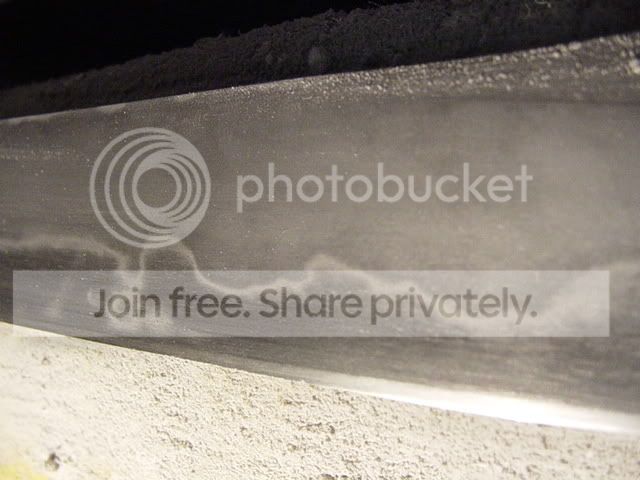
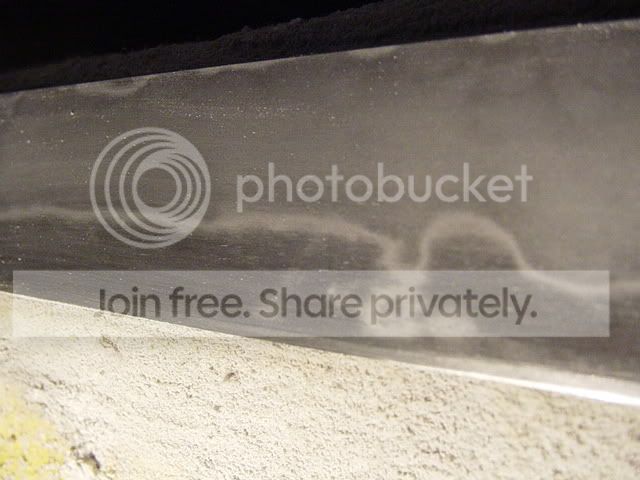
I'm having some real trouble etching a 1084 hunter. I clayed, took to 1480 for ~3min and quenched. Everything came out nice. Cleaned it up a little, tried to etch... it's not really working. The 1095 that I have etches fine in the same solution, but I don't know exactly what concentration FeCl3 I have. Anyone run into this before?

You can see a faint hamon after ~30 min of etch at room temp, but it sands right off. I'm not getting nearly as much oxide as I normally do, either. It's like the steel just doesn't want to etch.

Any help would be appreciated.
 
Taylor, what grit are you going to before etching? I normally don't see much until I put a 400x on it. I etch in hot vinegar and get my lines with that.
 
1084 is a deeper hardening steel than 1095. the hamon shows a difference in structure between hardened and un-hardened steel. Properly clayed, a shallow hardening steel will have a hard edge as the edge quenches quickly, and the spine will be softer as it lags few seconds behind. 1095 needs a very quick quench to harden properly, the added thermal mass of the clay prevents the spine from hardening properly, allowing it to tranform to mostly pearlite while the edge becomes martensite. 1084 hardens well even when it quenches relatively slowly. You're going to harden all the way across the 1084 hence no contrast because it's all pretty much the same structure.

-Page
 
Page, I guess I should explain that I don't just dunk the whole clayed blade in but just to cover the exposed steel, kinda like a hybrid edge quench. I do get some activity but not following the clay tightly like I do in 1095.
 
There are so many variables in forming a hamon. The thickness of the clay, how the blade was quenched ,steel type,and finishing technique.

Sanding to a high grit (1000 minimum, 8000-10,000 is better) is usually required to get a good display. The hamon will indeed sand out at lower grits. Etching is not done until the final stages of togi, except to see where the hamon lies (as you have done).

Finally, a hamon is not a line drawn along the blade. It is a somewhat elusive zone that may be plain or stunning. It may be bold or visible only in the right light.

It is a wonderful thing, and if it was an easy guarantee, it would be on most blades.

Stacy
 
It's the only reason I clay coat for the most part... chasing the hamon, temperline, differential hardening line... :confused: whatever we're calling it this week. :p
 
Every time I try to bring out the hamon, it ends up polishing right out. I guess I will try and go up to a higher grit as recommended before the etch. I usually can see the differential hardening line after the quench and I have been using 1095 with both warm lemon concentrate and vinegar.
 
try finishing it up to 600grit... use some oil on the paper.... then degrease it ..... etch it till it has a nice oxide... neutralize...

then use an abrasive to remove the oxide... the idea is to just remove the oxide and not get back into repolishing the metal.... or your back to square one..

myself ... i use very fine powdered pumice... other use autobody polish... on a soft cloth..... and rub .... till you get what you want... ;)

or you can simply spend the hours... and put it into high polish with water stones... ..good luck on that


Greg;)
 
Here's what I have found out with the 1084. The times I have gone with a longer soak the less visible the hamon is. Also I have also had better luck at 1450 degrees. Have you tried warming up your etch?
 
Maybe I'm just asking too much from the 1084, or I don't know how to get it just right yet. With the 1095, I would at least get a line of demarcation fairly quickly. Not so here...

I haven't been warming my etch.

I always go to 400 with a Trizact belt, then hand sand to 600 before I etch.

Now, after I etch for a long time, the oxide shows up following right along where the clay was, but unlike the 1095, when I steel wool the oxide off, the hamon line goes with it. Hmmm... I dunno. I guess I just need to experiment more.
 
Try going over the blade after you have etched it with your 600 grit paper and see if you can see any difference then. 1084 is a lot more like fishing than with the 1095. The times that I have done a longer soak the whole blade hardens and there is no sign of a temperline or hamon. How have you been holding your mouth?
 
Here's a picture of knives I just finished. The bottom blade is 1084 that I purchased from Aldo Bruno here on this forum. 1450 with 1 minute soak and quenched in Texaco Type A quenching oil at 120 degrees. Type A is a slow quench. The top blade is W-2 done the same way and in the same oil. I know the pictures aren't that good but I was trying for the hamon.

IMG_1083.JPG
 
Try going over the blade after you have etched it with your 600 grit paper and see if you can see any difference then. 1084 is a lot more like fishing than with the 1095. The times that I have done a longer soak the whole blade hardens and there is no sign of a temperline or hamon. How have you been holding your mouth?

Yeah, that's what I mean... I cn see some hamon before etch when the steel is clean. When I etch it takes a long time to etch, and only shows a little difference in the oxide buildup, then when I go back over it with the 600 grit the hamon is just gone and I have to start all over again. You're right... it's like fishing.

I tried taking some off on the grinder... thinking maybe I just had a freakishly thick, even layer of decarb... nope.

Maybe I need to play with Ferric stength. What stength do you make your ferric? Mine is about 50g of ferric in a quart of water.
 
You can do it with 1084. I've never managed the sharp whispy stuff like I can get with W1/W2, but you can get some pretty stuff.

This is 1084 hand sanded to 2000X and then etched in warm vinegar/dish soap about 25 times. The oxides were removed with polishing powders.

Of course you can't see all the fancy little stuff going on in a static photo, but there was a lot in there. :)

standard.jpg
 
Hello Taylor. My first question is what is your quench medium? I seem to get the best results using parks50, heated to about 120. I also use clay at about 1/8" thick and submerge the whole blade. I then finish grind to 400, then had rub to 800. I am using a 3 to 1 solution of FeCl. As Greg mentioned, I use an autobody polishing compound, 3M medium cut( 1200 grit) to remove the oxide layer, then Flitz or Simichrome. Here is the result.
IMG_1279_1_1.jpg

Just my method, I wish you luck.
Brion
 
Yeah, that's what I mean... I cn see some hamon before etch when the steel is clean. When I etch it takes a long time to etch, and only shows a little difference in the oxide buildup, then when I go back over it with the 600 grit the hamon is just gone and I have to start all over again. You're right... it's like fishing.

I tried taking some off on the grinder... thinking maybe I just had a freakishly thick, even layer of decarb... nope.

Maybe I need to play with Ferric stength. What stength do you make your ferric? Mine is about 50g of ferric in a quart of water.

When I mix a fresh batch I go for a 4 parts water to 1 to one part fc. What I have now is over a year old plus I have added a lot more water. I'm actually surprised it still etches.
 
Hello Taylor. My first question is what is your quench medium? I seem to get the best results using parks50, heated to about 120. I also use clay at about 1/8" thick and submerge the whole blade. I then finish grind to 400, then had rub to 800. I am using a 3 to 1 solution of FeCl. As Greg mentioned, I use an autobody polishing compound, 3M medium cut( 1200 grit) to remove the oxide layer, then Flitz or Simichrome. Here is the result.
View attachment 122683

Just my method, I wish you luck.
Brion

I'm using straight mineral oil with a little PMDS to cut the surface tension. It's roughly equivalent to AAA. It hardened my 1095 sufficiently, so it should work fine with the 1084. It's heated to about 140.

Let me try diluting my ferric a bit and I'll check back.
 
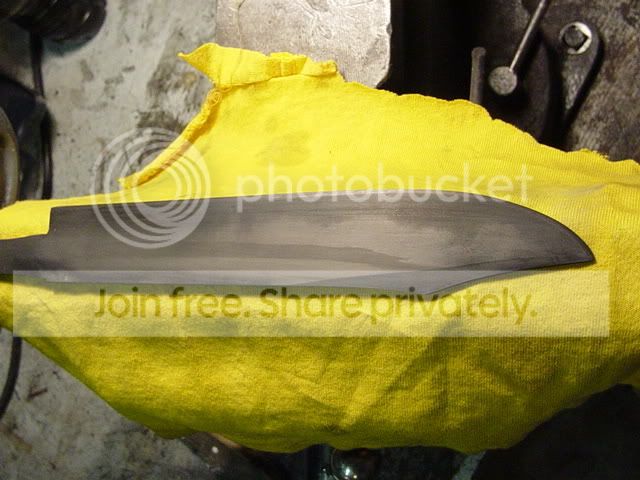
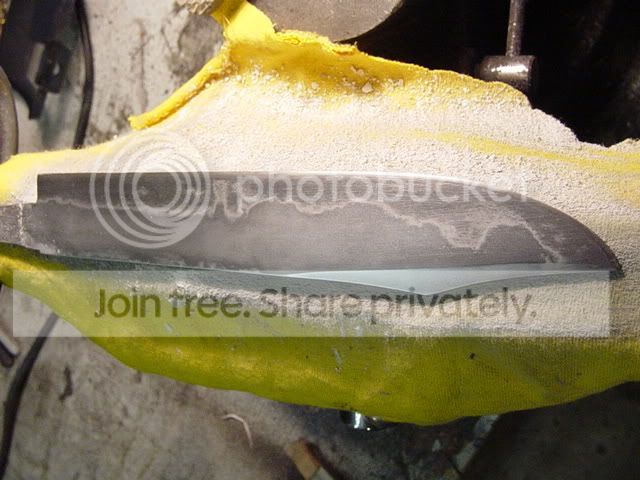
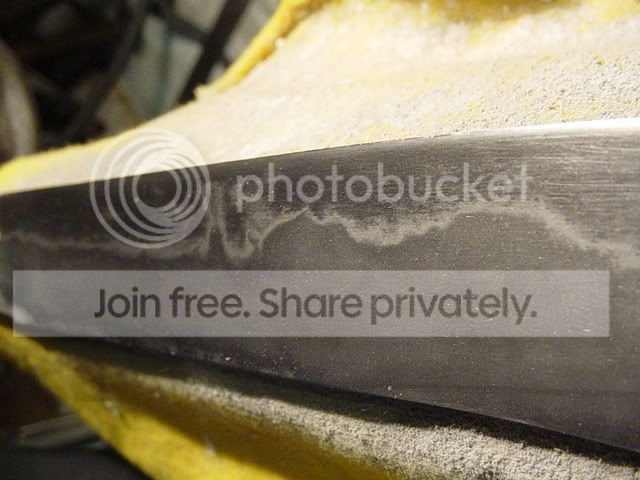
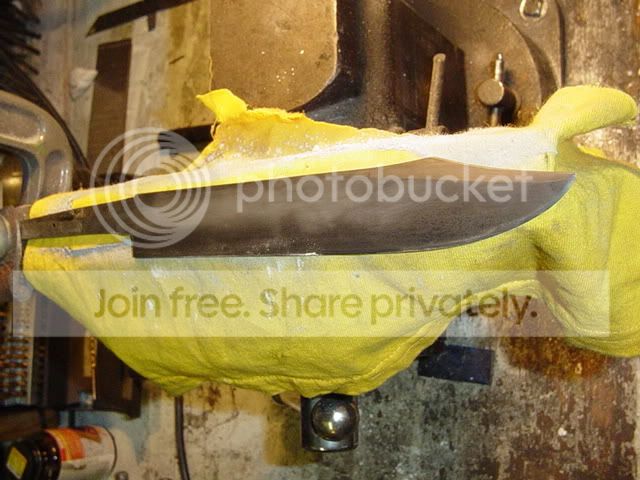
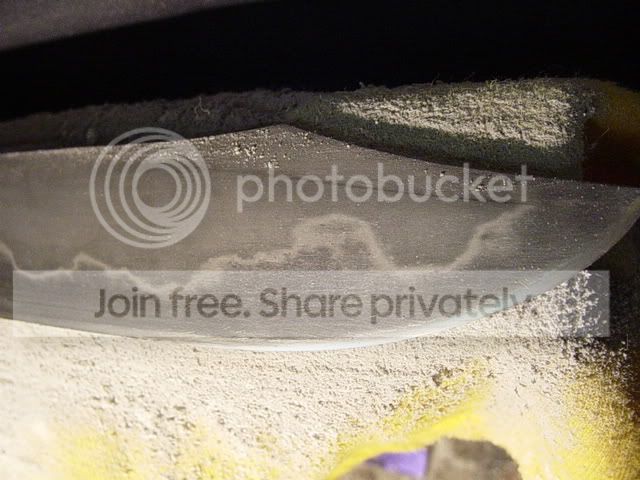
ok.. i took a little time out today... an i etched a blade and took some pic's... i know they're a little fuzzy but that'll give you an idea...

apparatus: basically degrease and etched in dilute nitric... then neutralized..
and clamped up in the vise...

DSC05190.jpg


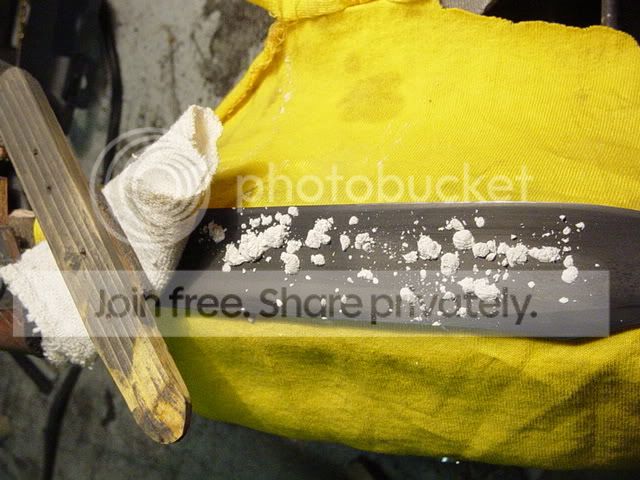
now i placed abit o pumice powder ( ultra fine ) and got my push stick with a cotton shop towel on it...

DSC05192.jpg


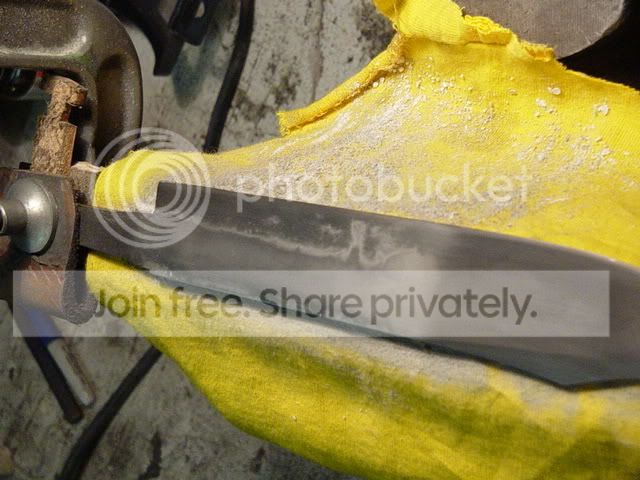
Now polish... and add pumice as you go

- here i'm halfway done to show the contrast...
DSC05194.jpg
 
now a little more poli

DSC05223.jpg


DSC05222.jpg


DSC05220.jpg


oh... that was an old black diamond file.... and no clay coat on the blade.

so.. the powder does work ok... ;)
 
Back
Top