
Trouble with heat treating

Joined
Jul 15, 2016
Messages
61
I need advice on heat treating/hardening. I feel like I am following the instructions for heat treating 1084 steel, but I'm still not getting good results. Check out my process and see if you can identify where I'm going wrong.

I forged this kukuri style chopper out of 1084 steel from NJ Steel Baron.
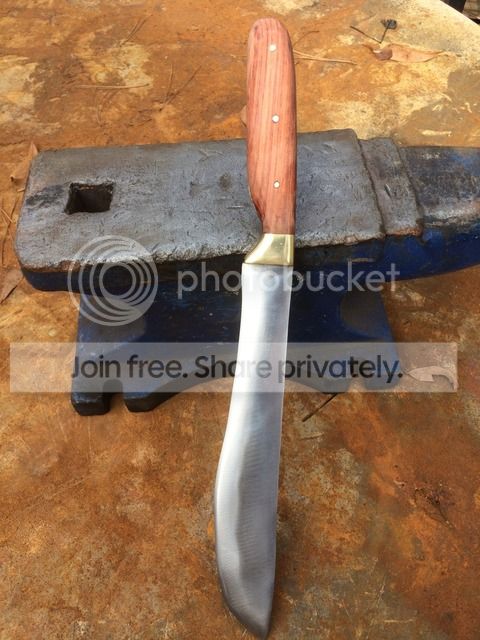


I use a Majestic brand 2 burner propane forge. I forged it into this shape and hammered in the bevel for the edge. I normalized it three times to allow myself to be able to drill the holes for the handle. I then heated it to 1500 degrees in accordance with this chart:
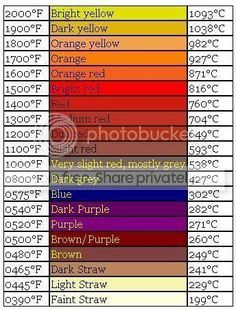


I quenched it in canola oil heated to 130 degrees. To quench it, I plunged it into the oil and stirred with it for about 8 seconds, then clamped it between two plates to straighten out any warps. I call myself having checked it with a file, but to be honest, I'm not 100% sure what it is supposed to feel like. It did not seem to dig in.

I then cleaned it up on the sander, making sure I dipped the blade regularly in water to keep it cool. Then I tempered it in an oven at 400 degrees for two sessions of one hour each.

I attached the handle and sharpened it on an expander wheel with 400 grit sandpaper on it--again dipping it in water to keep it cool. I stropped it with a leather belt until I could shave with it.

Here's where the problem came in. I chop tested it one time against a board from a pallet. As you can see it in the picture, I got considerable damage to the edge.
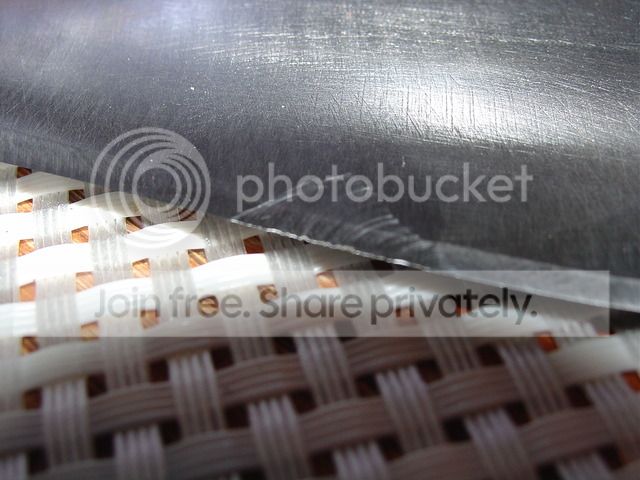
 
The picture us fuzzy. Is the edge chipped, or deformed? If it's chipped, temper at 450f which should drop it 2 RC points. How thin was the edge before you sharpened it, and what angle is the edge sharpened at? It may be a geometry problem, not just a heat treat problem.

The two most important things in making a knife are heat treat and geometry. Steel choice is a distant third.
 
Thanks for your response. Sadly, I do not yet know enough about blade making to tell you the geometry involved. Here are some pictures that I hope are helpful.


Here is another picture of the damage. It is not what I would call chipped.
 
If pieces of metal broke off the edge no matter how small, that's chipped. If it's just deformed from the edge bending back in spots, that's not chipped.

I am using the same 1084 from Aldo/NJSB and it is easy to get it to skate a file. If you clean off the black scale after heat treat, then the file will just slide along the steel without biting into it. It just slides along and won't even make a single scratch mark in my experience.
 
Several things:
1) Do tempering immediately after the quench. The cleanup should be done after the tempers. If not, you can put microscopic cracks in the edge that will chip later on.

2) The temper for 1084 chopper should be between 450F and 500F. A 400F temper would be for a fine edge slicing knife. If the quench was properly done, a 500°F temper is still Rc 59-60. I almost never temper 1084 below 450°F.

3) The edge shown looks far too thin and low angle. A chopper should have an edge angle of about 20° per side or even higher for a rough use chopper.


The quench and temper are done, and are what they are. What you can still do is change the edge. Grind it back just a tiny bit to a small flat edge again and sharpen at 20° per side. I personally use a convex edge on rough use blades, where the edge is sort of rounded down from the bevel. The angle is still the same, but there is a bit more meat above the edge, making it more durable.
 
Then I tempered it in an oven at 400 degrees for two sessions of one hour each.

Like Stacy said, temper right after quench and I temper twice for two hours each at 450 to 500F with a cold water quench in between.
 
Never trust your eyes to guess the temp of steel, depending on the lighting you can be way over or way under. A more reliable gage is using a magnet. Heat slowly and keep checking if the magnet still sticks. Once it stops sticking your very close. Just need to go up 75-100° from there and quench. The problem I gave found with trying to eyeball temp is your eyes will adjust to the brightness and give you false results. If you look at the steel for the first time it will look bright but the longer you stare at it in the forge the more you eyes adjust to forge brightness and things get wonky.

That does look like a rather thin edge for a chopper, considering the non optimum heat treat. Me personally would want the edge to role not chip. On somthing this size I would think 450° temper at LEAST if not a 500°. If you can get into the 58-59rc area you should be good. That being said there is nothing with going even softer by a few points considering lots of protection knives are even softer then that.
 
Get a set of calipers from a hardware store. I use the dial kind. Measure the edge thickness before you sharpen. For a basic forge, eye calibrated heat treat, leave 0.025-0.030" before sharpening. Then put a 20-25 degree per side edge on it.

Get one of these to learn your angles.

http://www.leevalley.com/en/Wood/page.aspx?p=32456&cat=1,43072

Don't fret. Grind the edge back as Stacy said, and put a different edge bevel on. It'll be better. Next knife will incorporate what you learned. For choppers, put a temp handle on and chop a bunch of stuff. It's easier to retemper before your good handle goes on.
 
your blade looks like some older butcher knives i have. grind out the chipped parts and make it a butcher knife rather than a chopper. between eBay and McMaster/Carr, spend $50 and get a digital thermometer and 2300F thermocouple so you can get accurate temperature readings. $25 can get you a set of basic digital calipers.
scott
 
Folsoml, it's a nice blade you've made. Do what they said & you should be fine. If you can measure BTE thickness prior to re-shaping the edge, I'd interested in knowing what your edge thickness is now, since it looks to be very thin. Once you get closer to .025-.030 you should have a good chopper blade with what others have said & a steeper angle for the bevel.

Can you measure the edge as it is now & let us know what you started with?
 
Best...forum...EVER!

I ground the edge back down to a flat surface.


I then put my best approximation of a 20 degree edge on it (not symmetrical I know. I tried to build a jig without much success. I just ordered a store-bought one)


I then went around my back yard chopping various things until I build up my confidence enough to chop through this dried oak limb.


When it took that with no damage, I returned to the original pallet. One whack at it did the original damage. This time I chopped all the way through the top board.


No Damage!
 
Looks like your HT turned out pretty well for a blade this size. With the thicker edge & different angle, it seems to be working as it should & cutting very well now. Without a real test of the blade, you can't know how hard it is, but it seems to be hard enough to maintain the edge & tough enough to not chip with what you're cutting.
 
Back
Top