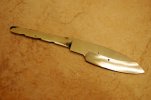
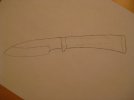
Here is how I would add the divots (artistic blemishes), only because from my experience I know this would work. Others may have some other or better ideas. First the disclaimer

....I am not a master knife maker but I have experimented a lot with etching both on knife blades and in the non-knife "artistic metal etching world"...I strongly suggest you experiment with this technique with a scrap piece of the same kind of steel you used for your blade before you do it to your blade. You will need a 12 volt car battery charger or another source of 12 volt electricity (car battery), white vinegar, salt, etching resist (more on this later), an etching tool (pick, toothpick, scribe, nail, dried out ball point pen,whatever), a glass or plastic bowl (not metal), and a scrap piece of the same (or close) kind of metal you used for the blade about the same size as the blade. Dissolve into the vinegar as much salt as it will absorb at room temp without the salt settling on the bottom. Pour the mixture into the bowl. Coat the entire blade with the etching resist. For etching resist I have used melted bees wax, axle grease, lipstick, chapstick....any of these would work for your project but for finer lines or details some work better than others...safest bet for your plan is probably axle grease. Put it on thick on all the areas you do not want to be altered (edges for example). Leave the tip of the handle uncovered because you will attach one of the electrical leads to it and you will want a good electrical connection. Then, using your scribe, etch in the divots where you want them, being sure to strike through the grease and expose the metal you want to be "divoted"...is that a word ? Connect the positive lead from the 12 volt source to the knife handle that is not covered with grease and submerge the blade in the vinegar without submerging the 12 volt connection. Connect the negative lead from the 12 volt source to the scrap metal and put it in the vinegar without submerging the elec connection....DO NOT let the scrap metal and knife blade come into contact with each other or you will create a short, sparks, etc. When everything is hooked up and in the vinegar, turn the 12 volt power source on and let it go for 60-90 seconds. The scrap metal should bubble up....make sure you have good ventilation. After letting it cook, turn it off and pull the blade out and examine your divots...if you want them deeper, give it another 60-90 seconds of treatment. When you are satisfied, shut it all down and wash off the grease....I use goop hand cleaner. If you are satisfied you are done....but if you need to treat it some more, simply repeat the process until you have what you want. There are a number of variables that affect this process so you should experiment...the variables are temperature, kind of steel, size of divots, electrical current etc. If you can control the amperage from your 12 volt source, 2-3 amps is plenty....many battery chargers give you a choice on amperage...start with the lowest. I have used this technique to etch in designs, mountain scenes, my initials, animals, artwork etc....for things other than "divots" where precise lines are needed, you will want to study and experiment with more refined etching resist and etching tools. There is a lot of info on the net regarding more refined artistic metal etching techniques but for your divot project this should suffice. Be safe and use basic shop common sense. Good luck and let us know how this comes out !!