Turning traditional

I have lately done some experimenting with friction folders. I have turned Opinels in to non-locking versions, just taken off the lockrings and tightened the pivots to my taste. This is my favorite so far, a nr. 9 turned in to a 80 mm drop (or spear) point. Works really well, no real need for a lock.

31032013037.jpg
 
I have lately done some experimenting with friction folders. I have turned Opinels in to non-locking versions, just taken off the lockrings and tightened the pivots to my taste. This is my favorite so far, a nr. 9 turned in to a 80 mm drop (or spear) point. Works really well, no real need for a lock.

31032013037.jpg

It looks like you're on the same path of discovery that I took. It was using the Opinel as a friction folder that lead me to real friction folders.

8606075567_a0968e9f38_c.jpg
 
It looks like you're on the same path of discovery that I took. It was using the Opinel as a friction folder that lead me to real friction folders.

Your postings on this forum have been instrumental in my turning to traditional folders, allthough my interest in historical european edged weapons and tools has also helped. :) In fact, I have now sold most of my "tactical" knives, I have kept only only those two I liked most, one because it is so outrageous and one because It is just my favourite in that scene. All the others are traditional and there is no turning back.
 
Like I said, some experimental friction folders made of Opinels. The handles look actually lighter in color than they are in reality, the nr 12 remained quite light. I have oiled them with Teak oil.

IMG_2828.JPG
 
Got my Laguoile R David today. The buffalo horn handle has some grey blotches, but I understand horn might be like that. The finish is nice enough, I like the engraving in the spring and the overall shape is charming. Problem is that I find it difficult to get the edge as sharp as I would like. I think that a blade this narrow has a geometry that is challenging to sharpen. I still think that my douk-douk and Opinels are the best cutters in my arsenal.
 
Success! I got a Gatco sharpening system with angle guide. I reprofiled the edge of my Laguoile and finished by lightly honing on a ceramic rod. Now the blade takes hair off my leg and I have yet to strop the blade on a leather strop loaded with green paste.

If I look closely there might be a very slight sideways curve on the blade. The bevel if is even on both sides so it is possible that the curve was there to begin with. It does not affect the performance in any way and you have to look closely to notice it.

I very much like the Laguiole style knife. The handle material (horn) is a bit plain. Therefore I have in my mind to get later something nicer like snakewood.
 
Some observations about friction folders. So far my friction only Opinels have serving me great. They are like slipjoints, only simpler and lighter. I think it was Jackknife that said friction folders can be actually safer than slipjoints, since they can not snap shut. I experienced it personally, I fumbled with the "nr 8" and it turned past the point where a slip joint might have bit me. Not this one. The feel of the action is actually quite like a slip joint, I tightened the pivot quite a lot. I also glued a strip of leather in the bottom of the groove to raise the blades sligthly higher when closed to make pinching easier. The modified points are still safely hidden in a closed position.

My favourite so far is a nr 9 turned to a spear point nr 8 (above), it is my traveling knife. Great for cutting anything, the point works well also for spreading cheese etc. The size is just right for cutting apples but it is small enough for carrying in pocket (I use a pocket sheath, allthough it might not be necessary, since the pivot is tight enough to keep the knife safely closed). So light you don't notice it and if you stuff a bandana in your pocket the knife keeps nicely vertical and out of way. Just yesterday I burned the handles of my Opinels with a gas torch and oiled them, the result looks nice in my opinion. Got to take a picture of those.
 
Do you have any pictures of your puukkot? I would like to see the knives that provided the inspiration for your stories.

- Christian

Here is what I have now. I had a Wood Jewel - puukko, but gave it to my son when he left to NZ as an exchange student.

IMG_2966.JPG


Two Roselli's and a Kullervo. The small Roselli, "Grannys tooth" is of UHC - steel.
 
Thanks for the picture. Isn't the bottom knife a small leuku though?

The small Roselli, "Grannys tooth" is of UHC - steel.

Mummonhammas correct?

You should treat yourself to a handmade puukko where the seppa makes everything himself -- blade, handle, sheath. They are not cheap, but it is a pleasure using and owning such a finely crafted tool.

- Christian
 
Thanks for the picture. Isn't the bottom knife a small leuku though?


Mummonhammas correct?

You should treat yourself to a handmade puukko where the seppa makes everything himself -- blade, handle, sheath. They are not cheap, but it is a pleasure using and owning such a finely crafted tool.

- Christian

Yes, it is Mummonhammas in Finnish. The Kullervo is quite close to what you meant by a handmade puukko. In my opinion the handle, made of bark, is quite perfect. It is not slippery and shape fits my hand oh so well. This puukko and me go ways back as you can see from the patina.

The larger Roselli is actually a leuku blade with a hunting knife handle. It is my camping knife, good for chopping and batoning. Mummonhammas is then a pocket puukko. I shortened the handle slightly to fit that role better.
 
My mistake. Was your knife made by Veikko Hakkarainen?

Here is some information I found regarding Kullervo puukkos.

This text was taken from: http://www.taitolappi.fi

The Story of the Kullervo Knife

"In the family Hakkarainen represents Veikko Kullervo the fourth generation of utility knife makers.
The Kullervo knife is an example of an ancient model of northern Finnish knives.
Veikko Hakkarainen is a recognized knife smith, awarded with the title "Best knife maker in Finland".

The Kullervo is handmade from the start, with over 60 phases in the making. Its each part, from the blade to the sheath is made by Veikko himself.
The handle is made of nature's own material, birch bark which is one of the oldest materials used in this purpose.
A handle made of bark is very durable, comfortable, warm and gives an excellent grip.
A few weeks from Midsummer is called the "Bark Month" which means that Veikko spends his time gathering bark.
The blade of the Kullervo knife is hand forged of carbon steel and its extremely precise hardening is a proof of quality even to the most demanding user.
The final sharpness of the knife is achieved through hand-sharpening with a water cooled grinder.
Later the knife is easily sharpened with a grindstone.

The smith, Mr Hakkarainen:

”It is important to me that the tools I make, the knives, are as good and of good quality as possible.
Old, proven good methods are essential in my production, but I don't hesitate utilizing new technology, methods and materials either.
Being a knifesmith in fourth generation I feel obliged to do my work in the best possible way.
I have seen how tools can be made since I was a child and thus my interest in the profession of a smith.
I became a smith when I was a young boy. I find it very challenging and there is always something to learn"

- Christian
 
What's the edge retention like on those Rosellis ? I've heard their steel is incredibly wear resistant, and reasonably tough. An older fellow I know, swears by them.
 
My mistake. Was your knife made by Veikko Hakkarainen?


- Christian

It is. I bought it from him from tourism fairs in Helsinki. I really can't remember the year, anyway a very long time ago. The knife and I have a lot of history and this knife I will not give away or sell.
 
I would say the edge retention in Roselli knives is quite amazing. I have had this bigger Roselli for a long time, used it for mostly rough woodwork like batoning and doing "kiehiset" (making woodchips to use as a tinder). It was shawing sharp when I bought it, it is still sharp enough. I have touched it up a couple of times. I should really take better care of this knife, now that I remember I should sharpen it during the weekend.

I have bought a couple of Roselli hunting knives to my moose hunter friends as birthday gifts. They have been very pleased with them. The older of these guys is a very experienced hunter, practically kept his family in meat by hunting (he lives in northern Finland) and his comments about the knife were very favourable. I quess that from knife users like this you get the most reliable information.
 
Now that we are at it, is Enzo the best folding puukko (scandi grind) made that is readily available?
 
It is. I bought it from him from tourism fairs in Helsinki. I really can't remember the year, anyway a very long time ago. The knife and I have a lot of history and this knife I will not give away or sell.

I can understand why. Last year I picked up a birch bark handled puukko and it has quickly become a favorite. Whenever I spend time outdoors it is either on my belt or in my pack. I foresee it being a long time companion, although if my wife or daughter ever ask for it I will give it gladly. It will have meant that my efforts are bearing fruit and that they recognize and appreciate a good knife.

- Christian
 
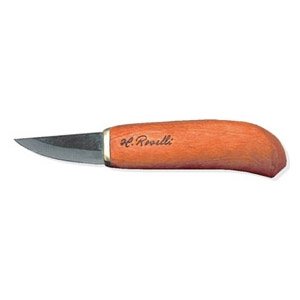
I made a mistake. The small Roselli is not the "Mummonhammas" but the "Karhunkynsi", the Bear clav. Below are pictures of each.

Mummonhammas
20126.jpg


Karhunkynsi
20104.jpg
 
Finally got my Case's, Sodbuster and Trapper. Both look and feel nice, decent size, not too heavy, sharp (some stropping might do both good). The trapper has "western gentleman" written all over it :)
The Soddie is a work knife. The springs are lighter than I had in mind before going on the friction folder trip, but now I feel they are just good.
 
Back
Top