
-
The BladeForums.com 2024 Traditional Knife is available! Price is $250 ea (shipped within CONUS).
Order here: https://www.bladeforums.com/help/2024-traditional/
You are using an out of date browser. It may not display this or other websites correctly.
You should upgrade or use an alternative browser.
You should upgrade or use an alternative browser.
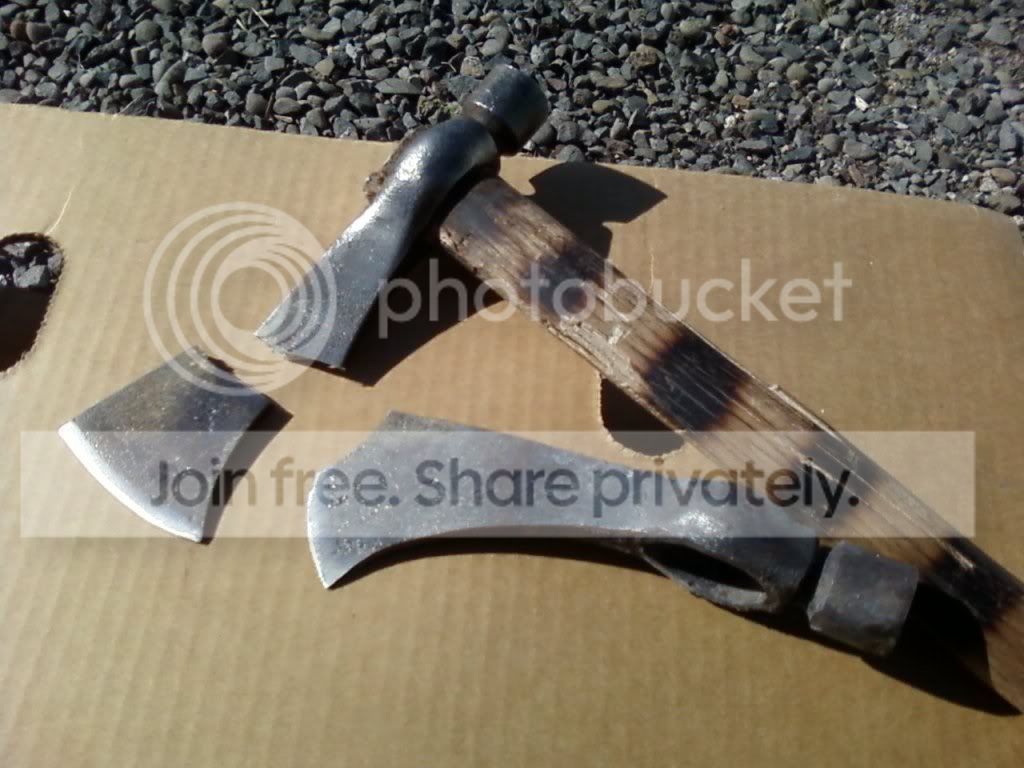
Two broken, what happened?
- Thread starter Kenny H.
- Start date
- Joined
- Jul 26, 2008
- Messages
- 1,006
I would have tried quenching in oil first. Water is pretty violent that way.
Water is pretty violent that way.Not an expert, but I'll bet it was the water quench...I quench in Brownell's Tough Quench heated to 130-140 degrees. Matter of fact, on my horseshoe rasp blades, I first test the rasp by heating to non magnetic and quenching in water...then snapping off the tip end to see if the steel is good enough for a blade. After that, it gets annealed, ground and then properly quenched in the oil. Quenching in water makes that rasp brittle as glass.
This might be the problem....maybe. Good luck!
This might be the problem....maybe. Good luck!
- Joined
- Dec 20, 2008
- Messages
- 1,937
yea... water's good for drinkin...not so much quenching. especially mystery steel. Good lookin hawks though! did you forge those?
Jason
Jason
Thanks!
Yeah I've been working on them on and off for a couple months, I just got the time to finish up the one on the top yesterday, snapped it in half ten minutes ago. The other one not on the handle I did quite a while ago and broke it on a throw.
I was hoping it would be something simple like the water, that's good, less discouraging haha. Will something simple like Motor oil work?
Yeah I've been working on them on and off for a couple months, I just got the time to finish up the one on the top yesterday, snapped it in half ten minutes ago. The other one not on the handle I did quite a while ago and broke it on a throw.
I was hoping it would be something simple like the water, that's good, less discouraging haha. Will something simple like Motor oil work?

Stacy E. Apelt - Bladesmith
ilmarinen - MODERATOR
Moderator
Knifemaker / Craftsman / Service Provider
- Joined
- Aug 20, 2004
- Messages
- 38,720
I NEVER full quench a hawk. Edge quench only. If you are bold you can do it in water, but cracking is a real possibility. Oil is much safer.

- Joined
- Jul 26, 2008
- Messages
- 1,006
There is no shame in learning from ones mistakes...only from repeating them.
I certainly should have asked all this when I broke the first one but I figured it was due to how thin I had made it, so I bulked up the second one and didn't heat it as far as I did the first one; but problem remains.
So I'll find some new steel and quench with oil next time.
Thanks for all the replies by the way!
So I'll find some new steel and quench with oil next time.
Thanks for all the replies by the way!
Last edited:
- Joined
- Jun 5, 2010
- Messages
- 16
OUCH that sucks.... but hey they were looking mighty fine up untill the break

- Joined
- Jun 17, 2001
- Messages
- 5,705
Did you temper after you quenched?

- Joined
- Jul 4, 2009
- Messages
- 1,201
There is no shame in learning from ones mistakes...only from repeating them.
Word!
- Joined
- Jul 26, 2008
- Messages
- 1,006

Stacy E. Apelt - Bladesmith
ilmarinen - MODERATOR
Moderator
Knifemaker / Craftsman / Service Provider
- Joined
- Aug 20, 2004
- Messages
- 38,720
"Word" means "Those are the right words", or "I agree with those words".
As to the breaks...
With the breaks at odd places and angles, and with only an edge quench, I would guess that the cracks were there ( but not visible) before the quench....probably from forging. Two things cause this:
1) Cold forging. Most steel forges at temps ranging from 1600F/870C to
2300F/1260C. Go below that and micro-cracks form. These comeback to get you in the quench or when applying stress to the metal later on. To avoid this, only forge at full red and above heat. If it isn't glowing...don't hit it! Stress relieve the steel when done for the day,too.
2) Cracks form in quenches that you may not think about. Did you stick the hot metal in the slack tub while forging to take a look at it or show a buddy? That can cause the dreaded "PING". It may also set up tiny cracks that will separate later.
Another thing to always try and do is to "cycle down" the steel after a long forging session. Enormous grain structure and other bad things can form with the steel being heated to 2300F/1260C over and over again. Learn to reverse this and leave the steel in a fine grain and pearlite structure when done forging and you will avoid a lot of problems later on.
As to the breaks...
With the breaks at odd places and angles, and with only an edge quench, I would guess that the cracks were there ( but not visible) before the quench....probably from forging. Two things cause this:
1) Cold forging. Most steel forges at temps ranging from 1600F/870C to
2300F/1260C. Go below that and micro-cracks form. These comeback to get you in the quench or when applying stress to the metal later on. To avoid this, only forge at full red and above heat. If it isn't glowing...don't hit it! Stress relieve the steel when done for the day,too.
2) Cracks form in quenches that you may not think about. Did you stick the hot metal in the slack tub while forging to take a look at it or show a buddy? That can cause the dreaded "PING". It may also set up tiny cracks that will separate later.
Another thing to always try and do is to "cycle down" the steel after a long forging session. Enormous grain structure and other bad things can form with the steel being heated to 2300F/1260C over and over again. Learn to reverse this and leave the steel in a fine grain and pearlite structure when done forging and you will avoid a lot of problems later on.
I embarrassingly knew nothing about Tempering and I'm certain that's my problem after reading about it, I always thought the quench was the final step! It's incredible that not a single guide or tutorial I've read on forging has mentioned Tempering, or maybe I completely missed it.
- Joined
- Jun 17, 2001
- Messages
- 5,705
I embarrassingly knew nothing about Tempering and I'm certain that's my problem after reading about it, I always thought the quench was the final step! It's incredible that not a single guide or tutorial I've read on forging has mentioned Tempering, or maybe I completely missed it.
From what I was seeing in the picture you posted I figured it couldn't have been anything else than not tempering. Very important!
Thank you for mentioning that or I would have gone on to ruin more steel, both of the breaks are very straight and clean, no bending or "rolling over" involved so it has to be because they were too brittle from lack of tempering.
Thanks a bunch for all the replies!
Thanks a bunch for all the replies!
- Joined
- Jun 17, 2001
- Messages
- 5,705
Since you don't know what steel it is you should start at 400 degrees and let it soak for an hour. Check it after the first hour. You may want to raise the temp some more. Don't be in so much of a rush. I've never forgot to temper a blade but I had forgotten to harden one years ago.