Two current model SOGs

Joined
Sep 11, 2014
Messages
4,682
While like others, I too feel rather disappointed in many of SOG's current models and look back longingly to what
SOG used to make back in the day, there are two models I own that are not vintage but still impress me.
The first is the Seal Pup Elite. I have the Seki made Seal Pup in Aus6 with the partial serration and I think it is
a great knife as it was. But SOG's post 2006 Taiwan made Aus8 Seal Pup Elite with straight edge really does improve on the overall Seal Pup design, from blade shape and thickness to the handle shape.
The other oldie is the SOG Tomcat that was first introduced back in 1986 one of the earliest "Tactical Folders". Originally requiring two hands to operate, it gained thumbstuds and jimping to become the Tomcat 2. And the latest version Tomcat 3.0, while still weighing a ton and not sporting a clip, has become a very smooth operating big folder thanks to the Arc Lock system. One of the few SOGs still made in Seki Japan it is still a "tank" in the hand.
Both knives are current modernized versions of old vintage SOG models. And they reflect not just a history of development, but a level of quality well above that of some of SOG's other present day offerings.

DSC_0373_zpsjyqdujg5.jpg
 
I appreciate the seal pup.
The elite even more.
But that odd shaped handle franken folder called the 3.0
Does not vaguely resembling the original profile of a seki tomcat.
I can't understand the concept of having such a handle design
Which quite frankly, appears to have been fitted the wrong way round...
or maybe someone who has handled one
Could explain any apparent advantages or improvement in grip traction?
 
The Seal Pup in all its iterations are fantastic with the Elite Satin PE being at the top IMO. I recently came across one at an unbelievable price. Because of the bad rep SOG has on BFC the exchange can be an excellent place to get good deals on SOGs.

20150521_150819.jpg

20150521_150732.jpg


With its friends (Seki, regular, Elite):
20150521_150936%25280%2529.jpg


With my modded kydex sheath (removed material around the edges) it makes one of the smallest profile fixed blades I have:
20150521_150857.jpg
 
I appreciate the seal pup.
The elite even more.
But that odd shaped handle franken folder called the 3.0
Does not vaguely resembling the original profile of a seki tomcat.
I can't understand the concept of having such a handle design
Which quite frankly, appears to have been fitted the wrong way round...
or maybe someone who has handled one
Could explain any apparent advantages or improvement in grip traction?

The Tomcat 3.0 handle is an improvement over the original and Tomcat 2 in my opinion. It isn't a big chunk of kraton,
but a very ergonomic steel handle with thin krayton padding. The traction is quite remarkable. One really
needs to hold it themselves to appreciate it. It is close to the ergonomics of the Vulcan, except that it is much heavier
both by design and materials. It is far better designed and comfortable than the handle of my BM Adamas 275, an equally big heavy folder.

DSC_0363_zpsqnzkjbac.jpg


DSC_0366_zpsigxzef27.jpg
 
Last edited:
The seal pup would go thru hell and back
And still looks ever ready for more.
I wouldn't trade it for any thing other than.
Nice score kenH!
And thanks for the insightful sharing of the tomcat 3.0.
I had for sometime suspected otherwise
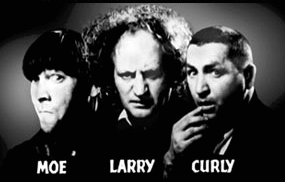
Considering that perhaps a genius threesome had some hand in putting it together in the dark...
3stoogespic.gif

Btw, the flash folder series shares a near similar handle profile
sog_s95-n.png

sog_fsa7-cp.png
 
Last edited:
LOL. No I am certain those three designers are in charge of SOG's current line of offerings. I think the on the far right
came up with the "Fusion" line.

The Tomcat 3.0 is not in that group. One of the first "tactical folders" born in 1986, winning an award in 1988,
having evolved over nearly 30 years, still made by G.Sakai in Seki Japan, it is in a different league.
It does have it's drawbacks; a basic design and shape nearly 30 years old when large folders were all huge and heavy,
a weight that very likely would make a clip impractical. The result being that the highly material stripped and lighter Vulcan series
made in the same factory is a better suited modern "EDC" knife. Still, the Tomcat 3.0 is THE folder that lets you carry around
the sexy SOG blade curves wthout resrting to a fixed blade. And close examination shows that it's high quality of fit and finish
is hard to refute.
 
Well, it could be a distinct possibility
And That someone has been very good
At turning a blind eye ...
https://www.youtube.com/watch?v=_bLCXRHu9Ik
The classic original was indeed a glamour puss.
Having won some blade magazine award way back
In the age of snail mail and mail order catalogues.
Tomcat Pretty high tech then
Just like its namesake the f14
But the checked diamond grid on those kraton slabs was to me at least
Far too large, clumsy and crude looking
by current standards of refine taste.
The updated versions maybe very well made.
But its just like me in not seeing what the fuss was all about.
Guess i would have to try it out for size someday.
The vulcan looks better to me though.
 
I think one would have to have been buying knives in the 1980s to appreciate what the fuss was about. I was buying knives using mail order catalogs and
snail mail. It's very difficult to look at knives that have origins decades ago without the inevitable bias of today's knives, with their materials and design trends.
Knives like firearms fundamentally don't change in their ability to function over time as much as other man made products. In the computer age where
anything over two years old is "outdated" my Winchester 94, manufactured in 1964, orginally designed in 1894, functions perfectly fine for what it was
designed to do. Same can be said of knives. I'm not aware of any knife that is decades old and "can not cut" something today that a modern knife can.
80-90% of the knives I own are 10, 20, 30 years old. I run into quite a few folks who seem to have no appreciation for the past. One kid was trying to convince
me how much garbage Aus6a was as a knife steel, as if it couldn't slice cheese. But to me, appreciation of the past simply magnifies my appreciation of the present,
including today's knives, their materials and design trends. As for personal tastes, they are countless and vary. Which is why there are so many different knife models on the market.
 
The Seal Pup is a great knife. I wish the latest version was still made in Seki. Wish it were a little larger (longer blade) too.

BTW; I am reworking a seal pup (a very early version with a smaller serrated section), it has been used and sharpened to the extent the serrations are below the rest of the blade (by about 1/16 inch) - should I keep the serrations or reprofile to have a straight blade, what say the hive?
 
Normally I would never suggest modding any Seki Sog. But since you've already used to the point of the straight edge being above the serrations I would think there is no reason to
not reprofile it to your liking. While serrations have their purpose, I always felt that it took away so much straight cutting edge on the older model. That's really why I went for the Elite,
they offered a straight edge.

DSC_0368_zpsnsovbudj.jpg
 
Just for clarifcation; I just aquired the knife in it's current well loved condition. It is such an early model, the serrations are only about two-thirds the length of those on the seki seal pup shown above.

I have removed the powder coat, and handle. I am making up a nice black palm handle with aluminum hilt and stainless pommel. Blade will be hand rubbed satin.
 
Last edited:
I also have a tech 1 and tech 2. Those will not be modded :)

There is really no comparison to the hand ground blades, brass hilt, and krayton handles on those.
 
Last edited:
Hi kenH!
Aus6 was the tech steel for early al mar knives :-)
Which the late Al mar himself having pioneered the hyped marketing of its superior japanese imports
All made seemingly kosher through premium pricing it's product line.
I figure back then nobody knew as much about steel types
Beyond the 400 series stainless steels.
You're absolutely right that all knives can cut and get jobs done
No matter what steel types were employed in their respective eras.
Just as I m certain that there still is a healthy market in the world
For Pakistani made knives.
But I suspect the main culprit behind the use of exotic for factory made knives
Would be benchmade knives.
Strangely enough the economic slump
Brought about the popularity of domestic US made carbon steel products to the forefront.
In the end it's the effectiveness of spin masters which helps formulate market directions.
Economic woes would not hamper the belief of the hardcore super steel purist though!
 
Though the AUS series steels are compared to the 440 series, I've found the AUS series to take a better edge and hold it longer than 440C. I also find it easier to sharpen than the sandvik stainless. I think that AUS-6 and -8 are great alloys for knives, even in today's climate of latest popular uber steel.
 
Last edited:
Just for clarifcation; I just aquired the knife in it's current well loved condition. It is such an early model, the serrations are only about two-thirds the length of those on the seki seal pup shown above.
I have removed the powder coat, and handle. I am making up a nice black palm handle with aluminum hilt and stainless pommel. Blade will be hand rubbed satin.

Sounds very interesting. Please post a pic when completed so we an see this knife.
 
I also have a tech 1 and tech 2. Those will not be modded :)

There is really no comparison to the hand ground blades, brass hilt, and krayton handles on those.

Agree completely. The reason is because the Seal series were made in the Kinryu Factory until 2007.
Kinryu has and contiunes to make the Aus8a SRKs for Cold Steel as well. While the finer quality
Tech, Tech I and Tech II were made by Hattori. I have the Tech which is like the Tech II but in SK5
carbon steel.
 
Agree completely. The reason is because the Seal series were made in the Kinryu Factory until 2007.
Kinryu has and contiunes to make the Aus8a SRKs for Cold Steel as well. While the finer quality
Tech, Tech I and Tech II were made by Hattori. I have the Tech which is like the Tech II but in SK5
carbon steel.

Very nice, I have always wanted to get my hands on a Tech / sk5 SOG. I thought some of the Techs were in stainless, as the name change wasn't due to steel change but rather when the tech I came out? In fact one of my tech "II"s I suspect is a tech in stainless. But to differentiate from the Taiwan blade usually just stick with tech II.
 
Agree completely. The reason is because the Seal series were made in the Kinryu Factory until 2007.
Kinryu has and contiunes to make the Aus8a SRKs for Cold Steel as well. While the finer quality
Tech, Tech I and Tech II were made by Hattori. I have the Tech which is like the Tech II but in SK5
carbon steel.

I knew about the Hattori knives, did not know the factory where the seals were made. Very interesting to learn that fact.

The seki seals are fine knives, just much more of a mass produced machine feel especially with the powder coat and zytel handles.
 
Very nice, I have always wanted to get my hands on a Tech / sk5 SOG. I thought some of the Techs were in stainless, as the name change wasn't due to steel change but rather when the tech I came out? In fact one of my tech "II"s I suspect is a tech in stainless. But to differentiate from the Taiwan blade usually just stick with tech II.

Yes you are right, the Tech went from SK5 to Stainless, then whenn the smaller version came out they named that TEch I, and the Stainless Tech became Tech II.

I personally had bought my knife thinking it was a Tech II. But when tested with vinegar it produced a color reaction proving that it was a carbon steel blade, and that would mean an SK5 Tech. Some Tech Is and Tech IIs have the letter "S" over the words "Seki Japan". No one seems to know for sure what it means, possibly designating "stainless".
SOG had the steel type listed as 440A as with many of their models of that era, however SOG did disclose later that it was
actually Aus6A, which is the Japanese close equivalent (Aichi) and they felt consumers would feel more comfortable with a
US steel designation. SOG is not the only knife company that followed this line of thinking back in the 1980s.

DSC_0180_zpse0a6ccc3.jpg


The Taiwan version is called "Tech Bowie" model S10B and has a 6.4" Tini Aus8A blade.
 
Back
Top