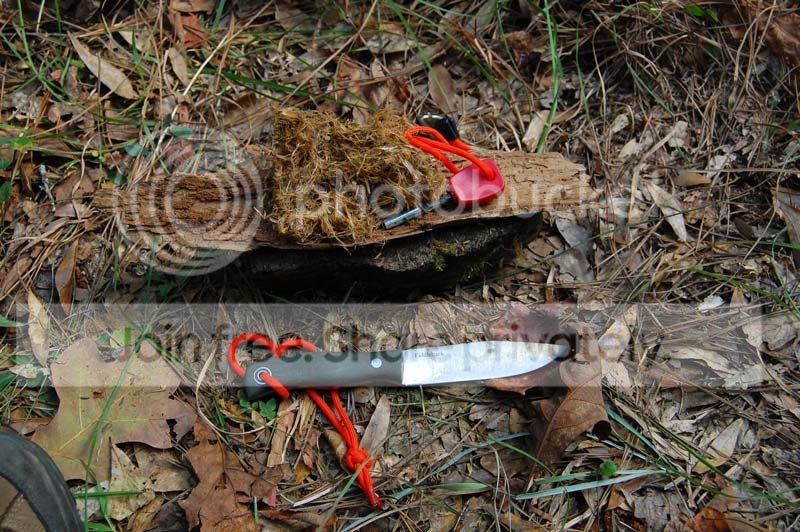
Well, I got my first Breeden and my first Fiddleback in the mail yesterday! I've been waiting not-so-patiently for both, and boy was I glad to see them! I didn't have much time yesterday to play around with them, but I was able to get an idea of their strengths and (non-existent, far as I can tell) weaknesses. The test was making a Paiute string deadfall—at least I'm pretty sue that's what it was I was trying to make—which was my first attempt at trap-making. The knives both did incredibly well, but the trap, I'm sorry to say, never quite worked out. I got it made alright, but I couldn't for the life of me get it set up and balanced right. I guess practice will help.
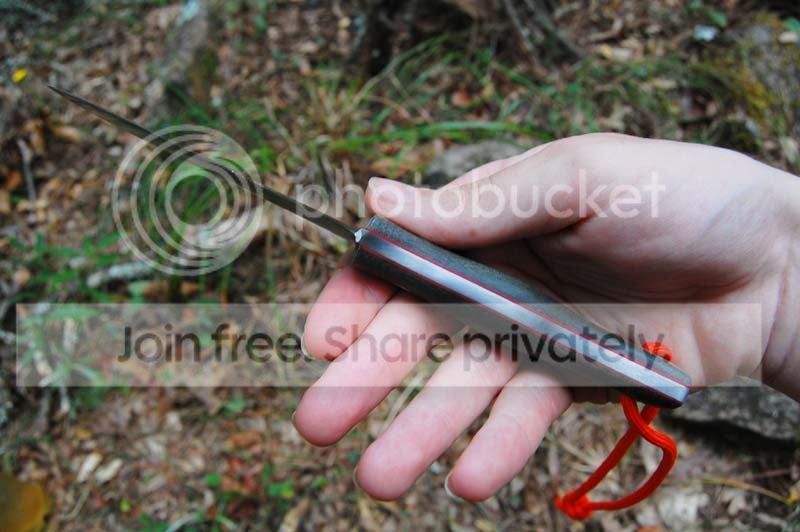
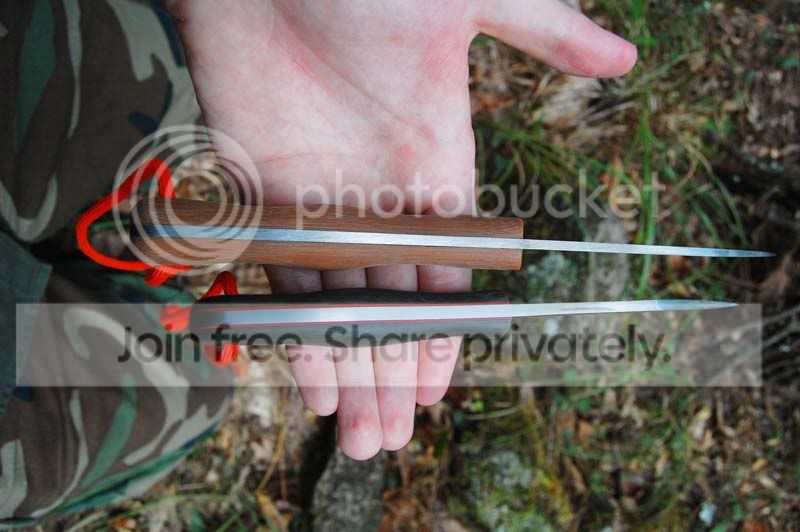
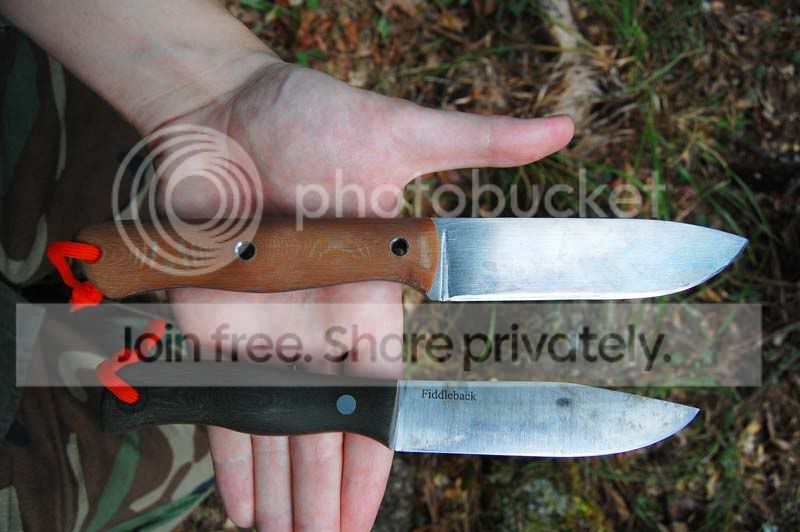
Ahead of time, let me apologize for the poor pictures. I was more interested in playing with the steel than in photographing said steel, and I was losing light fast back here in the woods. Better pics will be coming, I promise!
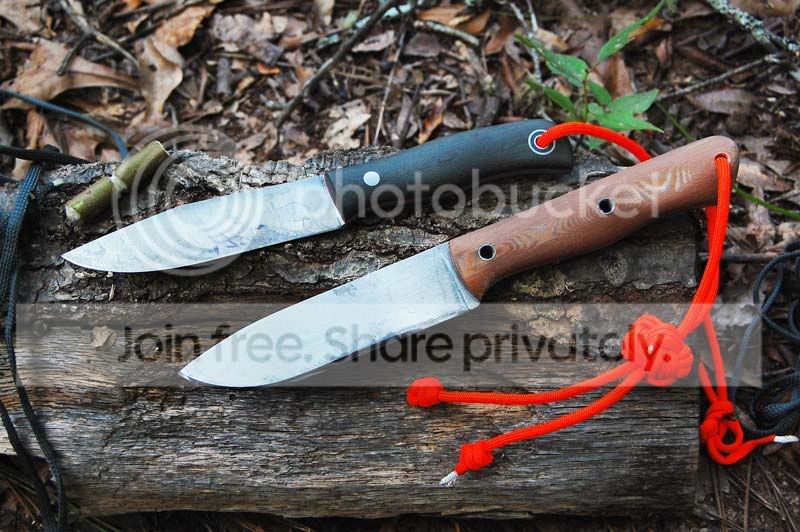
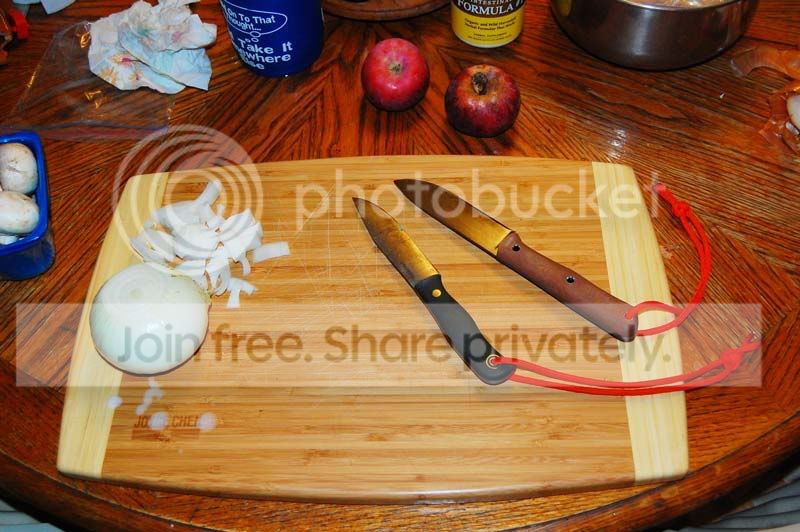
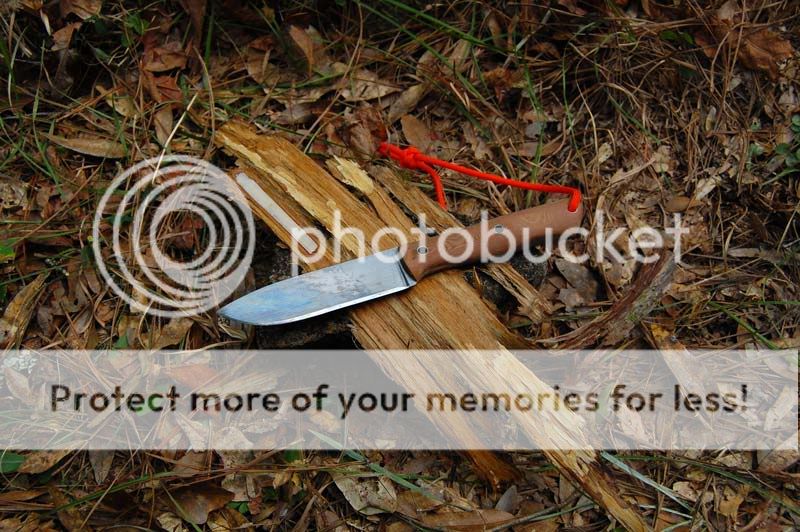
The pair together on a handy prop, along with the toggle for the trap.
On to the reviewing! This is only a preliminary look; again—there will be more pictures later; I somehow managed to completely neglect to get shots of the sheaths, since they were both on my belt at the time. As I work with them both more I'll post more detailed reviews, and of course more pics. I'll get a few shots tomorrow, for sure.
~|~|~|~|~|~|~
First Look — Breeden Knives "Blackwood Bushcrafter":
Specs:
Blade Length: 4 1/2" (cutting edge)
Blade Thickness: 1/8"
Blade Width: 1 1/8"
Handle Length: 4 3/4"
Overall Length: ~9 3/8"
Steel: O-1
Grind: Full flat grind with convexed edge
Handle Material: Tan/Natural Linen Micarta
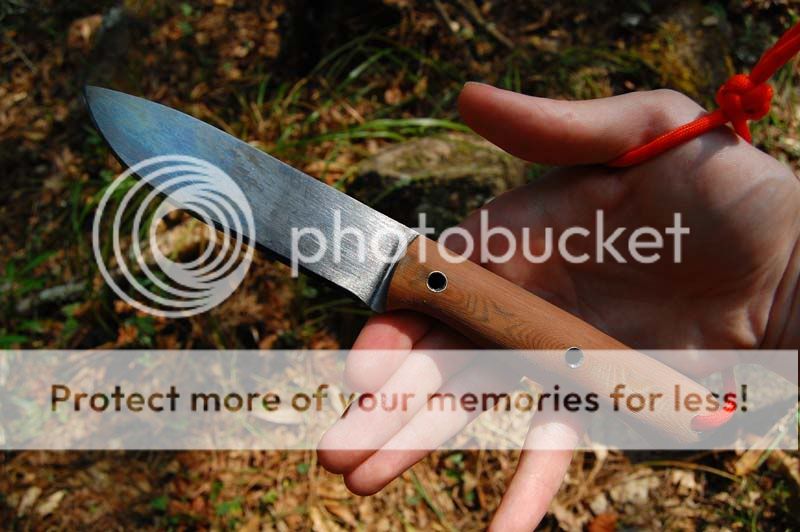
The Breeden is a custom that we're calling the Blackwood Bushcrafter, I posted a thread with the pic Bryan sent me earlier in the week. The pic he sent just didn't do it justice, though. This is one hell of a knife. I pretty much blatantly ripped off the BRK&T Bravo 1 handle design and contours (I'll make it up to you by buying an Aurora come spring, Mike ), had Bryan put it on a 1/8" thick flat-ground blade of O-1, a little wider than his usual fare at 1 1/8", with a nice drop point with just enough belly and a good point. The handle scales are tan linen Micarta, which I think Bryan is going to keep in stock now. I gotta say, it's absolutely gorgeous!
First impressions of this knife were: Wow, it's perfect! closely followed by, Holy Two-Tailed Skunk of Doom, that's frickin' sharp!
I don't think I've ever had a knife come this sharp before. The convex edge is so highly polished I could use it for a shaving mirror, and forget shaving-sharp—the hairs just say, "forget it," and jump off seemingly before the blade touches them! It goes through newspaper (tested on the newspaper it was packed in) like it's just not there, with no weight put on it. I can just about rest the newspaper on it and it'll fall through it. The edge excels at slicing paper-thin curls, cutting and finishing notches in green wood (haven't tried notching dead wood yet) and pointing sticks. It seems just a hair thicker than I usually like, but I think that's just me getting used to a true convex edge on a flat grind. Tomatoes quiver n fear as this blade approaches, and fall away in translucent slices at its touch. Pics of that later.
The sheath is simple yet perfect for the knife. The color of the leather near perfectly matches the color of the Micarta handle scales, the leather is good quality and sturdy, and retention is excellent without it being a pain to extract. It rides low, just like I prefer, and is well-put-together with even stitching. It is on my belt as I type this, and I hardly know it's there. It rides just behind my right hip. Nothing fancy, but I love it.
The knife is exactly what I wanted. The handle feels just amazing in the hand, and is comfortable in a far wider variety of grips than I thought it would be, largely due to the length. The blade length is just perfect for just about anything, and the little bit of extra width makes it easier on the knuckles for kitchen duty. Bryan really did a superb job on executing this design. The grind lines are about as close to dead on as I've seen, handle fit and finish is excellent, and overall, two thumbs up to Bryan for this blade! :thumbup:
First Look — Fiddleback Clipped Bushcrafter Jr.:
Specs:
Blade Length: 4 1/4"
Blade Thickness: 5/32"
Blade Width: 1"
Handle Length: 3 7/8"
Overall Length: 8 1/4"
Steel: O-1
Grind: Full convex grind with secondary edge bevel
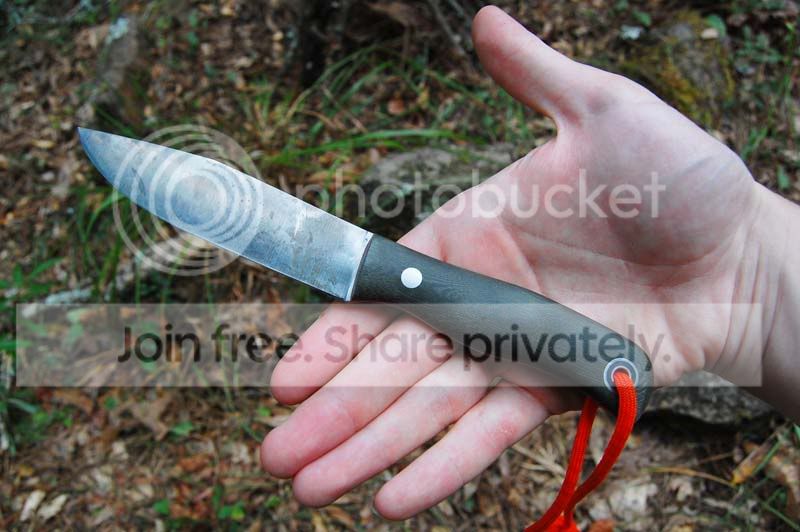
Handle Material: Green Linen Micarta
As soon as I saw this knife in a thread Andy posted here on the forum, I knew I had to have it. The combination of the beautifully shaped handle, clipped point, and that really neat bulls-eye lanyard hole design just called out to me. So I got in touch with Andy, it was available, and then it was mine.
First impressions of this one were: Dang, that handle really IS beautiful! followed closely by, This thing is beefy!
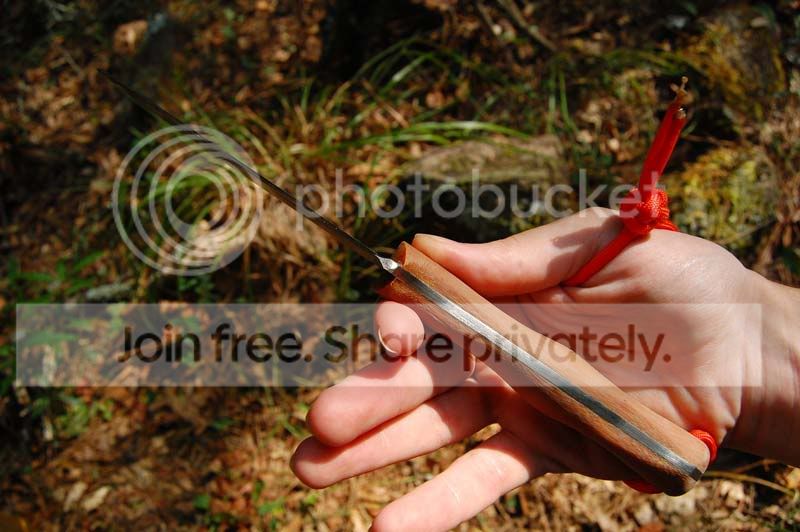
The handle fits like a glove, despite being smaller than I'm used to, or really like. It's also far more secure than you might think, due to the contours, and is really comfy for prolonged use. It's a bit limited in grip options, but not severely so. The red liners really make it snap, as does that already mentioned bull-eye lanyard hole setup. The contours are smooth, and the 'grain' of the linen Micarta shows really well. It ends a bit abruptly at the blade end, so you do have to be a bit more careful with it, but I like that as it puts usable edge right at my hand. For woodworking power cuts or fine work, that is never a bad thing in my opinion. Ergonomically, it beats out anything else I own or have held.
The fit and finish is right up there with the best I've ever seen, clean, fine grind lines, handle scales fit perfectly, everything is smooth and tight. I was disappointed, however, in one area: sharpness. It would barely scrape shave my puny arm hair out of the box. This didn't bother me for long, however, because it gave me an excuse to make that Altoids tin sharpener Siguy showed in a post here (mousepad taped/glued onto the top of an Altoids tin, sandpaper taped on top, stored inside). So I made one real quick, and in about ten minutes I had it easily shaving sharp, almost hair-popping. I started with 400 grit, which was probably too coarse actually, then went to 1500 when it would catch on my fingernail every time. I couldn't find my 800 grit, going to have to go get some more of that soon.
I also love the sheath for this one. It was made by JRE, and is a nice light-colored leather with a firesteel loop. My Light My Fire Scout Model now resides there. One of the things I like about the sheath is the way it's set up for carry: it has a belt loop positioned for a high riding carry, or a loop just the right size for a paracord loop to be fed through to make it a dangle sheath. As mentioned, I like low-ride sheaths better, so I ran a length of paracord through this loop, then through a Turk's Head knot, and finished it up with a simple overhand knot, so I have an adjustable length. The Turk's Head goes behind my belt, leaving the sheath to hang just even with the bottom edge of the belt. The sheath also has a rivet at the bottom, and a snug enough retention, that I could put it on a Merc Harness for under-the-arm upside-down carry. It too is on my belt as I type this.
~|~|~|~|~|~|~
Getting Down N' Dirty — Using Both Blades In A Practical Environment:
As soon as I got the Fiddleback touched up, I grabbed my camera and headed for the front yard to do some cutting. My front yard isn't like most; it is terraced, sloping uphill. The next terrace up is used for barbecuing in a small fire pit, plinking with the .22 rifles, and little else. Due to little use lately, it's been let grow up in sweet gum saplings, so I headed for those to start with. My plan was to make a Paiute string deadfall using both knives. I'm going to lay this out by types of cutting, and for each type I'll have two sections; one for each knife. No other tools were used.
Cutting the saplings:
Breeden — I was cutting saplings around 3/4" thick to 1" thick, and bent, 2-3 good cuts would just about sever the saplings. Though very sharp, the edge lacked some bite that a less polished edge might have.
Fiddleback — This knife really excelled here. The full convex grind just flew through the wood, one good cut being all that was needed most of the time. Though it needed some work to get to an acceptable level of sharpness (yeah, I'm going to rub that in, Andy. ), once there, it just couldn't be beat!
Angling the ends of the sticks to fit in the notches:
Breeden — Here the Breeden showed its strength. The smoothly polished edge made sweet thin curls of the wood, and easily flattened the ends of the sticks at the angle needed.
Fiddleback — Though it too did great in this area, the convex grind wanted to bite in just a bit too much, and it was more difficult not to slightly concave/dish the cuts. It was a bit harder to make flat cuts with this one due to the different grind.
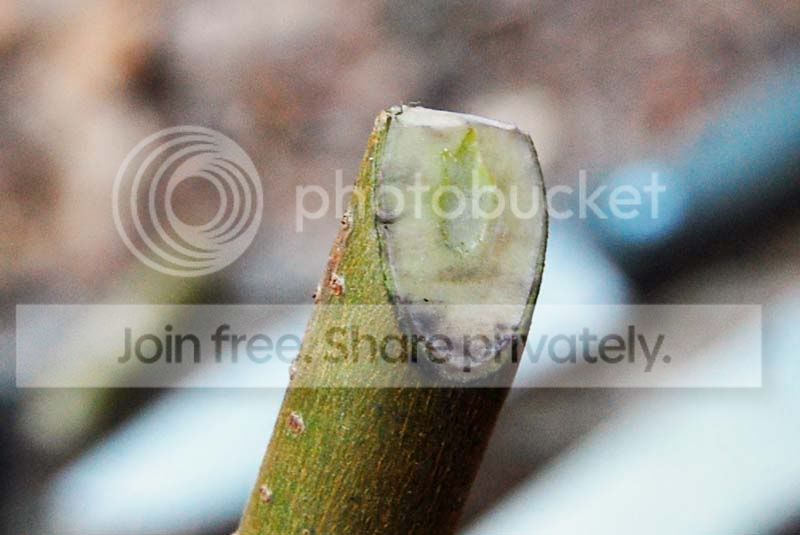
The finished end.
Notching:
Breeden — At first I wasn't sure, but after a while it grew on me. Very easy to control despite the slightly wider blade, made clean cuts, and did the job quickly and well. Better at making 90-degree notches like in a normal figure-four trap, and flattens the inside of the notch better, I think.
Fiddleback — Again, it excelled. It cut easier, especially for notching around the stick for string, all that was required was a rocking motion around the circumference of the stick. Also was better at making 45-degree notches like in the support stick of the deadfall.
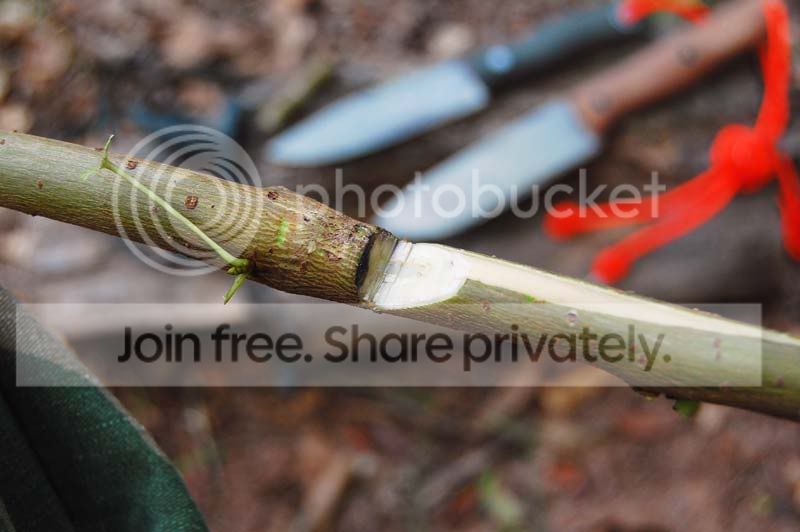
A look at one of the notches.
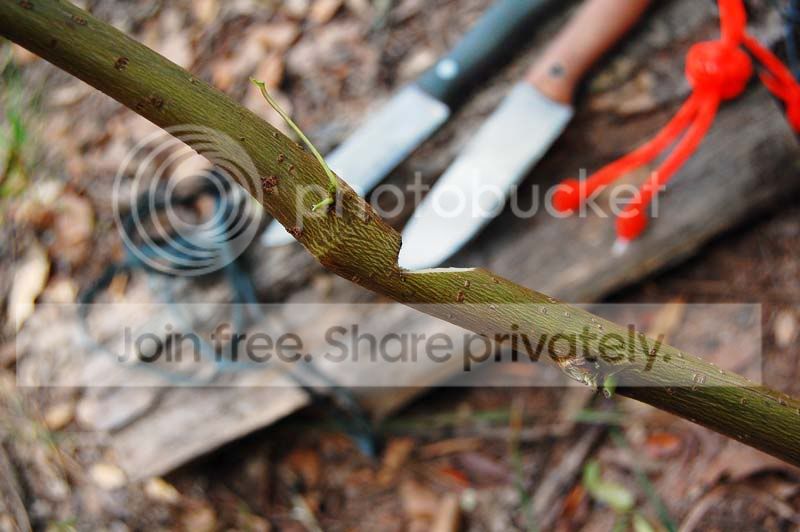
Another angle.
Fuzzsticks:
Breeden — (Well, I only made one, but I used both blades. I honestly couldn't say which I liked better.) I think the Breeden could make very slightly thinner curls easier. It did exceptionally well, despite my lack of experience with making fuzzsticks.
Fiddleback — Hard to say. Perhaps the Fiddleback cut a bit easier, but was just a hair harder to control in making thin curls. Too close to tell, really. I could chalk it up to my inexperience.
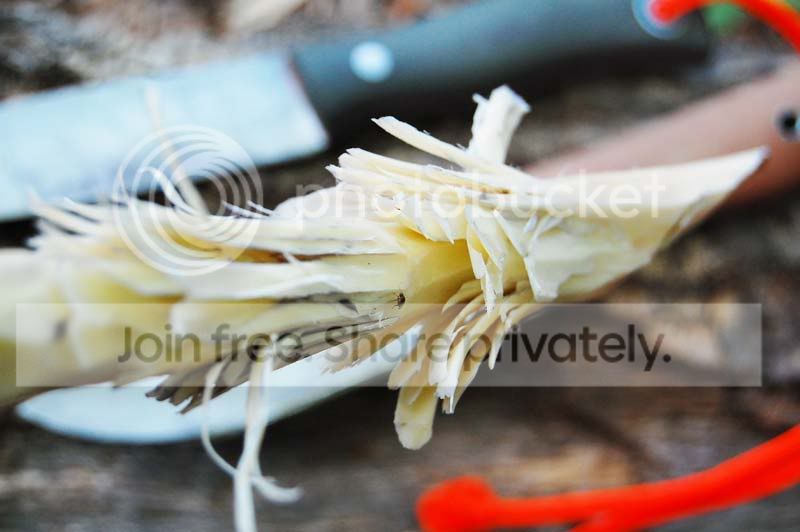
The focus is on the second set of shavings here, done by the Breeden.
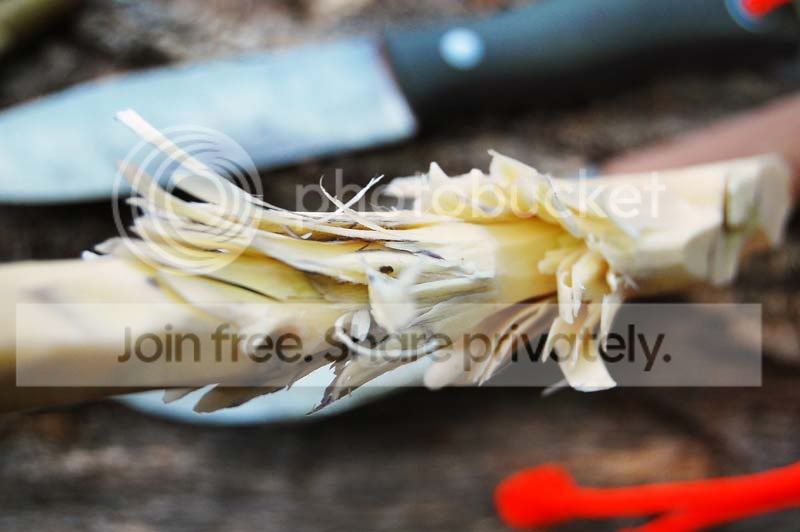
Here the focus is on the first set of shavings, done by the Fiddleback.
Drilling:
Breeden — Did very well, making a nice, fairly wide, but clean hole, cutting shavings nicely. I could easily thread a piece of 450 paracord through the finished hole.
Fiddleback — Did exceptionally well, its finer point making faster work of the drilling process, also cutting nice shavings, but making a smaller hole. Altogether, I'd prefer this one for drilling. It's easier to widen drilled holes with the point of this knife, too.
I couldn't get the trap to actually stand on its own, unfortunately. I just don't have the knack yet, and I'm not even positive I made it totally right. I was working from memory of a diagram found on the Web. I was also trying to use a garbage can lid for the deadfall, which may have something to do with my lack of success. So no pictures of it in its entirety, sorry. I have to preserve some dignity here...
All in all, though, it was a good test of practical usability for both of these fine knives, and that's the important bit, I think.
~|~|~|~|~|~|~
Final Words:
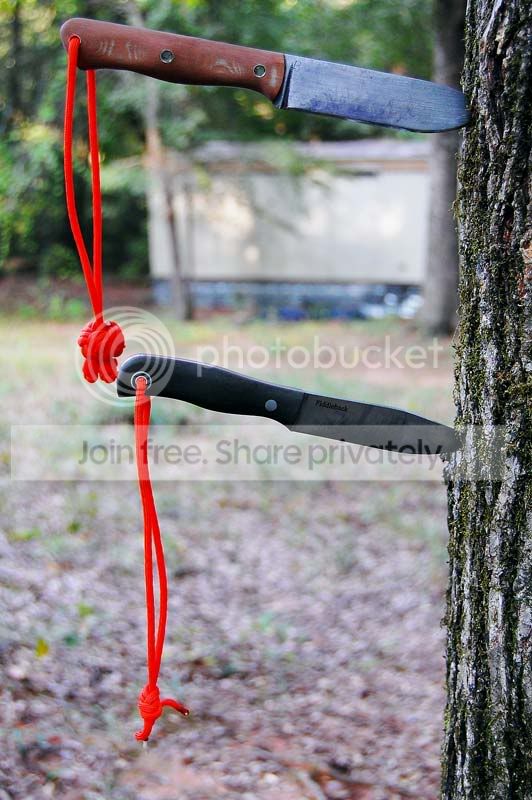
Knives In Trees thread, here I come!
The Fiddleback Bushcrafter Jr. seems easier to control and a better overall cutter of wood, excelling at deep cuts but making short work of lighter cutting too, and doing it in a most genteel manner. The handle, though small, is secure and doesn't slip, though a lanyard helps to ensure this. If I knew I was going to be doing just dedicated woodworking, I'd probably carry this knife. The blade, though 5/32" thick, is the best overall cutter I own, bar none. I'm hooked on convex grinds. This little knife is sturdy enough that I have absolutely no fear of breakage or damage out in the wilds. The sheath allows for a good range of carry options, and has a firesteel loop, which is a big plus.
The Breeden Blackwood Bushcrafter is just about the best all-around knife a guy could hope for, in my opinion. It does it all with equal ease, from slicing a tomato or onion to notching a stick for a trap. It carries easily on the belt, is light enough to not notice until you need it, and performs so well you'd never want to be without it. The handle is comfortable in a larger variety of grips, and if anything even more secure than that of the Fiddleback. The hollow stainless steel pins allow for a lanyard through any of them, if so desired. The drop point provides plenty of belly and just a tad more cutting edge, while the width sacrifices just a bit of maneuverability for that belly, and comfort on a cutting board.
At the end of the day, I'm left with no idea which one of these two blades I like best, so I'm still carrying both of them. They'll probably eventually go into an EDC rotation where I carry one on Sunday, the other on Monday, the first on Tuesday, the second on Wednesday...wash, rinse and repeat.
They actually weigh right about the same, due to the thicker steel but shorter handle and blade of the Fiddleback, but the Breeden feels lighter in hand. It balances about .5"-.75" behind the first pin, while the Fiddleback balances pretty much right at the first pin. Both just feel awesome in the hand. I'll try to take some in-hand shots tomorrow.
I'll post more as I get to use these beauties more, especially in the kitchen, and batoning. If there is anything you guys want me to test them at, or take pics of, let me know and I'll do my best. If you have any questions about either of these knives, ask away! Hope you enjoyed the read! It turned out a lot longer than I thought it would be, sorry. :foot:
Ahead of time, let me apologize for the poor pictures. I was more interested in playing with the steel than in photographing said steel, and I was losing light fast back here in the woods. Better pics will be coming, I promise!
The pair together on a handy prop, along with the toggle for the trap.
On to the reviewing! This is only a preliminary look; again—there will be more pictures later; I somehow managed to completely neglect to get shots of the sheaths, since they were both on my belt at the time. As I work with them both more I'll post more detailed reviews, and of course more pics. I'll get a few shots tomorrow, for sure.
~|~|~|~|~|~|~
First Look — Breeden Knives "Blackwood Bushcrafter":
Specs:
Blade Length: 4 1/2" (cutting edge)
Blade Thickness: 1/8"
Blade Width: 1 1/8"
Handle Length: 4 3/4"
Overall Length: ~9 3/8"
Steel: O-1
Grind: Full flat grind with convexed edge
Handle Material: Tan/Natural Linen Micarta
The Breeden is a custom that we're calling the Blackwood Bushcrafter, I posted a thread with the pic Bryan sent me earlier in the week. The pic he sent just didn't do it justice, though. This is one hell of a knife. I pretty much blatantly ripped off the BRK&T Bravo 1 handle design and contours (I'll make it up to you by buying an Aurora come spring, Mike
), had Bryan put it on a 1/8" thick flat-ground blade of O-1, a little wider than his usual fare at 1 1/8", with a nice drop point with just enough belly and a good point. The handle scales are tan linen Micarta, which I think Bryan is going to keep in stock now. I gotta say, it's absolutely gorgeous!First impressions of this knife were: Wow, it's perfect! closely followed by, Holy Two-Tailed Skunk of Doom, that's frickin' sharp!
I don't think I've ever had a knife come this sharp before. The convex edge is so highly polished I could use it for a shaving mirror, and forget shaving-sharp—the hairs just say, "forget it," and jump off seemingly before the blade touches them! It goes through newspaper (tested on the newspaper it was packed in) like it's just not there, with no weight put on it. I can just about rest the newspaper on it and it'll fall through it. The edge excels at slicing paper-thin curls, cutting and finishing notches in green wood (haven't tried notching dead wood yet) and pointing sticks. It seems just a hair thicker than I usually like, but I think that's just me getting used to a true convex edge on a flat grind. Tomatoes quiver n fear as this blade approaches, and fall away in translucent slices at its touch. Pics of that later.
The sheath is simple yet perfect for the knife. The color of the leather near perfectly matches the color of the Micarta handle scales, the leather is good quality and sturdy, and retention is excellent without it being a pain to extract. It rides low, just like I prefer, and is well-put-together with even stitching. It is on my belt as I type this, and I hardly know it's there. It rides just behind my right hip. Nothing fancy, but I love it.
The knife is exactly what I wanted. The handle feels just amazing in the hand, and is comfortable in a far wider variety of grips than I thought it would be, largely due to the length. The blade length is just perfect for just about anything, and the little bit of extra width makes it easier on the knuckles for kitchen duty. Bryan really did a superb job on executing this design. The grind lines are about as close to dead on as I've seen, handle fit and finish is excellent, and overall, two thumbs up to Bryan for this blade! :thumbup:
First Look — Fiddleback Clipped Bushcrafter Jr.:
Specs:
Blade Length: 4 1/4"
Blade Thickness: 5/32"
Blade Width: 1"
Handle Length: 3 7/8"
Overall Length: 8 1/4"
Steel: O-1
Grind: Full convex grind with secondary edge bevel
Handle Material: Green Linen Micarta
As soon as I saw this knife in a thread Andy posted here on the forum, I knew I had to have it. The combination of the beautifully shaped handle, clipped point, and that really neat bulls-eye lanyard hole design just called out to me. So I got in touch with Andy, it was available, and then it was mine.
First impressions of this one were: Dang, that handle really IS beautiful! followed closely by, This thing is beefy!
The handle fits like a glove, despite being smaller than I'm used to, or really like. It's also far more secure than you might think, due to the contours, and is really comfy for prolonged use. It's a bit limited in grip options, but not severely so. The red liners really make it snap, as does that already mentioned bull-eye lanyard hole setup. The contours are smooth, and the 'grain' of the linen Micarta shows really well. It ends a bit abruptly at the blade end, so you do have to be a bit more careful with it, but I like that as it puts usable edge right at my hand. For woodworking power cuts or fine work, that is never a bad thing in my opinion. Ergonomically, it beats out anything else I own or have held.
The fit and finish is right up there with the best I've ever seen, clean, fine grind lines, handle scales fit perfectly, everything is smooth and tight. I was disappointed, however, in one area: sharpness. It would barely scrape shave my puny arm hair out of the box. This didn't bother me for long, however, because it gave me an excuse to make that Altoids tin sharpener Siguy showed in a post here (mousepad taped/glued onto the top of an Altoids tin, sandpaper taped on top, stored inside). So I made one real quick, and in about ten minutes I had it easily shaving sharp, almost hair-popping. I started with 400 grit, which was probably too coarse actually, then went to 1500 when it would catch on my fingernail every time. I couldn't find my 800 grit, going to have to go get some more of that soon.
I also love the sheath for this one. It was made by JRE, and is a nice light-colored leather with a firesteel loop. My Light My Fire Scout Model now resides there. One of the things I like about the sheath is the way it's set up for carry: it has a belt loop positioned for a high riding carry, or a loop just the right size for a paracord loop to be fed through to make it a dangle sheath. As mentioned, I like low-ride sheaths better, so I ran a length of paracord through this loop, then through a Turk's Head knot, and finished it up with a simple overhand knot, so I have an adjustable length. The Turk's Head goes behind my belt, leaving the sheath to hang just even with the bottom edge of the belt. The sheath also has a rivet at the bottom, and a snug enough retention, that I could put it on a Merc Harness for under-the-arm upside-down carry. It too is on my belt as I type this.
~|~|~|~|~|~|~
Getting Down N' Dirty — Using Both Blades In A Practical Environment:
As soon as I got the Fiddleback touched up, I grabbed my camera and headed for the front yard to do some cutting. My front yard isn't like most; it is terraced, sloping uphill. The next terrace up is used for barbecuing in a small fire pit, plinking with the .22 rifles, and little else. Due to little use lately, it's been let grow up in sweet gum saplings, so I headed for those to start with. My plan was to make a Paiute string deadfall using both knives. I'm going to lay this out by types of cutting, and for each type I'll have two sections; one for each knife. No other tools were used.
Cutting the saplings:
Breeden — I was cutting saplings around 3/4" thick to 1" thick, and bent, 2-3 good cuts would just about sever the saplings. Though very sharp, the edge lacked some bite that a less polished edge might have.
Fiddleback — This knife really excelled here. The full convex grind just flew through the wood, one good cut being all that was needed most of the time. Though it needed some work to get to an acceptable level of sharpness (yeah, I'm going to rub that in, Andy.
), once there, it just couldn't be beat!Angling the ends of the sticks to fit in the notches:
Breeden — Here the Breeden showed its strength. The smoothly polished edge made sweet thin curls of the wood, and easily flattened the ends of the sticks at the angle needed.
Fiddleback — Though it too did great in this area, the convex grind wanted to bite in just a bit too much, and it was more difficult not to slightly concave/dish the cuts. It was a bit harder to make flat cuts with this one due to the different grind.
The finished end.
Notching:
Breeden — At first I wasn't sure, but after a while it grew on me. Very easy to control despite the slightly wider blade, made clean cuts, and did the job quickly and well. Better at making 90-degree notches like in a normal figure-four trap, and flattens the inside of the notch better, I think.
Fiddleback — Again, it excelled. It cut easier, especially for notching around the stick for string, all that was required was a rocking motion around the circumference of the stick. Also was better at making 45-degree notches like in the support stick of the deadfall.
A look at one of the notches.
Another angle.
Fuzzsticks:
Breeden — (Well, I only made one, but I used both blades. I honestly couldn't say which I liked better.) I think the Breeden could make very slightly thinner curls easier. It did exceptionally well, despite my lack of experience with making fuzzsticks.
Fiddleback — Hard to say. Perhaps the Fiddleback cut a bit easier, but was just a hair harder to control in making thin curls. Too close to tell, really. I could chalk it up to my inexperience.
The focus is on the second set of shavings here, done by the Breeden.
Here the focus is on the first set of shavings, done by the Fiddleback.
Drilling:
Breeden — Did very well, making a nice, fairly wide, but clean hole, cutting shavings nicely. I could easily thread a piece of 450 paracord through the finished hole.
Fiddleback — Did exceptionally well, its finer point making faster work of the drilling process, also cutting nice shavings, but making a smaller hole. Altogether, I'd prefer this one for drilling. It's easier to widen drilled holes with the point of this knife, too.
I couldn't get the trap to actually stand on its own, unfortunately. I just don't have the knack yet, and I'm not even positive I made it totally right. I was working from memory of a diagram found on the Web. I was also trying to use a garbage can lid for the deadfall, which may have something to do with my lack of success. So no pictures of it in its entirety, sorry. I have to preserve some dignity here...
All in all, though, it was a good test of practical usability for both of these fine knives, and that's the important bit, I think.
~|~|~|~|~|~|~
Final Words:
Knives In Trees thread, here I come!
The Fiddleback Bushcrafter Jr. seems easier to control and a better overall cutter of wood, excelling at deep cuts but making short work of lighter cutting too, and doing it in a most genteel manner. The handle, though small, is secure and doesn't slip, though a lanyard helps to ensure this. If I knew I was going to be doing just dedicated woodworking, I'd probably carry this knife. The blade, though 5/32" thick, is the best overall cutter I own, bar none. I'm hooked on convex grinds. This little knife is sturdy enough that I have absolutely no fear of breakage or damage out in the wilds. The sheath allows for a good range of carry options, and has a firesteel loop, which is a big plus.
The Breeden Blackwood Bushcrafter is just about the best all-around knife a guy could hope for, in my opinion. It does it all with equal ease, from slicing a tomato or onion to notching a stick for a trap. It carries easily on the belt, is light enough to not notice until you need it, and performs so well you'd never want to be without it. The handle is comfortable in a larger variety of grips, and if anything even more secure than that of the Fiddleback. The hollow stainless steel pins allow for a lanyard through any of them, if so desired. The drop point provides plenty of belly and just a tad more cutting edge, while the width sacrifices just a bit of maneuverability for that belly, and comfort on a cutting board.
At the end of the day, I'm left with no idea which one of these two blades I like best, so I'm still carrying both of them. They'll probably eventually go into an EDC rotation where I carry one on Sunday, the other on Monday, the first on Tuesday, the second on Wednesday...wash, rinse and repeat.
They actually weigh right about the same, due to the thicker steel but shorter handle and blade of the Fiddleback, but the Breeden feels lighter in hand. It balances about .5"-.75" behind the first pin, while the Fiddleback balances pretty much right at the first pin. Both just feel awesome in the hand. I'll try to take some in-hand shots tomorrow.
I'll post more as I get to use these beauties more, especially in the kitchen, and batoning. If there is anything you guys want me to test them at, or take pics of, let me know and I'll do my best. If you have any questions about either of these knives, ask away! Hope you enjoyed the read! It turned out a lot longer than I thought it would be, sorry. :foot:
Last edited:



 Thanks for the kind words, too. I think I kinda get carried away when I start talking about my knives.