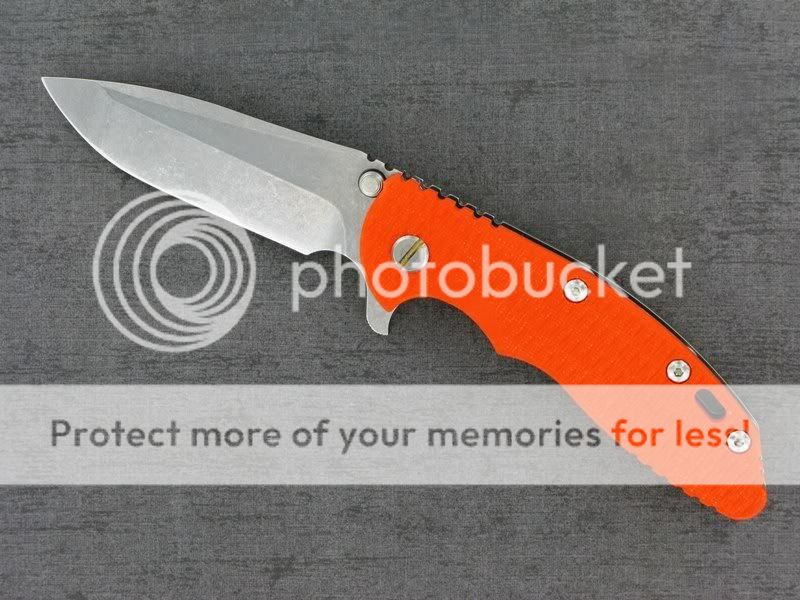
It's foolishness to sit behind a computer and say for 100% certainty that a SNG bests a Sebenza in such a vague tyerm as "Stoutness". One is better in some areas, one is better in others. That's all there is to it
I would be happy to discuss this on the phone, in person, or in whatever other modality might be desirable. In the context of a knife forum, sitting behind the computer is what we are doing, though. Sitting behind the computer and making comments.
It is true that my comments are colored by personal experience as a user. I am not speaking from the perspective of a materials scientist or an industrial engineer. Most of my engineering experience is confined to statics as used to evaluate building systems.
So... I am trying to keep this relatively simple; which as posed by O/P, I think it is.

My perspective on folders is that they are general cutting tools. An effective blade is inherently fragile, because it needs to be slender enough to cut well, and it needs to be hardened beyond its structural strength range. If we were going to design a folding breaching tool that did not need to cut, we could relax the cutting parameters and end up with a much more robust tool.
Just slicing things with any of these knives is not going to come close to inducing structural failure. So in that sense, they are all over-designed, and they would all perform much better if material was removed from them. As you step off the basic cutting path and start to pry, or perhaps force the knife through a sheet of material and twist it, etc., significant loads start to develop.
This isn't rocket science. You just trace the load path into the knife and find the weak link. In the case of a Large Sebenza, the tip of the blade is going to fail at a pretty low threshold laterally. But it has a much better cutting geometry than the SnG. So a Sebbie isn't very good for opening paint cans, or even prying heavy staples out of a drawing set. I could do either of those all day long with a 0.20 Game Warden, though.
Next thing would be a higher load farther back on the blade. If it were lateral, the blade itself might fail. If it were axial or torsional, the pivot starts to present itself as the weak link.
I think of the stop as part of the pivot. Either way, axial loads continue past the pivot into the stop and/or lock, depending on direction. All of these load paths can be demonstrated either mathematically or with physical testing. It's easy enough to see where the weak links are for a given load path.
You are correct that I'm not considering much in the way of dynamic loading - largely because I don't use folders this way. The kinds of things I might be inclined to do with a pocket-sized knife are more like prying and twisting with the first 1/4 or maybe 1/3 of the blade. Increasing those forces too much is going to result in blade failure. So you're back to cutting geometry vs. prying capability - until you switch blade materials.
I don't have any Striders in S30V. I've also never done anything with either the Striders or my CRK's that caused any sort of failure. Just based on my experience with use and sharpening, my guess is that a Sebenza blade would be more inclined to chip along the edge due to moderate impact loads than the SnG would; but that is just a guess.
So anyway... considering a general scope of use for folding knives, and moving out into some more potentially damaging but still rational areas of use, I think it's perfectly reasonable to characterize the SnG as "stouter" or "more robust" than the Sebenza. And conversely, the Sebenza performs better than the SnG at basic cutting tasks, and will continue to do so over a long period, owing to its grind geometry.