Im making scales for a texas toothpick ive made and I have some slivers of african blackwood and it seems a perfect material for me, im just wondering about treatments, the wood is dry(I got it from a Cabinet maker)do I need to give it a treatment before assembly to stop i warping and what have you?

-
The BladeForums.com 2024 Traditional Knife is available! Price is $250 ea (shipped within CONUS).
Order here: https://www.bladeforums.com/help/2024-traditional/
You are using an out of date browser. It may not display this or other websites correctly.
You should upgrade or use an alternative browser.
You should upgrade or use an alternative browser.
un treated african blackwood for scales?
- Thread starter squazy
- Start date

- Joined
- Oct 4, 2010
- Messages
- 1,315
African blackwood (sometimes called grenadilla) is a relative of Brazilian Rosewood and Cocobolo. Contrary to popular belief, it isn't related to Ebony, which is a different genus entirely. It is an extremely dense and somewhat oily wood, similar to rosewood - and definitely less brittle than ebony. Blackwood is used as a "tonal" wood in the manufacture of musical instruments.
I doubt it would stabilize very well, but I could be wrong. I definitely like the way it works with hand tools - very consistent and minimal tear-out.
TedP
I doubt it would stabilize very well, but I could be wrong. I definitely like the way it works with hand tools - very consistent and minimal tear-out.
TedP

Stacy E. Apelt - Bladesmith
ilmarinen - MODERATOR
Moderator
Knifemaker / Craftsman / Service Provider
- Joined
- Aug 20, 2004
- Messages
- 38,514
I muse it all the time. It does not need stabilization, and from what I hear, doesn't take stabilization well.
Sand to 800 and buff to get a nice finish. Just like any good wood, avoid heat in sanding and buffing.
Sand to 800 and buff to get a nice finish. Just like any good wood, avoid heat in sanding and buffing.

Horsewright
Knifemaker / Craftsman / Service Provider
- Joined
- Oct 4, 2011
- Messages
- 14,044
I've used it a lot too. Follow Bladsmth's advice and you'll be happy. I use pink scratchless to buff and then follow with a coat of wax.

- Joined
- Dec 3, 1999
- Messages
- 9,437
I've used it a couple dozen times over the last 20 or so years... it's one of my favorite woods. It's one of the most dense (I believe it's 80+ pounds/cubic foot!!!), it has an excellent feel, it's a dream to work with (assuming you use sharp bits, blades, broaches, abrasives), even without being stabilized you can polish it to a near mirror shine (if you wish), its coloring goes with nearly ANY blade steel/style/finish, and it's a very stable wood.
For the longest time, I didn't think it could be stabilized, but my friend Chuck Bybee at Alpha Knife Supply has provided me with some blocks that were professionally stabilized. I'm not sure if he had it done at WSSI or K&G.
The only drawback to AB, is the color is so dark, it's hard to see the figure unless you have the knife in sunlight.
For the longest time, I didn't think it could be stabilized, but my friend Chuck Bybee at Alpha Knife Supply has provided me with some blocks that were professionally stabilized. I'm not sure if he had it done at WSSI or K&G.
The only drawback to AB, is the color is so dark, it's hard to see the figure unless you have the knife in sunlight.

Hengelo_77
Basic Member
- Joined
- Mar 2, 2006
- Messages
- 6,319
handsand to 2500 and you won't be able to put it down.
So shiny, and smooth, and, and, and
So shiny, and smooth, and, and, and

- Joined
- Oct 19, 2005
- Messages
- 20,015
When you purchase dense oily hardwoods stabilized, how can you be sure they soaked up any of the solution? You cannot. Even if they did, what good did it do but make them slippery?
This wood is excelldnt without stabilization. And it provides excellent contrast with micarta pins. It has a 'formal' feeling to it. Classy. (Big seller $$$)
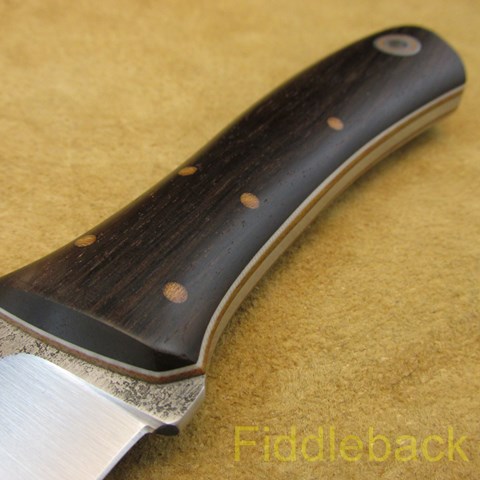
This wood is excelldnt without stabilization. And it provides excellent contrast with micarta pins. It has a 'formal' feeling to it. Classy. (Big seller $$$)

jdm61
itinerant metal pounder
- Joined
- Aug 12, 2005
- Messages
- 47,357
You want to see figure in blackwood? Sheesh!!!  I want the jet black instrument grade stuff and if it does have some brown, I oil it until it goes away. For me, blackwood is the "substitute for ebony,the "color" more than the species, so to speak. It does work very well. I have tried the stabilized stuff once. It worked very well, but I don't really see the point.
I want the jet black instrument grade stuff and if it does have some brown, I oil it until it goes away. For me, blackwood is the "substitute for ebony,the "color" more than the species, so to speak. It does work very well. I have tried the stabilized stuff once. It worked very well, but I don't really see the point.
I've used it a couple dozen times over the last 20 or so years... it's one of my favorite woods. It's one of the most dense (I believe it's 80+ pounds/cubic foot!!!), it has an excellent feel, it's a dream to work with (assuming you use sharp bits, blades, broaches, abrasives), even without being stabilized you can polish it to a near mirror shine (if you wish), its coloring goes with nearly ANY blade steel/style/finish, and it's a very stable wood.
For the longest time, I didn't think it could be stabilized, but my friend Chuck Bybee at Alpha Knife Supply has provided me with some blocks that were professionally stabilized. I'm not sure if he had it done at WSSI or K&G.
The only drawback to AB, is the color is so dark, it's hard to see the figure unless you have the knife in sunlight.

- Joined
- Dec 7, 2008
- Messages
- 7,187
First I want to say I like Joe M and consider him a friend.
With that said I will now disagree with him.
Natural Blackwood can show all kinds of wild looks.
I have had pieces that showed a metallic flash in silver, green and purple. Looked black at first glance until you moved it around in the light then the colors would appear.
Also there will sometimes be pieces with burl figure that shows itself with sort of a silver-ish flash.
Now to agree with Joe.
The black natural stuff polishes up beautifully and takes on a glassier finish than I have been able to obtain with ebony.
In my opinion it is one of the easiest Rosewoods to work and finish.
In old posts by Chuck B, I remember his comment that the figure disappeared in a burl piece that he had stabilized.
Talking to Chuck in person he told me that the Blackwood took stabilizing well and finishes with a nice satin look.
With that said I will now disagree with him.
Natural Blackwood can show all kinds of wild looks.
I have had pieces that showed a metallic flash in silver, green and purple. Looked black at first glance until you moved it around in the light then the colors would appear.
Also there will sometimes be pieces with burl figure that shows itself with sort of a silver-ish flash.
Now to agree with Joe.
The black natural stuff polishes up beautifully and takes on a glassier finish than I have been able to obtain with ebony.
In my opinion it is one of the easiest Rosewoods to work and finish.
In old posts by Chuck B, I remember his comment that the figure disappeared in a burl piece that he had stabilized.
Talking to Chuck in person he told me that the Blackwood took stabilizing well and finishes with a nice satin look.
jdm61
itinerant metal pounder
- Joined
- Aug 12, 2005
- Messages
- 47,357
Mark, i know that it CAN show figure. I just don't want it to.  You know I love the rosewood family in general, but to my eye "lighter" blackwood is not nearly as attractive as its more reddish-brown cousins. I feel the same about striped ebony, without getting into why I hate to work the stuff.
But seriously, aside from being very attractive in whatever form you prefer, blackwood is, like the other members of the dalbergia family that we use is an excellent handle material not only for the customer, but for the knife maker who has to work with it. The only problem that you might run into is that you can develop an allergic reaction to some of the species.
You know I love the rosewood family in general, but to my eye "lighter" blackwood is not nearly as attractive as its more reddish-brown cousins. I feel the same about striped ebony, without getting into why I hate to work the stuff.But seriously, aside from being very attractive in whatever form you prefer, blackwood is, like the other members of the dalbergia family that we use is an excellent handle material not only for the customer, but for the knife maker who has to work with it. The only problem that you might run into is that you can develop an allergic reaction to some of the species.
First I want to say I like Joe M and consider him a friend.
With that said I will now disagree with him.
Natural Blackwood can show all kinds of wild looks.
I have had pieces that showed a metallic flash in silver, green and purple. Looked black at first glance until you moved it around in the light then the colors would appear.
Also there will sometimes be pieces with burl figure that shows itself with sort of a silver-ish flash.
Now to agree with Joe.
The black natural stuff polishes up beautifully and takes on a glassier finish than I have been able to obtain with ebony.
In my opinion it is one of the easiest Rosewoods to work and finish.
In old posts by Chuck B, I remember his comment that the figure disappeared in a burl piece that he had stabilized.
Talking to Chuck in person he told me that the Blackwood took stabilizing well and finishes with a nice satin look.
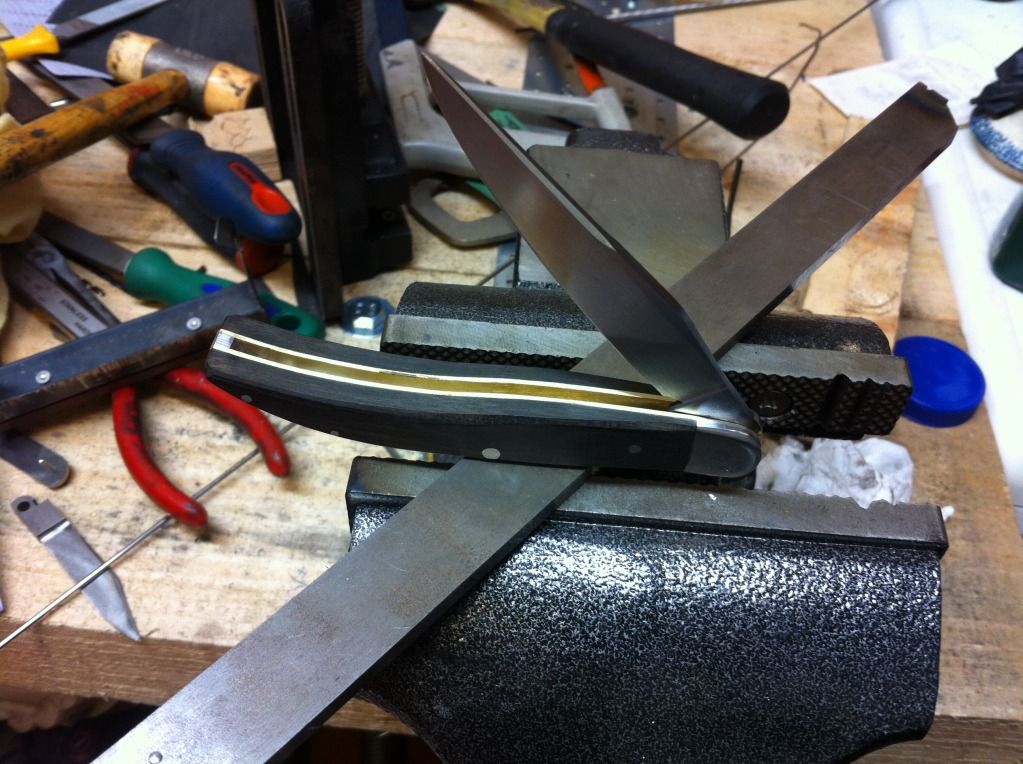
this was just a quick mess about while i was waiting for bushings back from the machinist for the lockback whittler, glad I did it as I made plenty of simple mistakes as its been over ten years since I made a knife, the wood is beautiful material to work with,this could have been executed much better if I had taken my time a bit


- Joined
- Nov 20, 2011
- Messages
- 5,023
Looks really good! Nicely done.