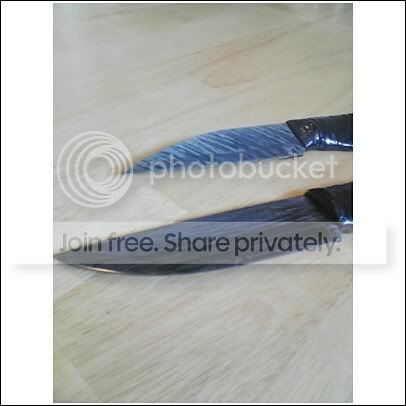
Uneven/Spotty vinegar patina?

Joined
Nov 29, 2005
Messages
475
I tried to give a blade a vinegar patina last night, and it didn't work out. I could see as it darkened, that one spot (Where the blade met the handle) wasn't going to darken. I tried to do a mustard patina over it to even it out, but it stayed relatively bright and patina-free. I ended up just polishing the blade back to a shiny finish.. but I'd like to know what happened there. The blade was edge-quenched 1095, washed well and dried before putting the mustard on (to make sure oil wasn't keeping the patina off)
 
Don Fogg did a demo at Ashokan last year where he showed the process by which he etches his blades... he took a LONG time going over and over the blade with 409 (he insisted repeatedly that he preferred Fantastic for this, as it works much better for him) in order to make sure that the steel was perfectly free of oils and such. If water didn't form a complete sheet over the blade (with NO beading or other anomalies ), he'd spray it and wipe it again. Must've taken him 15 minutes to get the results he wanted, and even still you could tell he was upset that he didn't have Fantastic. I know that every time I tried vinegar the results similar to yours, and sure enough when I went back to rinse the blade, it wasn't quite as clean as I had thought!
 
Cool thread, I'll try Fantastic. Casey's Cleaner/Degreaser has been working pretty well for me. It's mostly just alcohol, I think.
 
FWIW, A.G. Russell recommends cleaning the blade with WD-40 or very hot water.
 
WD-40 kind of surprises me, why would you want silicone on the blade?

I just checked an A.G Russell catalog to confirm my earlier post, and he recommends this cleaning before application of his product RustFree.

But I've heard from others also that WD-40 is a good cleaner for metal.

BTW, I wonder what kind of residue Fantastic or Formula 409 leave on surfaces, even after they're wiped off.
 
They're supposed to remove residue, IIRC...


WD-40 definitely leaves a coating...supposed to do that.
 
They're supposed to remove residue, IIRC...

supposed to remove "dirt", for sure, but I'm pretty sure they leave some type of residue. You can even see it on certain types of surfaces.


If you want very clean metal, you can wash it with hot water and
a quality dish detergent. Rinse if off with very hot running to cool water, dry it with the proverbial "lint free cloth",
and you have a squeaky clean surface. Residue has been removed by the product and the water and the cloth.
 
I tried to give a blade a vinegar patina last night, and it didn't work out. I could see as it darkened, that one spot (Where the blade met the handle) wasn't going to darken.


Is it possible some epoxy squeezed out and didn't get cleaned completely off? If you protect this area with wax, the epoxy won't stick.
 
I've liked the Loctite products I've used at work, and others here seem to hold their stuff in high regard as well. :thumbup: Maybe I'm just lazy, but I tend to stick with brands that have "walked the walk" for me in the past.

For that matter, maybe the A.G Russell RustFree is designed to work well with WD-40. I think he knows what he's talking about.
 
Couple of things here:
First, some of you are talking apples and oranges. Blue Dragon was etching a blade, not oiling it. Rust Free is a blade oil that prevents rust. Etching is a chemical activity that requires totally clean surfaces for the etchant to react with.WD-40 would be his worst enemy.

Second, without a photo or a more detailed description, it is hard to tell what the problem is. Is this an assembled knife. What kind of blade material? Soldered or epoxied guard? etc.

Several possibilities are:
Contaminant on blade - oil, grease,epoxy.
Solder flowed up onto blade and amalgamated with blade steel.
Slag or other metal inclusion in the steel from forging.
Differential hardening/tempering at that spot.
Gnomes crapped on your blade while you weren't looking.

Stacy
 
If you want very clean metal, you can wash it with hot water and
a quality dish detergent. Rinse if off with very hot running to cool water, dry it with the proverbial "lint free cloth",
and you have a squeaky clean surface. Residue has been removed by the product and the water and the cloth.

That is what worked for me!!
mustardpatina.jpg

I did 8 or 9 applications.The finish is pretty durable too I did'nt scratch it yet and I have been cutting everything in sight.
 
I clean the blade with acetone and a clean paper towel. Then I etch the blade for 15-20 seconds and see what is going on. If there are any problems I take a dry paper towel and pumice stone and rub off the etch. This cleans the surface but does not leave a residue. Then repeat until satisfied. I do a final couple of polishes with as fine a grit as I have, currently 50,000.

Chuck
 
It was 1095, stock removal, edge quenched... no soldering or anything like that. the culprit would have to have been oil/dirt/whatever. Also, I think maybe the blade didn't get rocked down quite fast enough, making the quench line come a little short of the plunge line.
 
If you want very clean metal, you can wash it with hot water and
a quality dish detergent. Rinse if off with very hot running to cool water, dry it with the proverbial "lint free cloth",
and you have a squeaky clean surface. Residue has been removed by the product and the water and the cloth.

That is what worked for me!!
mustardpatina.jpg

I did 8 or 9 applications.The finish is pretty durable too I did'nt scratch it yet and I have been cutting everything in sight.

Good to hear!

Yes, that's what the stuff is designed to do, and it works well.
Tried and true. :thumbup:
 
Back
Top