Unintentional hamon???

Joined
Aug 12, 2006
Messages
1,302
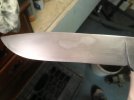
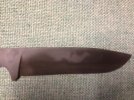
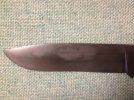
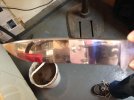
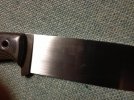
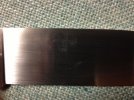
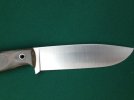
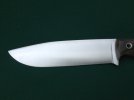
So far I have tried FeCL etching two 1084 (Aldo) knives and have run up against something similar in both but the one in the pictures is more extensive than the other. I outsource my HT and have tried to learn but still know very little about the heat treating process and how it effects the molecules in the steel, etc. I assume this occurs due to the same principal behind achieving an intentional hamon but maybe somone can shed some light for me. Is this common and or unavoidable or the other way around? Did I do something wrong in my post heat treat grinding? I post HT grind without gloves and have been very careful not to overheat.

The first pics are after a light etch and scrub. The second set are much darker and are basically untouched after the soak.
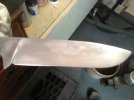
blotch.JPGblotch1.JPGblotch2.jpgblotch3.jpg

Thanks as always.
 
Could be, should talk to whomever does the HT. Could also be any number of other things. Is the steel very clean when you etch it. Its gotta be spotless, any contamination will affect how it gets etched. One last thing is even grinding of all the decarb layer and what not from HT, if any of this is left on it will show up similar to what you have. Now not saying thats it just throwing out different possibilities.
 
Hand sand it and polish it out!! Lets see whats hiding in there! You can achieve a hamon by quenching with OUT clay. Just the right geometry, heat, and precise quenching must be done to achieve it though. Do what was suggested above and if its still there polish that sucker out! ;)
 
Steel was cleaned with acetone then denatured alcohol and should have been good to go. No decarb as this one was hand sanded after two previous failed (and deep) etchings and was at one point sporting a mirror finish. photo.jpg It is definately not on the surface because of the matching marks on both sides.

When you say "polish it out," do you mean with the intent to highlight it? If so, how would hand sanding it fit into its development?
 
Last edited:
Without specific info on the heat treat this is mostly speculation but I have seen this kind of hardening activity with 1075 and 1084 in the past. Too low an austeninzing heat and/or too slow a quench is my guess.
 
I've seen similar behavior with 1080 on a few blades (with what was probably a slowish quench oil.) I thought it was kind of cool and etched/polished to bring it out.


I did the H/T and my first thought was decarb. but thats been ruled out. I did these blades the same way I always do 1084. Heat to 1500, soak for a couple of minutes, quench in Parks 50, & temper. I don't play with hamons so I have no idea whats going on here. If they don't perform as they should please let me know. I will do whatever it takes to make it right.
 
I'm sure they'll perform just fine, Darrin. No worries. Still just experimenting and seing what works for me so I don't have customers to worry about. I take it then that this is not very common so could it have something to do with me having these heat treated twice due to my mistake?
 
I forgot about that, it may have something to do with it. Maybe someone with a little more metallurgical knowledge will chime in.
 
I have had a couple of 1084 blades do that on me as well. They sure made good knives though.
 
I brought out the "hamon" in the knife above and I think it looks okay but the people I show it to all think it's maybe not all that great. So, the next knife I worked on from that batch started to show the same issue as the other two and I got frustrated and put a damn handle on it. Now I wish I didn't because I'm not at all happy with the finish. Lousy photos but I hope at least the idea comes across.a.jpgb.jpg

My question to you guys is do you think I can get away with stonewashing it now even with a handle on it? The handle is G-10 btw. I wouldn't mind ruining the finish on the G-10 as long as as stone damage would only be confined to the finish and not deep enough to require heavy sanding.

Thanks!
 
What were you planning to use as a tumbling medium? Ceramic or rocks?
I think the ceramic medium will just dull up your g10, but rocks might leave some serious marks.
Just a guess though.
 
Hey Leif. I have both ceramics and rocks but no actual tumbler so I was just going to improvise. It's probably not worth it though so I'll may just give it away and move on to bigger and hopefully better projects. I think I'll just abandon the rest of this batch, at least for now.

I'd like to see some of the stuff you've been working on. Those friction folders were looking real nice.

Thanks.
 
Soak it in white vinegar for 10 minutes. You will get a medium grey finish.
 
I could give that a shot but if it acts like the FeCl did on my other knives it would just highlight the areas I'm just trying to hide. Right?
 
I find the vinegar gives an even color, and shows the hamon after polishing, as the different lines polish differently.
 
If you're trying to get rid of it completely just do a scothbrite belt finish. Easy to do and won't mess with your G10 much. Make er a great usin' knife. Personally I find your top pics quite cool. I'd of left it alone as long as the knife cuts good.
 
Luckily for me my first Scotchbrite belt (VF) came in this week. Worked like a charm! Better than I could have hoped for, in fact. Thanks for the help.

photo-90.jpgphoto-91.JPG
 
Back
Top