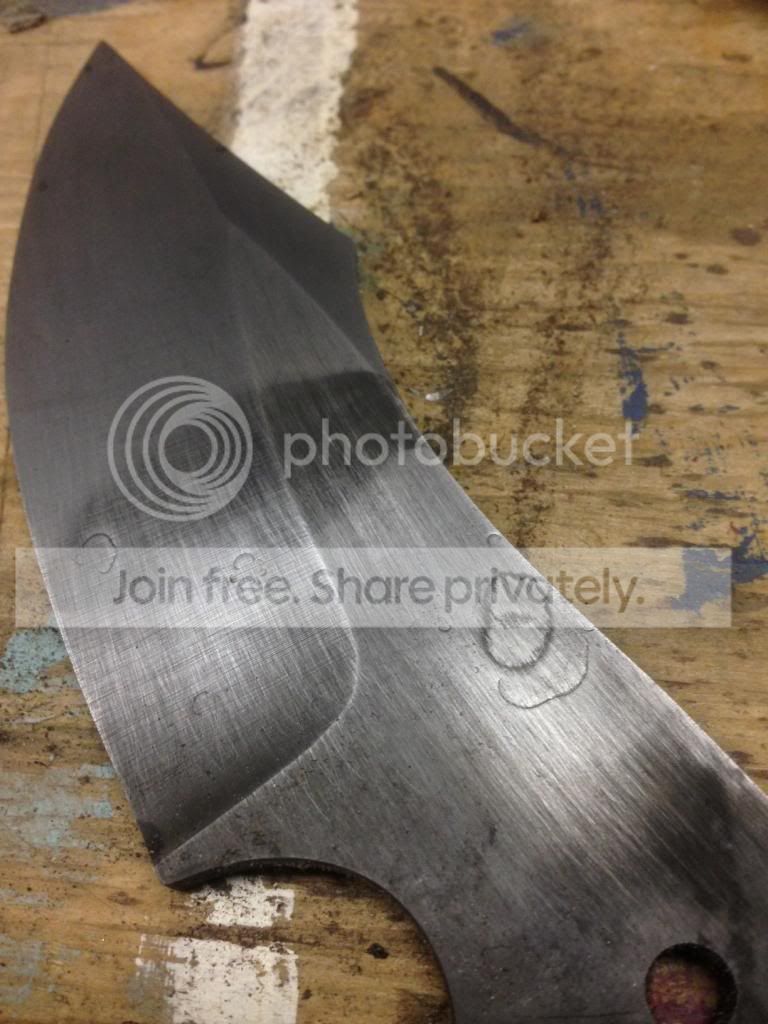
unknown marks on quenched blade

Joined
Nov 7, 2013
Messages
262
They look like hairs? I ran two blades through my new evenheat for the first time yesterday, both from different bars of O1 , quenched in transmission fluid and both have these, the other blade there are complete wobbly loking circles almost.

 
I have sectioned pieces like this and examined them under a microscope.

They are surface cracks,(uneven quench cracks) they may only be .005 or .010 deep, or they may go half way through the blade, your going to have to grind them down and see if they disappear. They were probably caused by bubbles forming on the blade when it was quenched. I've never used transmission oil so I don't know how it acts.
 
They have the look of cracks, though I've never seen any so...um...curved before. It seems you got lucky and they showed up before reaching the end of post-HT polishing. I've never used transmission fluid for quenching, but both canola and peanut oil have worked for me in the past with no cracks (so far) in O1. Have you made blades from O1 before? It may be a difference in steel chemistry; I had the unfortunate experience of using a "bad bar" of O1 a few years ago.
 
Thanks for the input guys , this is the first quench I've really tried. I'm pretty new to knife making and have only tried grinding O1 so far. This is blade #6 for me, There are two blades with this marks both from different bars of O1, one is 3/16 one is 1/8 heated to 1500 and soaked for 10 minutes in an evenheat. I heated the trans fluid on a burner,. Could it have boiled causing bubbles in the fluid itself? Thanks again for the input .
 
Get a better quench medium. Even canola oil would be better and healthier for you than ATF. Do you allow your kiln to equalize itself at 1500F before putting your blade in? Some folks just put their blades in and press start... that's a big no-no. Temperatures can shoot several hundred degrees higher during ramp up procedures.

I see people posting these bubble patterns a lot with O1. For whatever reason, it seems more susceptible to decarb issues.
 
I have the same marks on the blades that I had Delbert quench for me. I know the heat treat is good and that he used a good medium, but I sill have those weird bubble marks.
 
Quenchant questions notwithstanding, the thing I am noticing is that the blade was heat treated while still having very rough surfaces.
 
Thank you all for the replies

Quenchant questions notwithstanding, the thing I am noticing is that the blade was heat treated while still having very rough surfaces.
I was under the impression that a lot of guys heat treated their blade only using very rough grits,. then finishing after HT? I actually thought I went too far using to 220 before HT. Then I used a scotch brite pad to get some of the scale off. What do you recommend taking the blade to before heat treat?


Get a better quench medium. Even canola oil would be better and healthier for you than ATF. Do you allow your kiln to equalize itself at 1500F before putting your blade in? Some folks just put their blades in and press start... that's a big no-no. Temperatures can shoot several hundred degrees higher during ramp up procedures.

I see people posting these bubble patterns a lot with O1. For whatever reason, it seems more susceptible to decarb issues.

This was my first heat treat attempt,. I set the kiln to ramp to 1500 as quick as the settings would allow. So if I let it get to temp first then put the blades in.. there is a soaking cycle set at 10 minutes once it hits 1500, do I need to increase this time? I'll give the Canola oil a try, the transmission fluid was pretty awful for smoking out my shop.

Mark, did you agitate when you quenched the blade?

I stuck the blade in quickly edge first, and moved it around side to side once it was in there.
 
I have not heat treated myself yet but from what I have researched transmission fluid is not a good medium to quench in, and agitating the blade side to side can cause warpage. You want to move it forwards and backwards as if you were slicing something.
 
Side to side agitation is not good !, Edge to spine OK . The agitation breaks up the bubbles formed during quench.
 
It looks like it was overheated to me. Like Rick said, let your oven get to temp before you put the blades in.
 
I was under the impression that a lot of guys heat treated their blade only using very rough grits,. then finishing after HT? I actually thought I went too far using to 220 before HT. Then I used a scotch brite pad to get some of the scale off. What do you recommend taking the blade to before heat treat?

I can't speak for what "a lot of guys" do. I can only tell you that before I send my blades to HT, I sand them to at least 400 grit THOROUGHLY. Deep gouges and pits are a lot easier to get out before HT. What I saw in your picture was not thoroughly sanded to 220 grit. I saw grind lines going both horizontally and vertically, and they were DEEP gouges. If you're using 220 grit at all, you aren't doing much with it. When I'm done with 220 grit the finish is much smoother.

- Greg
 
Several things:
1) Do not use ATF. It is a terrible quenchant and the smoke is not healthy. As Rick said, get some quenching oil. At the minimum, use canola oil.....2 gallons of it. Too small a quench bath will; cause ail sorts of problems.
2) NEVER move the blade from side to side. Move it up and down or in a slicing motion.
3) The oven should be at the target temperature for a few minutes before putting in the blade. Once it returns to target, then the soak time starts. The best way to do this is to program a pre-heat step. Have the oven ramp to 1200F and hold for 5 minutes, then ramp to 1500F and hold for 10 minutes. Place the blade in the oven when it gets to the 1200F step.
4) The surface should be smooth before HT. I go to 400 grit, others to a minimum or 220.

I suspect that the quenchant and technique was most of the problem.

If you get a chance to check your oven's accuracy, it is a good thing. Either use a few pyrometric cones or bower a pyrometer to see how the Evenheat's TC is.

 
The best way to do this is to program a pre-heat step. Have the oven ramp to 1200F and hold for 5 minutes, then ramp to 1500F and hold for 10 minutes. Place the blade in the oven when it gets to the 1200F step.
From my own experience with a Sugar Creek kiln, I have to disagree with this procedure. The testing I did(on several occasions) showed that even on a slow ramp up from 1300F the infrared overheating of thin cross sections was significant. I used three independent pyrometers ... 2 standard K-TCs and one thinner, more sensitive TC. From 1300F to 1500F I experienced temperature spikes above 1700F. The kiln's readout only showed a 100F spike. I have never tested an Evenheat or Paragon but they appear to be of similar build.
 
Back
Top