Unsettling feedback

Joined
Jan 12, 2016
Messages
101
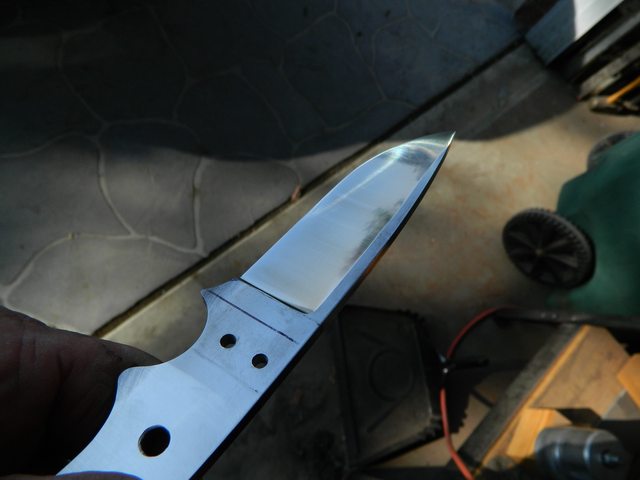
So I have a customer who is my guinea pig whenever I get a new steel in or have a style I want to try out. He loves the deal because all he pays for is 'materials and I gain the experience without much loss. He approached me this evening stating he has a couple flaws in one of the knives I've made and wanted to bring it to my attention. The knife is a lime cutter I had made because I had just enough left in the bar of 440c to pull it off. When he received it I pointed out the one line caused by turning the blade into the platen when grinding, no problem. The flaws he is seeing now is chips in the bevel 1/3 and 3/4 the way up the grind. Now when I was finishing it I did a very thorough check with 5x magnification to check for any stress marks or cracks and found none. My worry is due to I did my HT in a forge vs, an oven I wasn't able to retain the soak at a constant temp and caused microscopic cracks when I quenched. The only other thing I can think of is when grinding because my shop was maybe 35deg that I cooled it too harshly it my water tank from the heat of the belt. I have not yet seen these chips and wont for a few days but I would like some sort of what may have happened before hand since Ive known of this for only a couple hours and its haunting me. I will take literally any insight because other than the stated possibilities I'm stumped.
 
Well, for one thing-you have no idea how to heat treat 440-C. Nor do you have the equipment to heat treat 440C.
 
Idea yes, equipment you are spot on. As stated above this was 100% an experimental endeavor and with the research I had done prior and am currently doing I cannot find anything to explain why there are chips forming as my "guinea pig" claims no misuse or dropping of the knife.
 
Because your heat treat was wrong. You can not heat treat 440C without expensive controlled heat ovens. You don't quench 440C in water.
Stainless steels are best sent to professionals for heat treatment.
 
HD,
You need to stop being defensive and listen to Bill. I have no idea where you got the information you used to do your HT wit, but 440C can not be hardened in a forge without catastrophic results. It requires wrapping it in a stainless foil packet, controlled temperatures, steps, and soak times in a programmable HT oven, and it is cooled between aluminum plates or in air ... not quenched in any liquid.


FYI, you can't stress or crack steel by dipping it in cold water while grinding. There is no structur or phase change

Fiorst thing I suggest you do is read a book or some online articles on HT of knife blades and specifically Ht of stainless steels. Reading up a bit on metallurgy would help, too.
Second thing I would suggest is you refund any money the "guinea Pig" paid you for that knife. I woulkd not charge for any knife that you are using as a learning experience. If he is testing the knives for you, his "pay" is the knife.
 
The high carbon, high alloy, highly spheroidized steels have their carbon locked up in big balls of carbide when you receive them. Getting them to temp (or over temp) will allow them to get hard, but a short soak doesn't give the carbon time to even out. There may be plenty of carbon in solution, but the concentration is all over the place. You end up with a messy mixed structure that may skate a file but will be weak and crumbly.

440C needs a good long soak at an accurate temperature and is ill suited to a forge. I'm sure someone out there has got it to work, but there's probably a lot more people who just think they got it to work, but it actually just sucked.


People need to put more energy into testing their work.
I see lots of stupid shit out there that leaves me scratching my head (present company excluded, of course). People selling work have an obligation to know WTF they're doing. So I applaud the OP for doing his homework and learning about this before making and selling a bunch of forge hardened 440C. :thumbup:

...just my opinion...
 
"because I had just enough left in the bar of 440c to pull it off."

What did you make with the rest of the 440c, and how did it turn out?
 
So I have a customer who is my guinea pig whenever I get a new steel in or have a style I want to try out....all he pays for is 'materials and I gain the experience without much loss...

... I would not charge for any knife that you are using as a learning experience. If he is testing the knives for you, his "pay" is the knife.

No ofense to anyone here because I deeply respect this place and the community. BUT I would GLADLY pay the cost of materials to almost any of you knife makers as you tried out new styles or processes. You guys have enough experience that I would expect your success rate would be reasonably high and I would be getting a few unique beautiful knives for the cost of materials. I wouldn't bat an eye at the fails. Even if they failed 4 to 1 I would be getting a screaming deal.
 
Thank you Nathan that is exactly what I was looking for. Now Bill I am not dismissing what you saying and again please read what was said in the original post. I did not quench in water, it was quenched in parks. Also as stated I asked if the flaws could originate from the use of a forge vs. an oven. Bo the rest of the bar is sitting on a shelf profiled in a Nakiri I plan to send out to Texas knife for HT so I can achieve a precise RC and minimal chance of warpage. Lastly Stacy to be clear I was stating to Bill that I was aware of my lacking equipment, which negates your claim of being defensive. Aside from owning many Stainless knives I will be the first to admit ignorance on it's composition, hence the trial. As far as my HT with the exception of wrapping and soaking in an oven I replicated the procedure in my forge via its specs. It was a royal pain and very likely not worth the hand and forearm cramping that was endured in the process. I can understand why the thought of all this would set off red flags as the process for 440c is thoroughly documented, but this instance was a "hey I have a bit left let's try it out" scenario. So in conclusion thank you again I have all I need to move ahead on this issue.

Sent from my SM-G900R4 using Tapatalk
 
Water or oil, makes no difference. As Stacy correctly pointed out, 440c is an air hardening steel. Any quench is wrong. Trying to HT stainless in a gas forge is a fool's errand. The longer soak times and narrow windows for temp just ain't happening in an open gas forge.I am far from an expert, but the most cursory research on heat treating stainless makes this fact clear. I don't have a heat treating oven either, hence why I only work simple carbon steels for now.

Sent from my XT1095 using Tapatalk
 
Agreed and in the journey of finding my own preferred steels I am finding I very much prefer 0-1, W-2, and 1095/1080's for their workability. I have nothing against stainless but dollar for dollar it's not practical for me to tell a customer I can meet their budget with my own available epuipment using it. So for now I will continue to grind out profiles, send em out and likely eat some cost with the added HT charges. Such is life

Sent from my SM-G900R4 using Tapatalk
 
Regarding oil, I believe it is acceptable for small "less critical" parts to be quenched in oil, but for larger items that need consistency throughout treatment, really need to be done in an oven at a controlled and consistent temp.

I'm also curious how you were sure you were at or around 1805F to 1950F, and how scale wasn't a significant issue.


BTW, also regarding oil quench, this was at the very top of my Google results for 440C Heat Treat:

Process anneal, heat uniformly to 1350/1400 (732/760c), air cool brinell hardness aprox 255. Hardening: Heat 440c stainless steel to 1850/1950f (1010/1066c) soak, quench in warm oil or air cool. Do not over heat, when overheated maximum hardness cannot be obtained
 
Last edited:
The specs for my forge claim 1800 as being max temp. That being said I wasn't sold until I knew it passed the file test. As stated by Nathan that doesn't mean diddly as who knows what's goin on inside structurally

Sent from my SM-G900R4 using Tapatalk
 
Agreed and in the journey of finding my own preferred steels I am finding I very much prefer 0-1, W-2, and 1095/1080's for their workability. I have nothing against stainless but dollar for dollar it's not practical for me to tell a customer I can meet their budget with my own available epuipment using it. So for now I will continue to grind out profiles, send em out and likely eat some cost with the added HT charges. Such is life

Sent from my SM-G900R4 using Tapatalk
I don't sell my knives, but if I had someone who wanted stainless, I would just let them know the additional cost of material and sending it out to HT. They can take it or leave it.

Sent from my XT1095 using Tapatalk
 
I only grind stainless steel because I prefer it but cost has nothing to do with my steel selection. I just bought 6 feet of 440C and 6 feet of CPm 154 . I get about 8 blades out of each six foot piece and with shipping from Admiral Steel my blade blanks cost about $11.35 for 440C and $$18.21 for CPM 154. I note that O1 tool steel cost as much as 440C from this supplier. I put a lot of hours into each knife I make and use a ton of abrasives in the process. The few dollars per blade between steels doesn't even figure into what I would sell a knife for. I use Paul Bos company in Idaho for heat treat and send them at least 8 blades at a time and the cost is minimal for the work they do. I only worry about how professionally I can finish each knife I make and how I can make each one special and different even in classic designs. Send out your stainless knives for professional heat treat. It is money well spent in my humble opinion. Larry

xVnP4lcl.jpg
 
FWIW, when you factor everything in (ESPECIALLY if you're trying to sell the knife anyhow), paying for a reputable company to heat treat your blades is an almost negligible cost. If doing several at once, including cryo, it may very well cost less than doing it yourself, especially when factoring time in, and whatever your local cost of LN may be (not to mention the equipment to transport/store it.)

IMO, you heat treat your own stainless for convenience and turnaround... NOT to save money.
 
Last edited:
I only grind stainless steel because I prefer it but cost has nothing to do with my steel selection. I just bought 6 feet of 440C and 6 feet of CPm 154 . I get about 8 blades out of each six foot piece and with shipping from Admiral Steel my blade blanks cost about $11.35 for 440C and $$18.21 for CPM 154. I note that O1 tool steel cost as much as 440C from this supplier. I put a lot of hours into each knife I make and use a ton of abrasives in the process. The few dollars per blade between steels doesn't even figure into what I would sell a knife for. I use Paul Bos company in Idaho for heat treat and send them at least 8 blades at a time and the cost is minimal for the work they do. I only worry about how professionally I can finish each knife I make and how I can make each one special and different even in classic designs. Send out your stainless knives for professional heat treat. It is money well spent in my humble opinion. Larry

xVnP4lcl.jpg
I have heard good things about the Admiral, though I have almost 12' of 1084 from Aldo to burn up before I attempt an order from them.
 
I send all my blanks out to Peters. I figure I have enough of a learning curve trying to get the design, grind, handle and finishing right. The HT being such a critical piece, I've just decided for now it's a variable best left out of my equation. To this point most of my knives have gone to people I know and they've just taken care of the cost of the materials and consumables. HT is one more charge added to that sum.

I have 27 blanks at Peters right now. Even with shipping and insurance added that comes out to less than $6 per blade. Worth it for me.

I understand that for sum that is part of the fun and the challenge. Just offering my perspective.
 
As long as you know you're doing a seat-of-the-pants heat treat, and as long as you don't represent it otherwise, whether or not you use a forge or send it out to a pro like Peters is your own business.
When I started out just playing around with this knifemaking stuff, I made some 440c blades that were plate quenched after heating in a stainless box with a small opening, inside a blown gas forge. I didn't take them to knife shows and claim they were great, but I did give them to relatives, and several are still in continuous use, as favorite knives.
They're not as good as they could be, everyone knows that, but they're far from terrible, and perform somewhat better than many commercially available cooking knives.
Needless to say, the day I finished my programmable oven, I never did that again, and now I can say that my stainless is properly heat treated, to the best of my ability and current best practice.
All I'm saying is, keep it in perspective: Strive for the best, but don't ever feel like you can't try something you want to try, just because people tell you it's a terrible idea.
 
Back
Top