Use or ‘Baby’ a brand new knife that might be sold?

It seems like the thing to do, but when you stop to consider the financial loss absorbed in the sale, it seems worth it to just keep it in the collection. Probably not a sound financial move in reality, but it does make you feel better about it. 😁
I'm at that point where I'm mostly trading or gifting ones that just don't do it for me. Selling just doesn't appeal as much to me. I've had too many opportunities pop up where someone wants the same knife I'm not too thrilled with and they have something I've wanted to check out.
 
I'm at that point where I'm mostly trading or gifting ones that just don't do it for me. Selling just doesn't appeal as much to me. I've had too many opportunities pop up where someone wants the same knife I'm not too thrilled with and they have something I've wanted to check out.
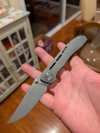
For example I snagged this DUK that has had a hardware swap so the COA doesn't match. It's otherwise in fantastic shape. I traded a knife and some cash and got it for considerably less than the market rate. It's a keeper so the COA mismatch means nothing to me.
 

Attachments

  • PXL_20260226_025713297.jpg
    PXL_20260226_025713297.jpg
    105.9 KB · Views: 4
I find the argument that there's no way to know with out using it first to be unpersuasive. Knives are just not that complicated.

100% agreed. I can appreciate the desire to try out a knife first. But I think that from measurements and a few good pictures, I can tell whether I would enjoy using it or not. Pics along with measurements can show you a knife's ergonomics and grind thinness. Having handled a few knives already, I think anyone can quite accurately execute the "will I like it" algorithm with just that basic info. If they just let themselves.
 
To speak to another part of the OPs question, is why "Like New" can drop so much value so quickly. Some manufacturers like CRK allow and even encourage disassembly, and will assist if disassembly goes wrong. Other brands who I will not name, void a warranty on a knife that's been disassembled.

When buying a used knife on the secondary, the buyer takes a chance. Has any disassembly been disclosed? Has the knife been abused in a way that isn't visible yet, but will lead to breakage very quickly? The additional risk is what the buyer is covering with a lower fee. And possibly why knives like CRK hold their value better than others.
 
It seems like the thing to do, but when you stop to consider the financial loss absorbed in the sale, it seems worth it to just keep it in the collection. Probably not a sound financial move in reality, but it does make you feel better about it. 😁
Good idea, Christmas is just around the corner at the end of a long corridor😉
itll be an interesting gift idea!
The amount of money I spent on packaging material, I essentially given away many knives for free, im gonna simply just refuse to do the math, dont wanna think about it.
 
There's always margin for error.

But I stand by what I said. Pics of an existing knife can tell you things like

1.) are the edges on the scales crisp or chamfered;
2.) does the handle profile have recesses, or points, or nooks that will either aid retention in my desired grips, or get in the way and cause hot spots;
3.) does the angle and profile of the blade relative to the handle lend itself to the types of slicing|cutting board|piercing|etc. tasks that I may want to accomplish with the knife;
4.) does the edge geometry look suitable for fine slicing|batoning|rope cutting|or whatever tasks I want to accomplish

etc.
 
Lots of good input and interesting takes have come along; I appreciate it! You have given me things to think about. Some members’ experiences mirror mine, some do not. But that is okay and expected.

I don’t buy tons of knives on whims and I have owned enough I usually do know if I am going to like something. If I like it then I put it to use immediately and don’t worry about making it mine through use marks. But at times I take a chance on something funky and cool in hopes of discovering something I didn’t know I liked or wanted. Sometimes that works and sometimes it doesn’t. Or I like it but over weeks or months I find I don’t end up carrying it for whatever reason. I try to keep my collection to a reasonable number, and not collect things I won’t use so occasionally I sell an item.

It sounds there is no way to mitigate the significant hit on resale value for many knives, even on a Like New, Pristine, Mint example. In that case, perhaps there is no advantage to keeping it in Like New condition during the examination and assessment phase. If the difference in value of a Like New example and Shows Wear example is negligible, what reason is there to be cautious with it? That really was the crux of my question/dilemma. And maybe there is no ideal solution to the issue.
 
Lots of good input and interesting takes have come along; I appreciate it! You have given me things to think about. Some members’ experiences mirror mine, some do not. But that is okay and expected.

I don’t buy tons of knives on whims and I have owned enough I usually do know if I am going to like something. If I like it then I put it to use immediately and don’t worry about making it mine through use marks. But at times I take a chance on something funky and cool in hopes of discovering something I didn’t know I liked or wanted. Sometimes that works and sometimes it doesn’t. Or I like it but over weeks or months I find I don’t end up carrying it for whatever reason. I try to keep my collection to a reasonable number, and not collect things I won’t use so occasionally I sell an item.

It sounds there is no way to mitigate the significant hit on resale value for many knives, even on a Like New, Pristine, Mint example. In that case, perhaps there is no advantage to keeping it in Like New condition during the examination and assessment phase. If the difference in value of a Like New example and Shows Wear example is negligible, what reason is there to be cautious with it? That really was the crux of my question/dilemma. And maybe there is no ideal solution to the issue.
It doesn’t matter if it is new or old, unused or used, the value you can expect to get from the sale of any item depends primarily on your ability to sell. Some items can be used but uncommon enough to hold their value, others may be enhanced (broken in by use); perhaps your sharpening helped the factory edge, or you upgraded the sheath or scales. For example, I have seldom purchased a Busse knife directly from Busse; the maker never includes a sheath and I don’t like the aggravation of having to send a new knife to a third party for a sheath, so I often buy them used with a sheath.

N2s
 
Sometimes when trying a new (and especially when expensive) knife that I’m not sure I am going to like enough to keep longterm, I tend to baby it, perhaps just fondling and examining it at home for a bit, with the hopes that if I decide I don’t love it I can sell it and recoup (most of) my money. I don’t do shelf queens, so either I keep it and use it, or I will sell it. However, sometimes I have decided to sell it as it isn’t really for me, but then I am surprised how much value the knife has “lost” despite being essentially brand new. Then I think, well if it is going to lose a quarter or more of its value while still in pristine condition, I should have just used it for real and not worried about marks or scuffs. What was the point of keeping it like new in the examination phase?

How do you approach this situation? I know there will always be some value lost in buying something preowned but sometimes the expected markdown on a Like New item seems a bit unrealistic.
I'm someone who often has to try something himself to really know if I like it or not. And I'm not immune to trends or even fads in the knife market. If I hear enough about a knife, I will often try it.

But it's like cars. Only models where demand greatly exceeds supply will not see an immediate and steep loss in resale value when sold secondhand.

I really only buy high-end knives these days, and I try to only buy ones that I am reasonably sure I can rapidly resell at 70% or better of their retail value if I don't like them. Sometimes I guess right, or get lucky, or am fastest, and I get something that when I resell it, I make a bit of money. Most of the time, I don't. Sometimes I see something I just have to have even though I know it won't resell. In six years of record keeping, I am +$5,441.46 on knives sold with an original cost to me of $73,812.37 and 151 sales. That probably sounds super impressive, but it includes the halcyon days of 2020-2022 when people would buy anything that was limited in any way, shape, or form at higher than retail prices, and I really enjoy chasing drops. The last two years? I'm at -$628.70 on 34 sales for knives with a total original cost of $24,264, and I'm very happy whenever I sell a knife and am able to break even, as it allows me to buy other knives and continue enjoying this hobby.

I guess when I look at those numbers I think gosh, I could have used that money better in a lot of ways. But on the other hand, much of that cost is more accurately described as short-term asset turnover rather than building inventory, i.e., the same thousand dollars spent on a knife, earned on a sale, spent on other knives, earned on later sales... and I got a lot of pleasure out of this collecting hobby in the last 22 years.

 
Back
Top