
Vacuum HT, 240min soak time?

Joined
Mar 26, 2012
Messages
2,301
I have seen a maker who send a group of Elmax blades to some local commercial HT that doesn't specialize in HTing knife blade. They mostly HTing only industrial tool stuff.

He want the aimed HRC as 59-60HRC but the HT company don't have actual HT program for this steel (they only do conventional steel like D2, 440C, M2 etc.) so seems like they put it with something (may be punch dies?) with similar range of austenitizing (from data sheet) but totally different in size.

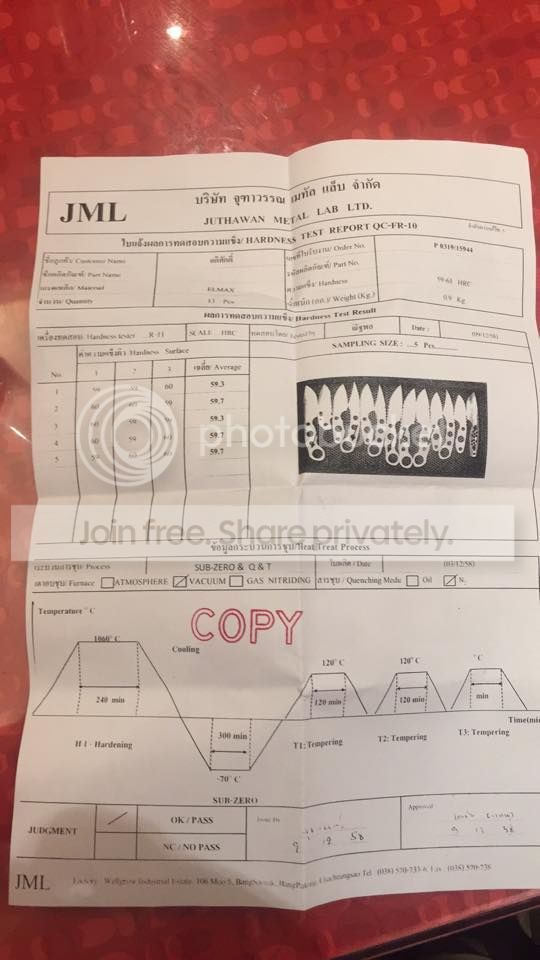
The blade end up with 59-60HRC but if look closely at the HT graph that they gave just looks totally off.

What do you guys think about this? 240min 1940F soak time and 250F tempering? Will this significantly effect the performance of steel?
 
Last edited:
I can't read the hardening temperature, but the sub zero is -94ºF which is dry ice range. Does Elmax require liquid nitrogen? OR is dry ice sufficient for Elmax?

The tempering temps are only 248ºF which is on the low side for most blades.

Here's Alphaknifesupply's HT infor for Elmax: https://www.alphaknifesupply.com/Pictures/Info/Steel/Elmax-Typical.gif

Shows in the range of 2,000ºF for a hardening temp which would be a 1100ºC range.

I've never used nor HT'd Elmax, just what I've read.

Ken H>
 
That what I was thinking too. The hardening temp is 1060c or 1940F... Seems like that was the only (improper)way to achieved 59-60HRC when austenitizing is low as 1940F.
 
Last edited:
Did thy really soak your blade for 4hrs, that's crazy. I have never used elmax but one thing I have seen across the board is it can be over soaked according to smarter people then me. I think this is the reasion why as the temp drops you can soak for longer but max hardness suffers from looking at the charts. Everything besides the austionate looks good for time. But the 250°f temper sounds a bit troubling, but you never know. At face value it's wrong given current heat treat practices but who knows maybe it will work amazing. You will never know till you try one of the blades out.
 
Ht looks OK to me - average or slightly below average (for ht with sz). Probably, it has a little more carbide volume than higher aust temp and those extra larger carbides would be in Cr23C6 form. Lower hardness has more to do with insufficient carbon in solution than excess dislocation(hence RA), so 250F tempered is fine.
 
Don't you think that the 4 hours over-soaked would have anything to effect grain structure?
 
Once more/less solution is in equilibrium (dissolution vs precipitation) - aus grain structure more/less stabilize (low flux) at certain size due to pinning/nucleation. It need higher energy/temperate to merge grain (implicit implies concurrent condition aus matrix over saturated and less + smaller particles).
Don't you think that the 4 hours over-soaked would have anything to effect grain structure?
 
I have never use these blade myself but my friend has done some test with them and its reported to be chippy and has much lower edge retention than another properly HT D2 blade.
 
Elmax has a boat load of Cr at 18% and Cr23C6 carbide probably quite large at lower aust temp. In this case, relative to D2, Elmax has more free Cr + higher carbide volume + large precip carbide (ignore MC) so need to consider parity of comparison. My point - if this company uses this ht for D2 as well, D2 would have better micro impact toughness from higher RA% but catastrophic at macro level.

As I stated before - it's avg or below avg ht w/ sz. With same aust temp+soak but with faster quench and cryo, result would be better - yeah like a bit more sugar to sweeten this lemonade. A much bigger improvement if aust temp ~2050F + cryo.
 
Elmax has a boat load of Cr at 18% and Cr23C6 carbide probably quite large at lower aust temp. In this case, relative to D2, Elmax has more free Cr + higher carbide volume + large precip carbide (ignore MC) so need to consider parity of comparison. My point - if this company uses this ht for D2 as well, D2 would have better micro impact toughness from higher RA% but catastrophic at macro level.

As I stated before - it's avg or below avg ht w/ sz. With same aust temp+soak but with faster quench and cryo, result would be better - yeah like a bit more sugar to sweeten this lemonade. A much bigger improvement if aust temp ~2050F + cryo.

That is not the HT recipe of D2, the D2 I mentioned is 1900 at 30 min and quench in molten salt pot with cryo.

I have a hard time to agree with you that is just a "slightly" below average Elmax HT. I don't think average Elmax would possibly to be chippy compare at D2 at similar HRC.
 
'avg/below-avg for ht with sub zero', where sz is not cold enough for Elmax/D2/etc. Plus N2 gas quenched was not optimal as well. Maybe my sarcasm "sweeten lemonade" wasn't clear. Elmax aust at 2050+F with sz would also be below avg as well.

Speculation is only useful at the surface, since knives & test config/type & tests result/word from an indirect source.
 
Subzero is cold enough to put most steel to Mf point and there are many makers who reported that they couldn't tell the different between subzero vs L2N cryo on the same steel. I doubt even you would find any different.

So saying HT recipe is below average just because it doesn't contain deep cryo is sound ignorant for me. The overall heat treating process, the proper temperature, the precision, timing etc. is much more important in my book.

And why N2 gas quenching isn't optimal? I have access to digital control nitrate salt pot for quenching and there is no measurable different between atmosphere HT+salt quench and vacuumht + N2 quench beside the surface finish.

When it come to vacuum furnace, the quench cooling rate is depending on gas pressure which can be up to 15 bar for mostly newer furnace.

Speculation is only useful at the surface.

This logic is totally applied to most of your opinion in this thread. Have you ever seen newer vacuum furnace? do you know some can quench at 20 bar which is fast enough for even some oil hardening steel?
 
My blissful ignorant thought your friend was complaining about this Elmax ht result... btw - LN2 is ultimate pressurized N2 and try to quench 1000C blade will be slower than 10s oil. Carry on.
 
Lets all keep it civil.

The main issue that strikes me is the three hour soak at austenitization. I can't see anyway that won't affect the final result .... and not in a good way.
 
Back
Top