Like I've mentioned before (with enthusiasm), I've recently become a khukuri owner. In fact I own three of them now. The khukuris themselves were the main reason for the purchase, but since carrying them around, I have come to appreciate the little karda knives that come with them.
What I particularly like about the karda is the handle shape. I've found that it is fairly easy to control even though it is short. So I'm currently thinking that if you have to have a short knife, then a handle with a karda shape might be a good idea.
Evidently a good few of the kardas that come with khukuris nowadays have handles that are a bit shorter than they might have been traditionally. I'm told that the handle was once the same length as the distance across the fingers at the middle knuckles. If I were to have a 'three finger' handle, it would be about two and a half inches long.
Another thing about todays kardas is that the steel seems to be a bit soft. This doesn't mean that they can't be sharpened...but the edge is likely to lose its sharpness relatively quickly.
If a lot of knife work has to be done, particularly if significant force has to be applied, then a knife should probably have a robust, full-sized handle. This would be particularly true in cold or wet conditions. However it is often more convenient to carry a smaller knife, and occasionally a smaller knife may even be handier than a big one.
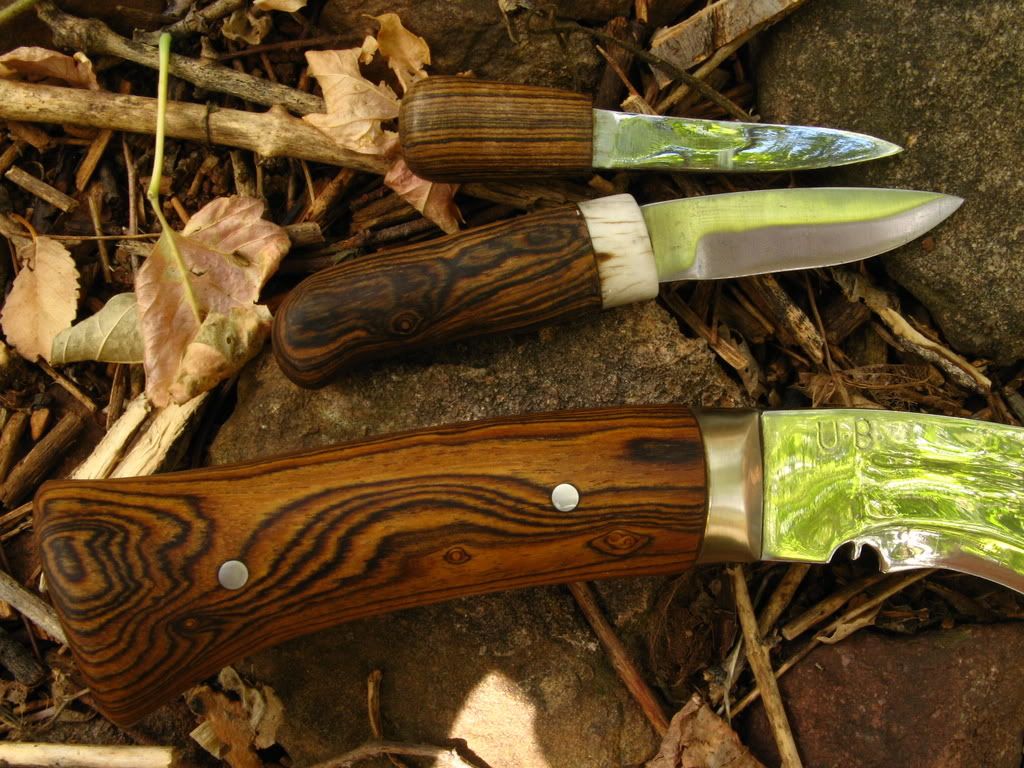
Here is the karda that came with my 12" (overall length) ang khola. I've used this to skin possums; and to skin, gut and behead a pig that my nephew shot. It performed well, but as you can see it doesn't have a 'three-finger' handle.

Over at the Himalayan Imports forum on this site, Berkley and Spiraltwista posted some photos of old kardas. One of these had a curved blade and was possibly used to shear sheep. This caught my imagination. I sometimes get involved with the rounding up and the shearing of a few semi-wild and very woolly sheep, and I would just love to try using a plain blade to remove some wool just to see how it works. Normally we use old-fashioned scissor-shears.
I also figured that it might be an idea to make a karda with a 'seax' type point. I have found this shape to be very good for making the opening cuts when skinning possums. Also, a knife with a slender seax front end can have a nice fine point for fine whittling or removing splinters.
The outcome of all this thinking is pictured below. The curved 'shearing' blade is smaller than the artifact Spiraltwista posted, but I didn't have a convenient longer bit of steel for the blade when the mood struck me to make these. Three of the knives have steel ferrules around them, but I don't know how essential these really are. The blades have a tang of maybe 1.5 inches long, and they are glued into a hole in the handle with two-pot epoxy. The karda with the spiral pattern doesn't have a ferrule, and I've used it for some fairly tough whittling and it is still in good condition. I carry this one in my pocket quite a bit...the blade slides into a length of polythene tube which I heated up in hot water then squashed flat by quickly clamping it between two bits of wood.
I was going to post this in RescueRiley's thread on blade shape, but I thought it was a bit of a change of subject. I would use all sorts of blade shapes, but just lately I've seen some benefits in having the low-angle seax type point.

What I particularly like about the karda is the handle shape. I've found that it is fairly easy to control even though it is short. So I'm currently thinking that if you have to have a short knife, then a handle with a karda shape might be a good idea.
Evidently a good few of the kardas that come with khukuris nowadays have handles that are a bit shorter than they might have been traditionally. I'm told that the handle was once the same length as the distance across the fingers at the middle knuckles. If I were to have a 'three finger' handle, it would be about two and a half inches long.
Another thing about todays kardas is that the steel seems to be a bit soft. This doesn't mean that they can't be sharpened...but the edge is likely to lose its sharpness relatively quickly.
If a lot of knife work has to be done, particularly if significant force has to be applied, then a knife should probably have a robust, full-sized handle. This would be particularly true in cold or wet conditions. However it is often more convenient to carry a smaller knife, and occasionally a smaller knife may even be handier than a big one.
Here is the karda that came with my 12" (overall length) ang khola. I've used this to skin possums; and to skin, gut and behead a pig that my nephew shot. It performed well, but as you can see it doesn't have a 'three-finger' handle.
Over at the Himalayan Imports forum on this site, Berkley and Spiraltwista posted some photos of old kardas. One of these had a curved blade and was possibly used to shear sheep. This caught my imagination. I sometimes get involved with the rounding up and the shearing of a few semi-wild and very woolly sheep, and I would just love to try using a plain blade to remove some wool just to see how it works. Normally we use old-fashioned scissor-shears.
I also figured that it might be an idea to make a karda with a 'seax' type point. I have found this shape to be very good for making the opening cuts when skinning possums. Also, a knife with a slender seax front end can have a nice fine point for fine whittling or removing splinters.
The outcome of all this thinking is pictured below. The curved 'shearing' blade is smaller than the artifact Spiraltwista posted, but I didn't have a convenient longer bit of steel for the blade when the mood struck me to make these. Three of the knives have steel ferrules around them, but I don't know how essential these really are. The blades have a tang of maybe 1.5 inches long, and they are glued into a hole in the handle with two-pot epoxy. The karda with the spiral pattern doesn't have a ferrule, and I've used it for some fairly tough whittling and it is still in good condition. I carry this one in my pocket quite a bit...the blade slides into a length of polythene tube which I heated up in hot water then squashed flat by quickly clamping it between two bits of wood.
I was going to post this in RescueRiley's thread on blade shape, but I thought it was a bit of a change of subject. I would use all sorts of blade shapes, but just lately I've seen some benefits in having the low-angle seax type point.