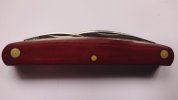
Verdigris on a GEC 62 Pocket Carver

rje58

Gold Member
Joined
Dec 21, 2013
Messages
2,825
I just pulled out a GEC 62 that has been living in its tube in my knife safe for the past few years, and was disappointed to see verdigris on the scales around the rivets. I used the search function, but most of what I found dealt with sheaths, more so than knives.

I am very reluctant to try to clean it up - I don't want to make matters worse, or discolor the micarta. I've learned that apparently micarta is more prone to this than most scale materials. What are the best practices for dealing with this? If I sell it or trade it, what effect will this have on resale value? Here's a photo:
GEC_62_pocket_carver_issue.jpg

Thanks in advance for your thoughts and assistance.
 
I use an old toothbrush, & toothpaste, to get rid of the green from the bolster/cover joint, rinse in warm water, then dry & lube the joint(s).
The toothpaste does not eliminate any bolster patina, or polish the bolsters or covers.
 
Last edited:
Things I learned today: verdigris is toxic.

Light brushing can remove it sometimes, otherwise a light acid (lemon juice and baking soda) can help remove it after it sits for awhile. Any acid will likely stain the carbon steel, so be very careful. Fish Hunter's method is what I would try first. It will leave the knife minty fresh as a bonus!
 
I don't think Micarta, a very durable substance, is more prone to verdigris than other materials. Fundamentally, the problem is the presence of brass, both pins and liners mated to carbon steel and light colour slabs.

Take a pin, match stick or very small bladed stainless knife and carefully scratch off the green slime on the pins until bright. Wipe with a microfibre cloth or similar. Any light colour scale, Bone, notably Stag will be prone to green staining from the chemical reaction of verdigris. I think the good news about Micarta is that you can then use metal polish on the scales and backspring and this should lessen the green effect.

It's one reason I prefer all steel construction, be it carbon or stainless in a knife.
 
Thanks, everybody! Much appreciate the comments, suggestions and expertise provided.

I use an old toothbrush, toothpaste, to get rid of the green from the bolster/cover joint, rinse in warm water, then dry.
The toothpaste does not eliminate any bolster patina, or polish the bolsters or covers.

I read on some forums and in some of the search engine results that the reason micarta is somewhat more likely to have verdigris is that it holds moisture more so than some other scale materials. I'm assuming leather does too, even more than micarta, and that is why leather is so often the culprit.

I don't think Micarta, a very durable substance, is more prone to verdigris than other materials. Fundamentally, the problem is the presence of brass, both pins and liners mated to carbon steel and light colour slabs.

Take a pin, match stick or very small bladed stainless knife and carefully scratch off the green slime on the pins until bright. Wipe with a microfibre cloth or similar. Any light colour scale, Bone, notably Stag will be prone to green staining from the chemical reaction of verdigris. I think the good news about Micarta is that you can then use metal polish on the scales and backspring and this should lessen the green effect.

It's one reason I prefer all steel construction, be it carbon or stainless in a knife.

Again, thanks to all who responded! I will see how it goes, now that I have some good info. I'll post what I decide, the outcome and photos. It may take a few days.
 
I just pulled out a GEC 62 that has been living in its tube in my knife safe for the past few years, and was disappointed to see verdigris on the scales around the rivets. I used the search function, but most of what I found dealt with sheaths, more so than knives.

I am very reluctant to try to clean it up - I don't want to make matters worse, or discolor the micarta. I've learned that apparently micarta is more prone to this than most scale materials. What are the best practices for dealing with this? If I sell it or trade it, what effect will this have on resale value? Here's a photo:

View attachment 3236453

Thanks in advance for your thoughts and assistance.
Very sorry to see that . I have Zero knowledge on how to fix it other than to re-handle it . My guess is that you are keeping it in a high humidity environment . I save all my desiccant packages that I receive in my knife drawers . I have a few Stag and White Bone handled knives and I have never seen any new Verdigris on any of mine . We also have central air and that also keeps humidity down . You also should take steps to protect all of your other knives from this Ugly thing happening .

Harry
 
Thanks for your reply! I am at a loss as to why this happened. The only thing I can guess is that the knife was somehow exposed to moisture or high humidity before I purchased it. I am not the original owner.

I have a over a hundred knives stored in the same location, in a humidity controlled environment. I have never experienced any verdigris, rust or corrosion in any other knife that's stored in this location. This knife was stored in tube, in the wax paper. I do have desiccant packs in there, and it stays between 70F and 78F year round, with low humidity. Of course, there are some knives in there, like this one, that I haven't looked at in a couple of years. Hoping for no more surprises!

Very sorry to see that . I have Zero knowledge on how to fix it other than to re-handle it . My guess is that you are keeping it in a high humidity environment . I save all my desiccant packages that I receive in my knife drawers . I have a few Stag and White Bone handled knives and I have never seen any new Verdigris on any of mine . We also have central air and that also keeps humidity down . You also should take steps to protect all of your other knives from this Ugly thing happening .

Harry
 
Last edited:
I never heard the word before. We always just called it tarnish and eating it never occurred to me…
I never thunk of licking it, ither.

Fun Fact ... a lot of things "humans" routinely consume are toxic: hot peppers, alcohol, chocolate, and caffine, to name four. 😇

I "think" it would take a lot of verdigris "dust" to harm the "average" "human".
Just "think" how many generations from the iorn age or even the bronze to today had verdigris on their knives used for food prep. (includes peeling and butchering game, and whatever fowl, sheep, goat, ox, cow they had).
They did not go extinct ... or even get ill from it.

Copper is a toxic on contact.
(copper is the primary ingedient in bottom paint that keeps ship & boat hulls free of algie, barnicles, and other nasties, and on wood hulled vessels, worms ... tho back in the day wooden sailing vessels, be they military, commercial, or recreational wee clad with copper sheets below the waterline, rather than painted.)
Yet copper pipes were and are used for the plumbing supplying faucets, water heaters, tubs, and showers ... if not the entire home, factory, or high raise condo/office.
Copper (or copper plated cookware with copper in contact with the food while cooking) "for even temperature" are popular, and legal for use in restaurants, while from what I hear, cast iron (and wood cuttingboards) are not.
 
You're kidding, right? It's a GEC, not a Benchmade. It's been a while since I sent anything to Benchmade, so I don't know if it's the same deal, but I've done that a few times in years past and they were - one word - awesome.

I have heard ... strange things ... mixed results ... about knives that were sent back to GEC, for whatever reason: repair, refresh, etc. I have no first hand knowledge in that area. I'm not sure this problem rises to that level, anyway.

You could always send it back to the Mother Ship and ask for the Spa treatment. I’ll bet it comes back looking like new.😀
 
You're kidding, right? It's a GEC, not a Benchmade. It's been a while since I sent anything to Benchmade, so I don't know if it's the same deal, but I've done that a few times in years past and they were - one word - awesome.

I have heard ... strange things ... mixed results ... about knives that were sent back to GEC, for whatever reason: repair, refresh, etc. I have no first hand knowledge in that area. I'm not sure this problem rises to that level, anyway.
I’ve gotten excellent results from the factory when I sent back knives for repair. The most recent was a BeerScout with a bent bail they replaced it and sharpened the blade and polished it up all for $15. 😀
 
Thanks for letting me know! I've heard mixed reviews about GEC service / repair, some good and some odd, so it's good to add yours to the good ones.

I’ve gotten excellent results from the factory when I sent back knives for repair. The most recent was a BeerScout with a bent bail they replaced it and sharpened the blade and polished it up all for $15. 😀
 
Back
Top