Verify this HT process

Rick Marchand

Donkey on the Edge
Moderator
Joined
Jan 6, 2005
Messages
9,680
Hi guys
I read a post where someone was hardening using a procedure I've never heard of....

Springsteel is heated to bright yellow at 2000F and allowed to cool slowly until the magnetic properties come back at orange(?)... then it is oil quenched and tempered.

I didn't know that proper hardening could be done at that high of a temp or that magnetism comes back at 1700F.

Does this have any validity?

Rick
 
Man the grain size and structure would be so large at that point it'd be as brittle as glass!, I bet if you dropped it off your work bench it'd shatter!, yea it'll go from austentite to martensite and it'll be seriously hard,(RC 63-66) but that knife would be a real piece o crap... not to mention that at bright yellow the steel is BURNT! Spring steel in usually 1095 - 5160 and at bright yellow it's usually looks like a fourth of July Sparkler!
 
If you're talking about 5160 , max forging temperature is 2150 F. When you go above that you get "burnt " steel. This is when the grain boundaries start to oxidize !!! Just to HT to 2000 F would certainly create large grains and problems with grain bondaries => brittle !! The advice was from someone who knows nothing about heat treating !!
 
I'm trying not to attack this gentleman but he's telling me(in a polite manner) that I don't know what I'm talking about and that hardening W2 or "Old Filesteel" at 1450-1500F is flat-out wrong... the proper temperature for hardening is 2000F!...... I'm far from being an expert but I can't wrap my head around this.... I think I'm just going to give up...

Just wanted to see if the world had indeed turned upside down... lol.

Thanks
Rick
 
Magnussen,
If I could give you only one piece of advise it would be to listen to mete.

As for my advise:
The information you posted is dead wrong.
Spring Steel is a pretty general term, but 1095 is sometimes called that (so is 5160). 1095 austenitizes at 1475F. Max forging temp (for shaping, not for hardening) is 2100F.
For 5160 the austinitization temp is 1525F and forging is 2200F.
W-2 has uses the same temp specs as 1095.
On spring steels you FORGE in the high temps and STOP at 1600F.
I think the person you quoted was looking at the FORGING data and not the HARDENING data. (Or ,he knows nothing about metallurgy)

Stacy
 
I'm trying not to attack this gentleman but he's telling me(in a polite manner) that I don't know what I'm talking about and that hardening W2 or "Old Filesteel" at 1450-1500F is flat-out wrong... the proper temperature for hardening is 2000F!...... I'm far from being an expert but I can't wrap my head around this.... I think I'm just going to give up...

Just wanted to see if the world had indeed turned upside down... lol.

Thanks
Rick

I would not bother with politeness as this guy is messing with you big time, because nobody could be that wrong about everything he tells you without it being intentional.

There are no simpler steels that could handle 2000F+ for any heat treating operation. Waiting until the Currie point (return of magnetism) to quench is the exact opposite of what you should do. This guy has given you the perfect recipe to make an easily broken blade that isn't even hardened.
 
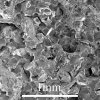
Here's what you will get when you over heat steel - brittle steel -intergranular cracking .A close look at the photo will reveal many grain bondary cracks !!
 

Attachments

  • Cracks.jpg
    Cracks.jpg
    69.9 KB · Views: 68
Thanks Mete!

Starting to really see what you guys been talking about. Scary when I can start to see myself when a blade comes off an 80 grit belt, comparing to how larger grain structure fights taking a finish. Your picture makes it very clear, as it dose not look like that would ever finish past a dull-gray?
 
GEE! do you guys see the resemblance of this post to the post I had a month ago about catching the temperature on the way down? And you guy's thought I was nuts!!!!
Rick, Go back in this forum to a post "Catching the temp on the way down". and you will find a very good and detailed explaination from Kevin and Stacy on this topic.
I know exactly what you are refering to and it struck me the same way. I thru away the magazines, don't listen to anyone but Stacy, Kevin and Mete. and keep my nose in the HTG 2nd edition. Hope the post helps.
Larry.
 
I will stick my neck out here and speak for Robert (mete), Kevin, and myself:
Don't just take our words and apply them as gospel !
We get numbers wrong, read posts backward, and make mistakes.
What would make us happy is for newer (and older) makers to UNDERSTAND the metallurgy of knife steels, and apply that knowledge with their own though process. Asking advise is good, asking for an explanation of what might be going on in a HT process is better, asking if your plans for a HT are proper (after you studied and developed the plan) is the best.
Having a reliable data source for information,charts, and specs is the main thing you need to do this. Several books are commonly posted. It amazes me that a new maker will purchase $3000-5000 in equipment and balk at purchasing a $100-200 book that will teach him how to get the proper HT on the knife made from that equipment.
Stacy
 
I will stick my neck out here and speak for Robert (mete), Kevin, and myself:
Don't just take our words and apply them as gospel !
We get numbers wrong, read posts backward, and make mistakes.
What would make us happy is for newer (and older) makers to UNDERSTAND the metallurgy of knife steels, and apply that knowledge with their own though process. Asking advise is good, asking for an explanation of what might be going on in a HT process is better, asking if your plans for a HT are proper (after you studied and developed the plan) is the best.
Having a reliable data source for information,charts, and specs is the main thing you need to do this. Several books are commonly posted. It amazes me that a new maker will purchase $3000-5000 in equipment and balk at purchasing a $100-200 book that will teach him how to get the proper HT on the knife made from that equipment.
Stacy

Taking anybody’s word for Gospel is how we got in the sad state that bladesmithing has been in for some time when it comes to solid information. If I can, I will word things to sound incredible or contrary in hopes of inspiring folks to research it themselves in an attempt to prove me wrong, to date it I have always been proven right so I really enjoy folks verifying my stuff ;). I am not proven right because I am that good or infallible, but because I care a little more about being wrong so I tend to have my facts in order and within reach before opening my big yap.

But bladesmithing is full of characters who either have a need for attention or want to make money at any cost and will broadcast any wild assumption that verifies their personal worldview, regardless of facts. They are the reason folks need to verify all information. Never, and I mean NEVER fall for the trap that just because the person is published or a demonstrator at a hammer-in that they know what they are talking about. Anybody can write a book, and the publisher won’t ask for proof of any degree’s or credentials before publishing, magazines are even worse- they need articles and aren’t too particular about where they get them as long as they are entertaining. Proof reading of those articles only involves spelling, grammar and catchy wording, rarely fact checking. Anybody with a camcorder and a computer can put out a DVD. Assembling a hammer-in is a serious chore and often the organizers are too happy to just fill the roster to be bothering with how factual the presenters will be. If a very famous smith inspired the people putting on the show most information from that smith will be gospel to them and not need verification, indeed that would be disrespectful, so you should expect to get a lot of regurgitated bad information thrown at you.

Stacy you are right about the equipment versus book thing. What is the very soul of a knife? The heat treat! Without it everything else will only get you a pretty piece of soft steel. Yet I get discouraged when I see makers who have spent from $500 to $1,500 on a grinder, engraver etc… cry like you stabbed them if you suggest they spend $50 on a good quenching oil. :rolleyes: Or worse, spend the money on really good equipment only to use it in working mystery scrap steel. I will admit that I dug in and insisted that I would not spend $300 on a damned book when I decided to get a “Heat Treater’s Guide” but then when I got my discounted used copy I realized that if you plan to heat treat many steels the book was worth $500 if you had to. 10 minutes of reading that book will remove all the chains of ignorance that traditional bladesmithing wisdom will have burden you with and have you producing better blades than some of the famous guys are doing after struggling for 20 years.

P.S. If somebody would care to drop me a private message or e-mail, I would be curious to know where this interesting heat treat information is coming from.

 
Mr. Cashen likes to play the iconoclast and tell you "don't listen" to anyone, but i respectfully disagree. If you listen to what he and other knowlegable guys like Mete say, you, like me, will be able to produce a blade that will actually take an edge and holds it and you won't even have to buy the super expensive stereo microscopes:D
 
Back
Top