

- Joined
- Dec 11, 2000
- Messages
- 1,150
Poor in skill and in $$ 
Has anyone ever tried something like this for making material flat and parallel? I want to try making some folders and this seemed like a good way to get liners, back springs, spacers and blades to be nice and uniform.
Yeah, I know there are some really tallented folk out there who do it all by hand but until I can gain a few skills I would like to stack the deck as much in my favour as I can 
What I don't have, and what this set up needs, is a micrometer depth guage. Without it there is a bit more maths and a greater tolerance stack up, which ain't so great.
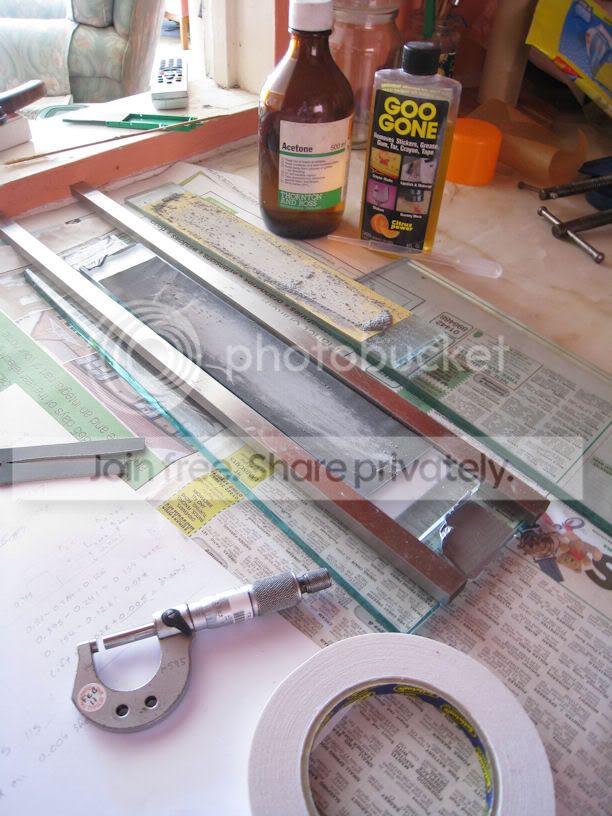
Two glass sheets about 10mm thick, three smaller pieces (probably should be wider than the 2" that I have used, two precision ground 10x15mm O-1 bars, spray glue, sandpaper, double sided tape and a stack of copy paper shims. The piece to be flattened is taped to one piece of glass (tape seems consistent at 0.004"), smaller bit of glass is shimmed and the part is sanded until the glass its taped to is sliding on the guide bars.
I reckon that, if it isn't a totally lame idea to begin with, the rig could do with and MDF base and some chocks to keep everything from sliding around.
So, anyone else use anything like this?
Has anyone ever tried something like this for making material flat and parallel? I want to try making some folders and this seemed like a good way to get liners, back springs, spacers and blades to be nice and uniform.
Yeah, I know there are some really tallented folk out there who do it all by hand
but until I can gain a few skills I would like to stack the deck as much in my favour as I can What I don't have, and what this set up needs, is a micrometer depth guage. Without it there is a bit more maths and a greater tolerance stack up, which ain't so great.
Two glass sheets about 10mm thick, three smaller pieces (probably should be wider than the 2" that I have used, two precision ground 10x15mm O-1 bars, spray glue, sandpaper, double sided tape and a stack of copy paper shims. The piece to be flattened is taped to one piece of glass (tape seems consistent at 0.004"), smaller bit of glass is shimmed and the part is sanded until the glass its taped to is sliding on the guide bars.
I reckon that, if it isn't a totally lame idea to begin with, the rig could do with and MDF base and some chocks to keep everything from sliding around.
So, anyone else use anything like this?
