Video Review of the BSI/BAS

Status
Not open for further replies.
Joined
Jan 18, 2012
Messages
619
Please watch below or go directly to YouTube.
[video=youtube;mj-SR00A]http://www.youtube.com/watch?v=mj-SR00A[/video]

Hope you like it,
sweetcostarica
 
Last edited by a moderator:
Here's the after test written review:
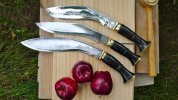
P1020118.jpg

Specifications

Himalayan Imports BAS Service No. 1 (top):

Length/Blade: 26.2 cm (10 5/16 in)
Length/Handle: 11.2 cm (4 7/16 in)
Length/Overall: 38.8 cm ( 15 1/4 in)
Belly width: 5.1 cm (2 in)
Spine thickness at point: 3 mm (1/8 in)
Spine thickness at belly: 7 mm (9/32 in)
Spine thickness at Bolster: 9 mm (11/32 in)
Weight: 550 grams (19.40 oz)

Khukuri House BSI Service No. 1 (middle):

Length/Blade: 27 cm (10 1/2 in)
Length/Handle: 10.8 cm (4 1/4 in)
Length/Overall: 39 cm ( 15 1/4 in)
Belly width: 4.5 cm (1 7/8 in)
Spine thickness at point: 4 mm (3/16 in)
Spine thickness at belly: 9 mm (11/32 in)
Spine thickness at Bolster: 10 mm (.39 in)
Weight: 555 grams (19.60 oz)


Tora BSI Service No. 1 (bottom):

Length/Blade: 29.2 cm (11 1/2 in)
Length/Handle: 12 cm (4 3/4 in)
Length/Overall: 41.5 cm ( 16 3/8 in)
Belly width: 5.5 cm (2 1/4 in)
Spine thickness at point: 3 mm (1/8 in)
Spine thickness at belly: 7 mm (9/32 in)
Spine thickness at Bolster: 8 mm (5/16 in)
Weight: 458 grams (16.15 oz)

Comparison
In this written review I will compare the Tora BSI Service No. 1 1960‘s version, the Khukuri House BSI Service No. 1, and the Himalayan Imports BAS Service No. 1. Both the Tora and Himalayan Imports (HI) Kukris were extremely sharp when they arrived at my door. But the Ex-Gurkha Khukuri House’s Kukri (KH) needed to be sharpened before use because it was just barely sharp.

The Companies
Himalayan Imports - Export company that focuses on providing quality Nepali made Kukri modified to western specifications and tastes. I consider HI to be a custom maker. High quality control.

Tora Blades - UK company that make close copies in weight and dimensions of historic Nepali Kukri both military and villager types. High quality control. Products are made in Nepal.

Ex-Gurkha Khukuri House - Exports lower priced hand made Kukris that have flaws but do the job in many cases. Quality control is spotty. Made in Nepal.

P1020187.jpg
Durability
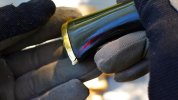
Both the HI and KH are tanks. They were very solid and inspire total confidence that they will not break even if abused. When the testing was over the Tora’s butt cap had cracked and loosened. It’s handle was still firmly attached and unaffected. I think the vibration of chopping hard wood and hitting the ground once (concrete) may have loosened it. An easy fix but should be noted. Other than that Tora’s BSI held up nicely.
No manufacturer’s blade suffered any nicks, bends, or chips. The Tora and HI kept their sharpness needing only a little steeling. The KH lost a little sharpness and needed more sharpening work.

Balance
KH BSI had very bad balance. The HI BAS had better balance but the Tora was well balanced and was a pleasure to use. This is thanks to the hollowed blade which takes more work by the Kami (blacksmith) who made it.

Weight
As mentioned above the labor intensive hollowed blade of the Tora make it the lightest Kukri in the comparison at just over 16 ounces. The KH and HI are very close to each other in weight at around 19 ounces. Which is about right for a current Issue Service No. 1. So all Kukri are accurate in weight for their type (historically speaking).

Kitchen Work
Hands down the thin edge and lighter blade make the Tora BSI a winner in slicing and dicing. The HI BAS did well too but it’s thicker edge slowed it down . The KH BSI was mediocre as a slicer and came in dead last.


P1020178.jpg
Wood Work
Feather sticks were done (picture above) but this was not included in the video. Putting it simply all kukris did well making feather sticks but the Tora BSI and HI BAS were much better at it.

The KH BSI easily beats the others in splitting because it has a slim triangle edge profile with a thick 1 centimeter spine that acts as a wedge splitting wood well. The HI BAS I’ve received just last month has a slight hollow grind edge on it that causes the blade to sometimes get stuck in wood. The thinner slightly convex edge of the Tora BSI got stuck too but not as much.

Overall Looks
If these knives were cars:
The Ex-Gurkha Khukuri House’s BSI would be a Chrysler = Heavy Duty but flawed
The Himalayan Imports BAS would be a Classic Cadillac = Beautiful and Tough
And the Tora Blades BSI would be a Jaguar = Traditional and Fast

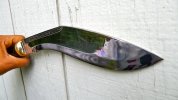
I love the lines on the Tora and it has a great looking blade. It’s finish is more unitarian. The HI blade says high quality with it’s superior high end polish. It’s blade has a nice shape with good scroll work. Last again is the KH because it just looks awkward with it’s short handle and small butt cap. I think most men prefer big butt caps :D.

Finial Comments and Observations
The KH BSI Service No. 1 was the cheapest Kukri and showed it in an uncomfortable for my XL hands handle. It’s bad balance and really thick spine make it just another Kukri. The Tora BSI Service No. 1 was a joy to use and it’s razor sharp quality blade handled everything I threw at it really well. The butt cap was it’s only weakness even though it’s just cosmetic. I highly recommend this model for an all round medium duty application knife. The HI BAS is the closest Kukri in the Himalayan Imports’s line up to a military Issue Kukri. As I used the knife for the first time it was obvious that HI put a lot of effort in making a high quality smaller Kukri. Their Kukri is a winner and there’s no wonder why it is one of their best sellers. Heavy Duty, sharp out of the box, and good looking. A winner.
P1020160.jpg
 
Last edited:
Very nice. Thanks for filming that, and giving the background information as well. having a BAS of my own, I can attest to the quality. Mine was a blem, but it is still the khukuri that my friends all gravitate to when we go off into the woods. I find it to be a wonderful design and a great "do everything" size.
 
I was surprised a little at the HI's tough quality. I actually thought I got a lot more knife than the amount I paid for it. That is rare these days. What you just wrote about you friends gravitating toward this smaller Kukri reminded me of a 30 minute long YouTube review by MrMosinMan89. He seemed in love with his HI BAS. Now I understand what he feels. Thanks for your comment.
britain-gurkha-soldiers.jpg
 
Thanks, SC. Like others, I appreciate the time you take to do these reviews, which are entertaining and informative.

My only suggestion -- and others might disagree -- is to perhaps test more diverse types of cutting of wood, shrubbery, perhaps camping type chores, rather than kitchen cutting (the apple test).

Why? Even the smaller khukuris seem overkill for most kitchen use, not to mention how easily they rust if not completely dried off after each use in the kitchen. The apple cutting test is a test of sharpness, which will vary from knife to knife even for the same model and manufacturer. It also tests the bevel angle, but a knife beveled for robust wood chopping probably wouldn't have a good narrow bevel for cutting something like an apple. So that particular test is like comparing apples and oranges. :)

That's just a quibble, though. Thanks again for the reviews.

-- Dave
 
I have been watching Knife Test.com too much. Anyway point taken. The HI BAS has given me a fresh new look at what Himalayan Imports can do with an ordinary military design. They made it extraordinary.
 
Is the tip of your KH Kukri sharp? I have a KH and the tip is dull as can be and blunted; I suspect sicne they ship the knife and sheath individually wrapped in the box they do that on purpose so the knife doesn't free itself.

Before I owned any Khukuris, I was told the best ones were from HI and KH, so I ordered from both the first time. That was the last KH I bought, and I have since bought about 12 more HIs. The KH is stout enough, but lacking everywhere else in comparison IMO.
 
I think you hit the nail on the head falar. The main problem with the Khukuri Houses (IMO) is "laziness". Their quality control is bad, their blades are as thick as bar stock, they grind instead of hammering the steel, etc. (thank you shortwinger).
About the sharpness of the tip; with mine it was the same semi-sharpness as the main edge of the knife. I think your knifes tip area dullness most likely happened at the factory and was missed or ignored.

Also, don't believe everything you hear, especially on the net :eek:.
 
I think you hit the nail on the head falar. The main problem with the Khukuri Houses (IMO) is "laziness". Their quality control is bad, their blades are as thick as bar stock, they grind instead of hammering the steel, etc. (thank you shortwinger).
About the sharpness of the tip; with mine it was the same semi-sharpness as the main edge of the knife. I think your knifes tip area dullness most likely happened at the factory and was missed or ignored.

Also, don't believe everything you hear, especially on the net :eek:.

I think you have been a bit misinformed. KH does indeed hammer forge their blades. Finishing is done by grinding, filing and sanding. In fact this is pretty much how all khukuri are made. The difference between KH and H.I. is in the finishing, attention to durability and final QC. H.I. makes the distinction between blems and quality work and prices accordingly.
For many years now H.I. has pretty much been the leader for quality because we make this distinction, With Tora being second in quality work when simon is able to keep stock on hand. KH has always made a decent khukuri for those whom are not concerned with having top quality and QC. All makers/houses are quite capable of producing top quality khukuri, but the concern there is material wastage and rework.
 
Last edited:
Thanks Karda for the correction and insight. When I said, "don't believe everything you hear, especially on the net, that includes me too :(. I miss quoted what I heard. It was said the Khukuri Houses grind more than hammer. In essence they are making short cuts by grinding too much. Is this what is happening?

Karda said:
KH has always made a decent khukuri for those whom are not concerned with having top quality and QC. All makers/houses are quite capable of producing top quality khukuri, but the concern there is material wastage and rework.
You correct in my case and are helping me to understand Kukri manufacturing. After reading your statement above I looked at the quality/QC of some of my first kukris (from Ex-Gurkha Khukuri House). They are lacking in refinement but will do splitting/chopping easily albeit they are a little heavy for carry and a full day workload.
 
Thanks Karda for the correction and insight. When I said, "don't believe everything you hear, especially on the net, that includes me too :(. I miss quoted what I heard. It was said the Khukuri Houses grind more than hammer. In essence they are making short cuts by grinding too much. Is this what is happening?

Karda said:You correct in my case and are helping me to understand Kukri manufacturing. After reading your statement above I looked at the quality/QC of some of my first kukris (from Ex-Gurkha Khukuri House). They are lacking in refinement but will do splitting/chopping easily albeit they are a little heavy for carry and a full day workload.

I wouldnt know what their processes really entail without observation, but i get my information from those on the ground in Nepal and thru Auntie. Anyone whom claims to know without real investigation is merely speculating from their observation of finished product rather than being there, which as we know, will be different for different people. Just FYI.... T.B. Bishwakharma and Mr. Lama are/were actually quite friendly with Uncle and Auntie despite being competitors. There is no need to be unfriendly, because in the grand scheme we and they occupy our own niches and different ends of the spectrum in the khukuri world. Simon from Tora is actually somewhat of a friend too, but his actions years ago on this forum left some things to be desired, As did Mr. Gottliebs, from the old GH days, now defunct.
 
I am slowly but surely learning about Kukri manufacture in Nepal and people like T.B. Bishwakharma and Mr. Lama. I would so much like to visit Nepal and check out the way things are in the Kukri world. The $2500 -$3000 USD price of a ticket holds me back. But thanks always for taking time to keep me straight on the situation as best you can Karda.
 
Status
Not open for further replies.
Back
Top