
-
The BladeForums.com 2024 Traditional Knife is available! Price is $250 ea (shipped within CONUS).
Order here: https://www.bladeforums.com/help/2024-traditional/
You are using an out of date browser. It may not display this or other websites correctly.
You should upgrade or use an alternative browser.
You should upgrade or use an alternative browser.
Vinegaroon on wood?
- Thread starter emr454
- Start date
- Joined
- Jun 20, 2007
- Messages
- 1,361
If either of these two will respond you will probably get the best answer, as they are two of the most knowledgeable, that I know when it comes to the era that Vinegroon comes from.
Wild Rose / Chuck Borrows
Here is a recent thread he did on vinegaroon.
http://www.bladeforums.com/forums/showthread.php?t=820500
LRB / Wick Ellerbe
Here is a recent thread he did on a sheath dyed with vinegaroon.
http://www.bladeforums.com/forums/showthread.php?t=820213
Wild Rose / Chuck Borrows
Here is a recent thread he did on vinegaroon.
http://www.bladeforums.com/forums/showthread.php?t=820500
LRB / Wick Ellerbe
Here is a recent thread he did on a sheath dyed with vinegaroon.
http://www.bladeforums.com/forums/showthread.php?t=820213
I assume by vinegaroon you mean some sort of steel dissolved in vinegar or acetic acid.
It will turn cherry black. It is easily sanded off, but can give an interesting aged effect if allowed to remain around steel pins, etc.
On curly sugar maple it can really make the grain stand out. Here is one (on the right) I finished in the last several months. I hand sanded the wood to 400 grit, then sanded with 0000 steel wool, then with a coarse cloth to burnish. I rubbed the ferric acetate/vinegaroon into the wood and allowed to dry, then carded it with 0000 steel wool. I think I gave this one 2 more applications of the ferric acetate (with drying and carding) and then rubbed a dilute solution of Fiebings leather dye to add some color. Carded it again with steel wool, burnished with the coarse cloth, then gave it several coats of Tru-Oil. The wood prep and vinegaroon application is basically what Chuck describes. This actually gave the wood a high degree of chatoyancy, which of course doesn't show well in the photo.
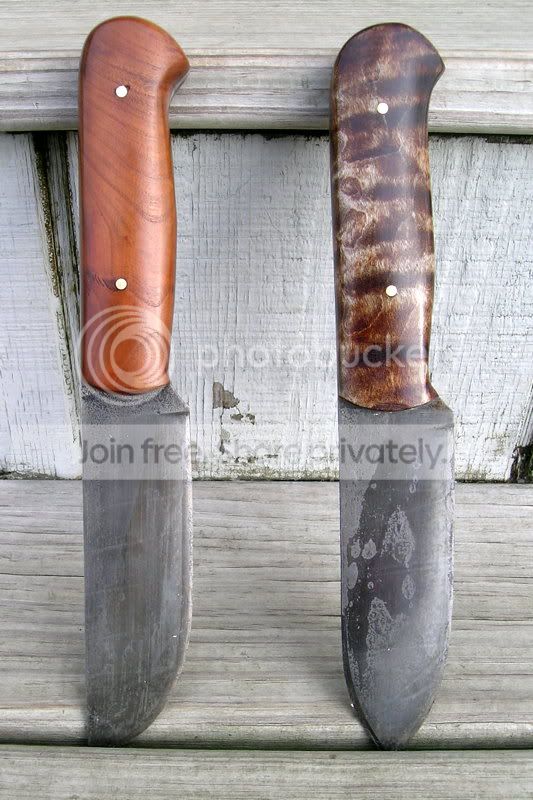
It will turn cherry black. It is easily sanded off, but can give an interesting aged effect if allowed to remain around steel pins, etc.
On curly sugar maple it can really make the grain stand out. Here is one (on the right) I finished in the last several months. I hand sanded the wood to 400 grit, then sanded with 0000 steel wool, then with a coarse cloth to burnish. I rubbed the ferric acetate/vinegaroon into the wood and allowed to dry, then carded it with 0000 steel wool. I think I gave this one 2 more applications of the ferric acetate (with drying and carding) and then rubbed a dilute solution of Fiebings leather dye to add some color. Carded it again with steel wool, burnished with the coarse cloth, then gave it several coats of Tru-Oil. The wood prep and vinegaroon application is basically what Chuck describes. This actually gave the wood a high degree of chatoyancy, which of course doesn't show well in the photo.
Yes, it will be gray, though depending on the steel you use you could get variations of red.
You probably won't see a lot of improvement in the grain if you have plain maple. You might be better off with a good quality wood stain. Plain wood is just plain wood.
You probably won't see a lot of improvement in the grain if you have plain maple. You might be better off with a good quality wood stain. Plain wood is just plain wood.

- Joined
- Aug 23, 2002
- Messages
- 1,398
It will often look gray until you add finish - if that doesn't brighten things up (always test on scrap):
1) Add some more vinegar to the mix
2) wipe the piece down with hydrogen peroxide
as for using on wood I seldom ever use it anymore, much preferring Ferric Nitrate aka Aqua Fortis which gives me better color and chatoyance on woods like maple, ash, hickory, Osage and walnut.
As to how it will look here's a comparison:
The upper piece of wood was the control using and old batch of Wahkon Bay Aqua Fortis, the lower piece is vinegar on the left, ferric nitrate crystals in the middle, and some home made AF on the right. All pieces had one coat of Tried and True Oil Varnish applied

With either AF or vinegaroon it's always a bit of a guessing game on what color evolves, but as noted it can be tweaked in various ways. The basics are in either case the iron in solution reacting with the tannic acid in the wood. The tweaks come from adding more tannic acid or applying another oxidizer - you can also tweak using regular wood or leather stains.
e
In contrast these two were stained with AF and heated as needed with AF, neutralized with potash, wiped down with hydrogen peroxide to redden them up a bit, and then fully finished with a batch of homemade 18th Century violin varnish.

Note on the left piece how the vertical face is much darker, this is because the AF was not properly neutralized.
As for soaking it in the vinegaroon after assembly, no need and yes the vinegar (acetic acid) can affect the epoxy. ON finished knives I just wipe on a coat or two of the stain and go from there.
1) Add some more vinegar to the mix
2) wipe the piece down with hydrogen peroxide
as for using on wood I seldom ever use it anymore, much preferring Ferric Nitrate aka Aqua Fortis which gives me better color and chatoyance on woods like maple, ash, hickory, Osage and walnut.
As to how it will look here's a comparison:
The upper piece of wood was the control using and old batch of Wahkon Bay Aqua Fortis, the lower piece is vinegar on the left, ferric nitrate crystals in the middle, and some home made AF on the right. All pieces had one coat of Tried and True Oil Varnish applied
With either AF or vinegaroon it's always a bit of a guessing game on what color evolves, but as noted it can be tweaked in various ways. The basics are in either case the iron in solution reacting with the tannic acid in the wood. The tweaks come from adding more tannic acid or applying another oxidizer - you can also tweak using regular wood or leather stains.
e
In contrast these two were stained with AF and heated as needed with AF, neutralized with potash, wiped down with hydrogen peroxide to redden them up a bit, and then fully finished with a batch of homemade 18th Century violin varnish.
Note on the left piece how the vertical face is much darker, this is because the AF was not properly neutralized.
As for soaking it in the vinegaroon after assembly, no need and yes the vinegar (acetic acid) can affect the epoxy. ON finished knives I just wipe on a coat or two of the stain and go from there.
Thread revival! I thought you all might be interested in seeing results of my vinegaroon-on-wood experiment. Short story is that vinegaroon effectively blackened wood for me. Longer version:
Last year I dipped a handful of steel wool pads in acetone, lit it and then let it burn out, then left in a jug of apple cider vinegar. The pads dissolved in a few days and I've been using the vinegaroon since then on leather. Thought I would try it on wood.
I had a piece of rough scrap nonstabilized big leaf maple laying around.

I let a black tea bag steep in a cup of boiled water for a few hours, dropped the maple block in and put another cup on top to submerge it. let it sit like this overnight. Next morning took it out and left it on counter to dry some. That night,
I swabbed on some vinegaroon. Just a few seconds of swabbing, a couple dips of the brush to re-apply vinegaroon, and I got this:

I let the block sit out wet with the vinegaroon. Once dried, I carved a little chip out and the blackening went in about a millimeter. Good stuff! I think I'm going to try it on a knife handle that has been sanded to 600 grit.
Last year I dipped a handful of steel wool pads in acetone, lit it and then let it burn out, then left in a jug of apple cider vinegar. The pads dissolved in a few days and I've been using the vinegaroon since then on leather. Thought I would try it on wood.
I had a piece of rough scrap nonstabilized big leaf maple laying around.
I let a black tea bag steep in a cup of boiled water for a few hours, dropped the maple block in and put another cup on top to submerge it. let it sit like this overnight. Next morning took it out and left it on counter to dry some. That night,
I swabbed on some vinegaroon. Just a few seconds of swabbing, a couple dips of the brush to re-apply vinegaroon, and I got this:
I let the block sit out wet with the vinegaroon. Once dried, I carved a little chip out and the blackening went in about a millimeter. Good stuff! I think I'm going to try it on a knife handle that has been sanded to 600 grit.