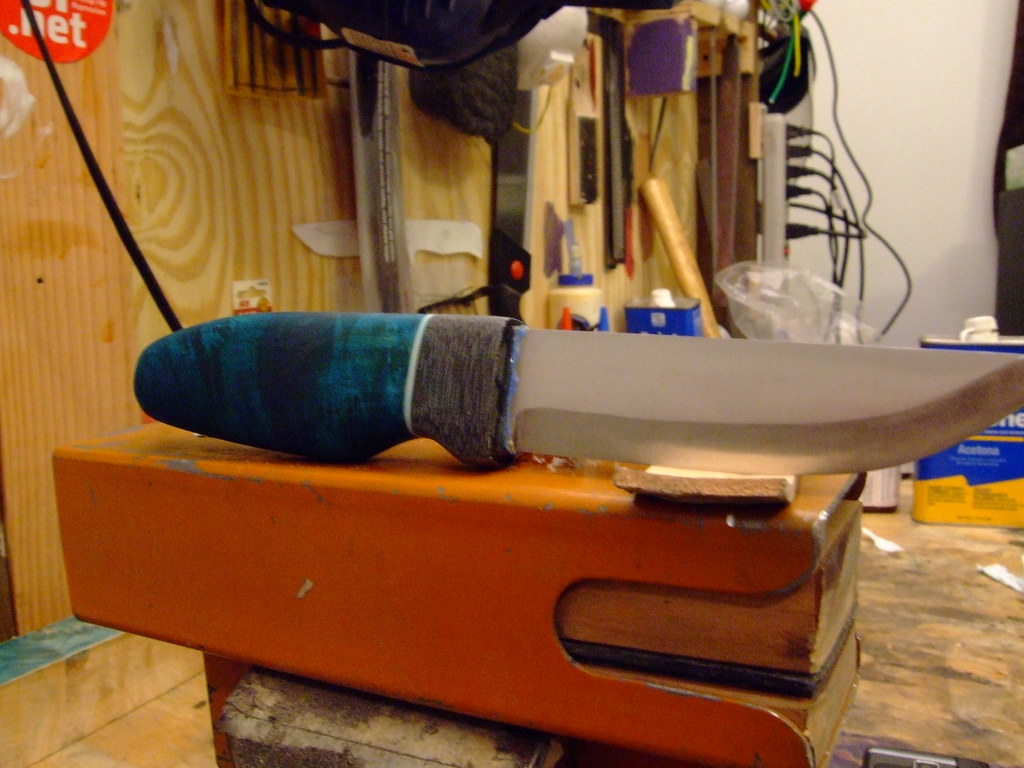
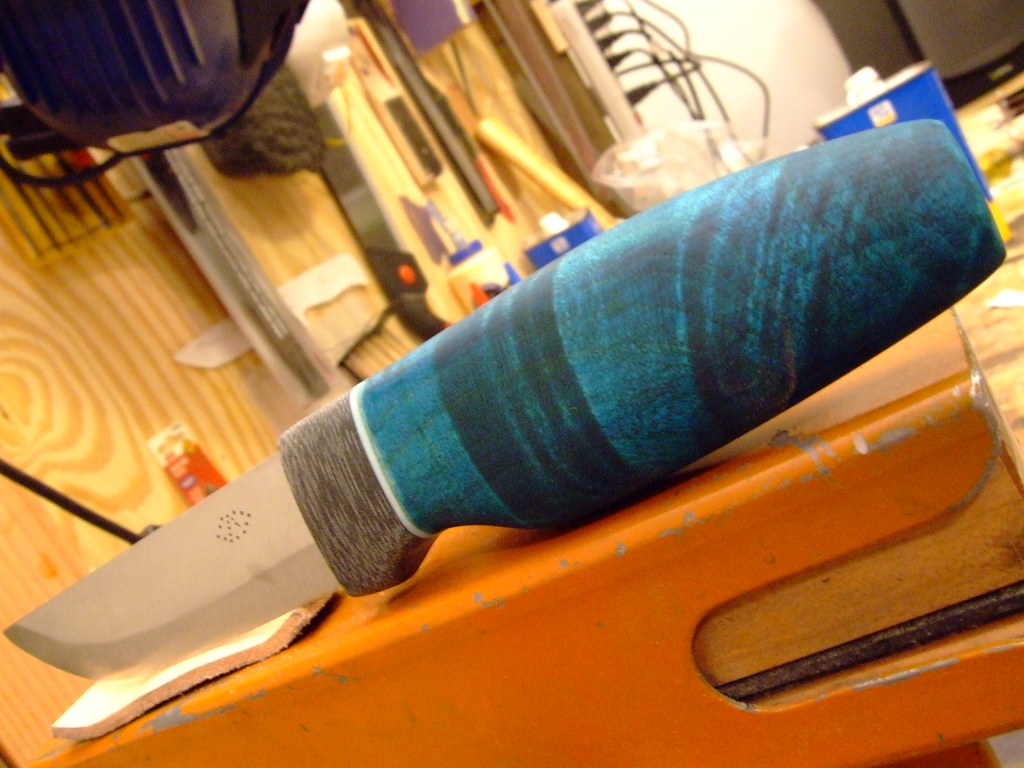
W.I.P.: My First Scandi Grind [was Blunted Tip]

This is a very good-looking Scandi grind especially with the hand filing technique. What file are you using and how long is it?

I start with the file pictured on the bottom -14" - and work my way up. The files are stamped as follows, from bottom: Nicholson Flat Bastard, Johnson Bastard, and Nicholson Mill Bastard. The bottom one is double-cut and the other two are single cut.

8249077113_6ca1748d85_b.jpg
 
Last edited:
Some people notch the tang to make it hold tighter in the epoxy. Most use a slightly larger tang and put a single pin through it to hold the blade tight. Redsquid had cut slots into his tang, which may have caused problems later on, so he ground them out in those dips. It isn't a normal shape, but it may have prevented a broken tang.

Ah, thank you, when I saw the follow up post about cross drilling the tang I thought maybe it was to shave some weight. But that does explain the angle on those cuts too... Much to learn yet =)
 
Got it back from Texas Knifemakers today.

Now more sanding. Woopeee!
 
The bubinga is very strong and so is the pau ferro its more like a rose wood. Either should last a very long time. The burl if its stabilized will be fine but if its not then I wouldnt use it. The sycamore I have not used but if I remember correctly its a pretty soft wood. That is if its not stabilized, like the burl if its stabilized then it will work just fine.

Do you know if any of these woods pose a problem as far as adhesion of the glue? Some woods are oily, so that might be a problem.
 
Here is some unstabilized wood I had lying around. I bought it about 4 - 5 months ago, and it came in the form of 2" X 2" sticks, with waxed ends. Can't remember who I bought it from. Do you guys think it would work?

Thanks.

8253061643_deb243d0b4_b.jpg
 
Here is some unstabilized wood I had lying around. I bought it about 4 - 5 months ago, and it came in the form of 2" X 2" sticks, with waxed ends. Can't remember who I bought it from. Do you guys think it would work?

Thanks.

8253061643_deb243d0b4_b.jpg

[update] Put the wood in the vice, and smacked it a few times in each direction. Smacked it harder than anything that would be expected in real-world usage. Held up fine.

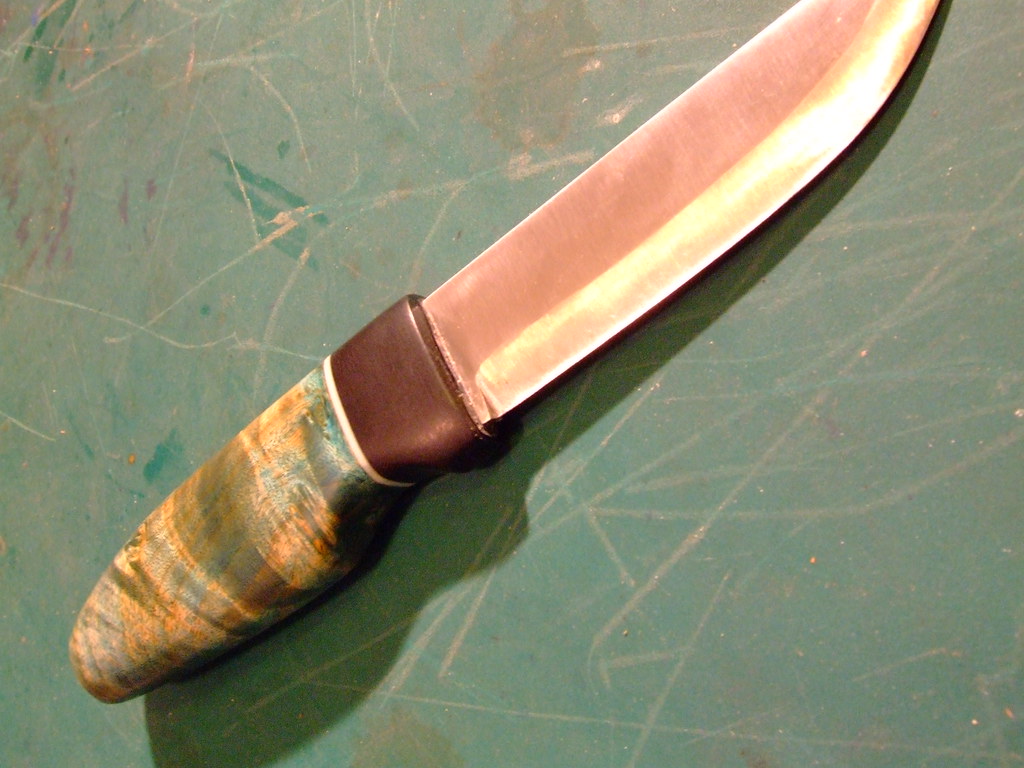
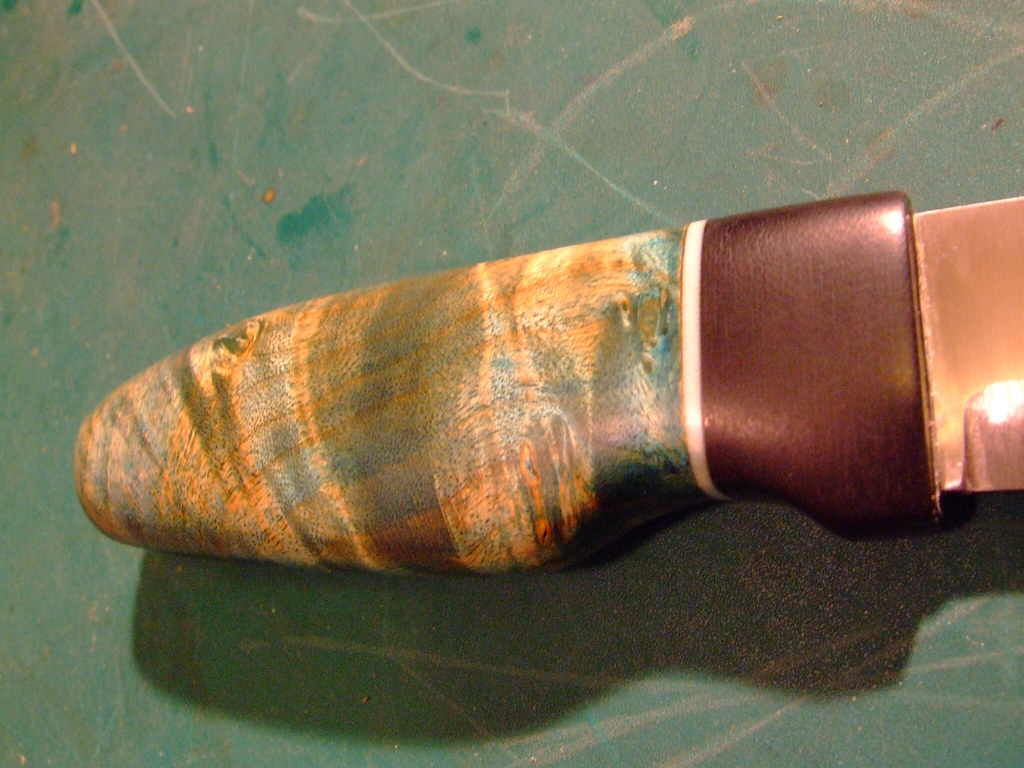
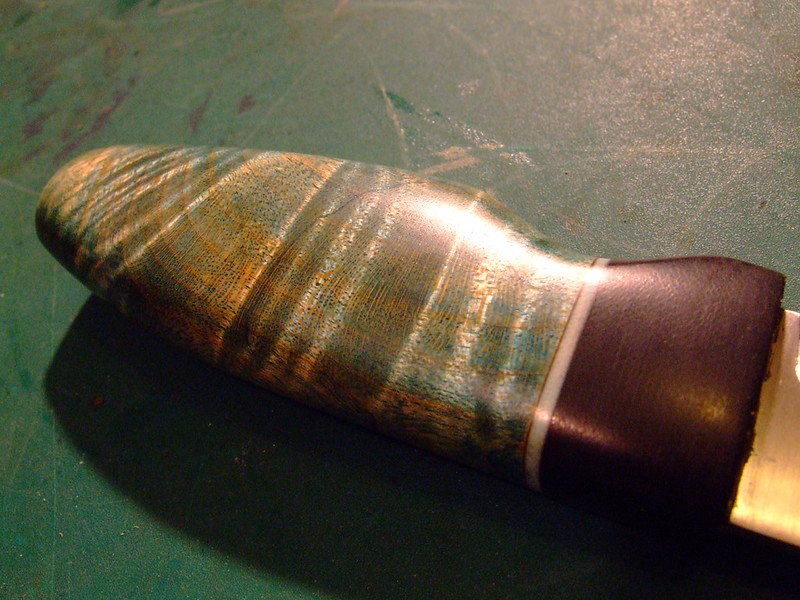
Regarding staining: I am conducting tests with light blue sharpie on the maple. I sanded it to 220 grit, applied the sharpie generously, then rubbed off the excess ink under running water, and wiped it dry. Waited 24 hours, then sanded it with 320 grit and rubbed in some Tru Oil. I will now move up in grit with each coat of Tru Oil, thinning it out with paint thinner. The sharpie produces an aquamarine kind of color on the maple. With a satin finish, I think a black canvas micarta guard will complement it well, and I am thinking of adding alternating o.d. and white G10 spacers.
 
Last edited:
When it came back from heat treat, I took 500 grit sandpaper and got the flats looking nice

I now need to sand down the Scandi bevels, to an edge. I think I will get a course barbwire edge, and then put the handle on, then resume working on the bevels with the course side of an India stone.

Here is what I was doing tonight. I started working on the bevels, with the jig, holding 120 grit sandpaper under the file.

8256894470_16f92a44dd_b.jpg


That seemed painfully slow, so I went to the lavatory, where there is a hard flat granite countertop, and started carefully lapping the bevels on 120 grit sandpaper. That still seems slow, so I will try 80 grit.

8255828793_db61af78b4_b.jpg


[update 10 Dec. 2012]: After lapping it with 80 grit, the progress still seemed pretty slow. I then tried just filing it with the 12" bastard. That seemed slow. Tried the course side of an India stone. Sloooooooow. Now I have it on the work arm, using a sanding block, 120 grit sandpaper, and a sharpie. You guys know what the sharpie is for, right?

[update 11 Dec. 2012]: I think I sanded on the bevels for 3-4 hours before finally getting a barb wire edge. I don't care what anybody says; I dont' think making a Scandi bevel is easy; it has to be nice and flat all the way to the cutting edge. While sanding down those bevels, I scuffed the flats, of course, so now I have to re-sand the flats.

 
Last edited:
Making the guard out of black canvas micarta:

8277418981_117535c685_b.jpg


I thought it would make it easier to fit the guard, if I cut in some "shoulders" on the tang, so I did that, with my Dremel tool and a cutting wheel.

8277423119_e472cbaaf7_b.jpg


A white G10 spacer. I cut out the hole with diamond burrs and the Dremel.

8278483048_7c3872c07b_b.jpg


To guide me in drilling the hole at the proper angle, I outlined my tang on the side of the block:

8277429221_fbdf8d8e00_b.jpg


I always use an oversized block; bigger than it needs to be, in every direction. If the hole turns out cocked off one way or another, or the blade doesn't set in there perfectly aligned, I can correct that by the way I remove material.

8277431487_af75915b69_b.jpg


Here is everything all glued up. G-Flex epoxy seemed like a good choice for this application, so that was what I used. I don't do any "clamping", per se, when using epoxy. The rubber band is just there to hold everything in place.

8277433737_f38ece66c1_b.jpg


To help the epoxy cure faster, I set a halogen lamp pointing at the knife, to warm it up. The thermometer says about 107 deg. Fahrenheit. In the plastic cup is the leftover epoxy. I want to see how fast it hardens under the lamp.

8278593834_ea77aee56b_b.jpg
 
Last edited:
As I shape the handle, I find it necessary to repeatedly re-draw the guideline along the top, as I go along. Otherwise, I may get the handle completely shaped, only to discover that it is cocked off to one side. Below is a picture of one that I had completely finished, before I looked at it and realized it was skewed. You can't tell in the picture, but it was so cocked to the left, I had to tear it off and start fresh.

puukko May 2012 - 3.jpg
 
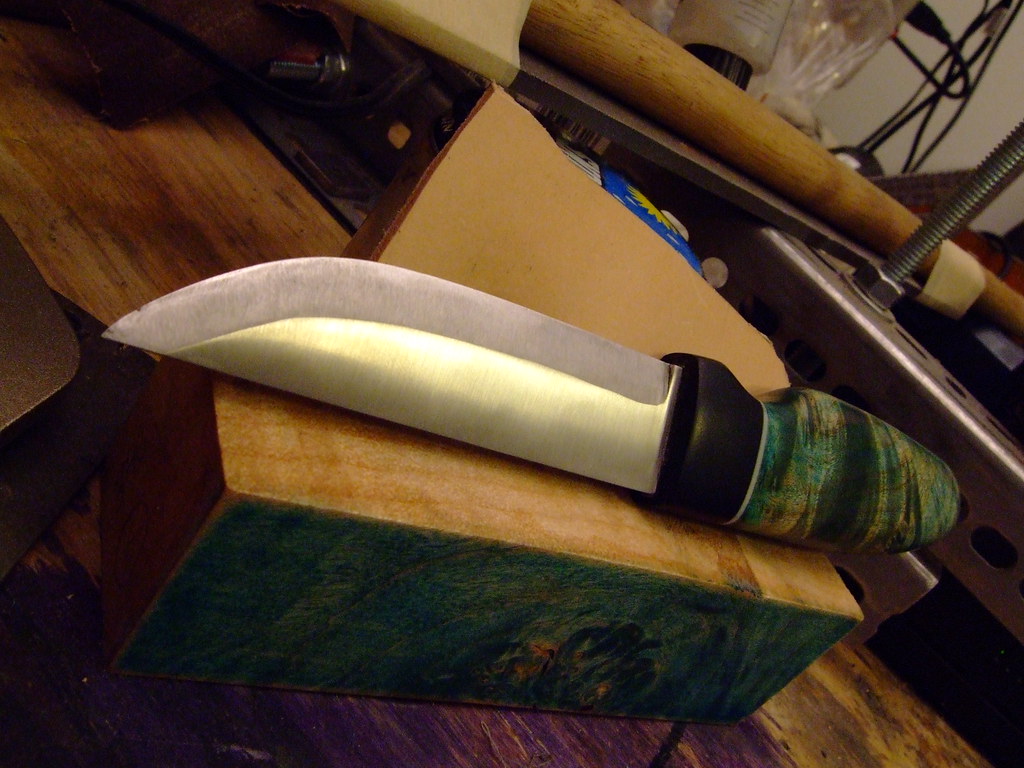
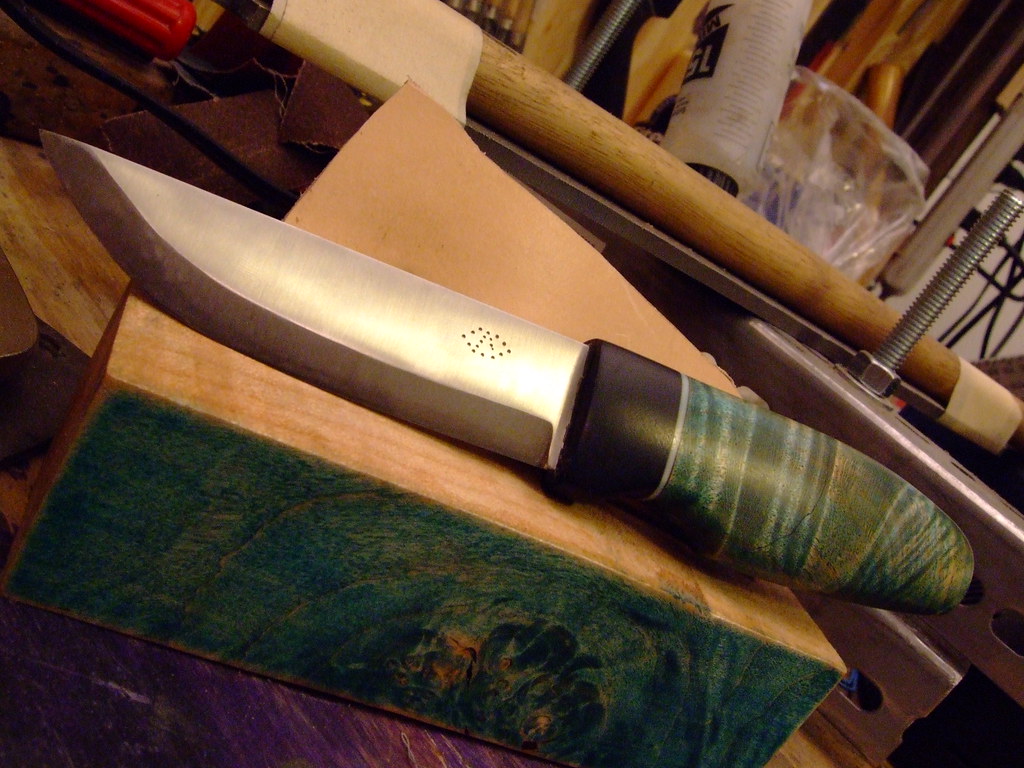
I finished the basic shaping tonight. Here is how I arrived at this handle shape: I started out with a simple ovalized barrel with palm swell.

8285540071_7d5c49fda5_b.jpg


8285531313_3c3a3e987c_b.jpg


The more I handled it, the more I thought there was just too much width at the front. So I decided to cut in that finger notch. I was aware that there were some Scandinavian knives with finger notches (see EKA H8 pictured here, from www.ragweedforge.com )

eka-h8-birch.jpg


The notch made it much more comfortable, too.

Then I worked on the shape some more, until I thought it was about as symmetrical and comfortable as I could get it.

Then I sanded up to 320 grit and stained it. I am not going to say what stain I used. Can somebody can guess?

8285543113_8b24ba469a_b.jpg


8286602742_4cb0bae9d1_b.jpg


There is a somewhat linear void going top to bottom on the left side up the handle. It could be a crack, but I keep stress testing it, with an amount of leverage that could reasonably be encountered in the real world. It is holding up, so that's good. Next I wait a while for the stain solvent to completely evaporate, then I start in with the finish. I think I will apply 8 - 12 coats of a very thinned Tru Oil. That's the only clear finish product I am familiar with.

I am finding stick tangs to be more challenging than full tangs; the challenge is keeping everything lined up as I shape the handle.

 
Last edited:
Scandi grinds to me are an excellent grind. They are a challange the first few times but you stayed with it. Thats a good thing. I have made a few stick tang scandi grinds lately. They are fun to make. Is your void between the spacer and wood ? Or where the blade meets the bolster ? I would still try and use clamps on the next one to snug up the void if that is where it is.
 
Scandi grinds to me are an excellent grind. They are a challange the first few times but you stayed with it. Thats a good thing. I have made a few stick tang scandi grinds lately. They are fun to make. Is your void between the spacer and wood ? Or where the blade meets the bolster ? I would still try and use clamps on the next one to snug up the void if that is where it is.

Marko, thanks for the tip. I have seen special clamps for making these types of knives, but I never pulled the trigger to get one. On this knife, I am pretty pleased with the joints between the spacers and/or wood.

The void looks more like a crack, the more I look at it. However, I don't think it goes very deep. I stress tested the handle again by putting the blade into a vise, then pushing the handle repeatedly side to side. Unless this knife is used as a pry bar, it will be OK.
 
That looks pretty damn good!!! You stained the handle with a sharpie?!?!? Very nice :)

Thanks, Mike. I stumbled on another thread where a guy had stained a handle with Sharpie. So I did some experimenting.

I tested Red Sharpie on a piece of scrap wood. It looked pretty good, but it also looked like the color of fresh blood, so maybe not the best color for a knife handle. So I went with the light blue.

Now I have five coats of Tru Oil rubbed into the handle. I just can't seem to get rid of hazy streaks. I rubbed it first with a red scotchbrite, then a dark grey scotchbrite, but still the hazy streaks, if I look close. I don't have any of the micromesh, or I would use that. I think I'll try 1500 grit and 2000 grit sandpaper.
 
Last edited:
I need to make the bevels look nicer, and clean up the area where ricasso meets guard.

8306275262_8d476661f6_b.jpg


8306278196_242b06c189_b.jpg


8306281172_b018e80dfb_c.jpg


8306265808_a6ef09d326_b.jpg


8305224077_f9c57a5314_b.jpg
 
Last edited:
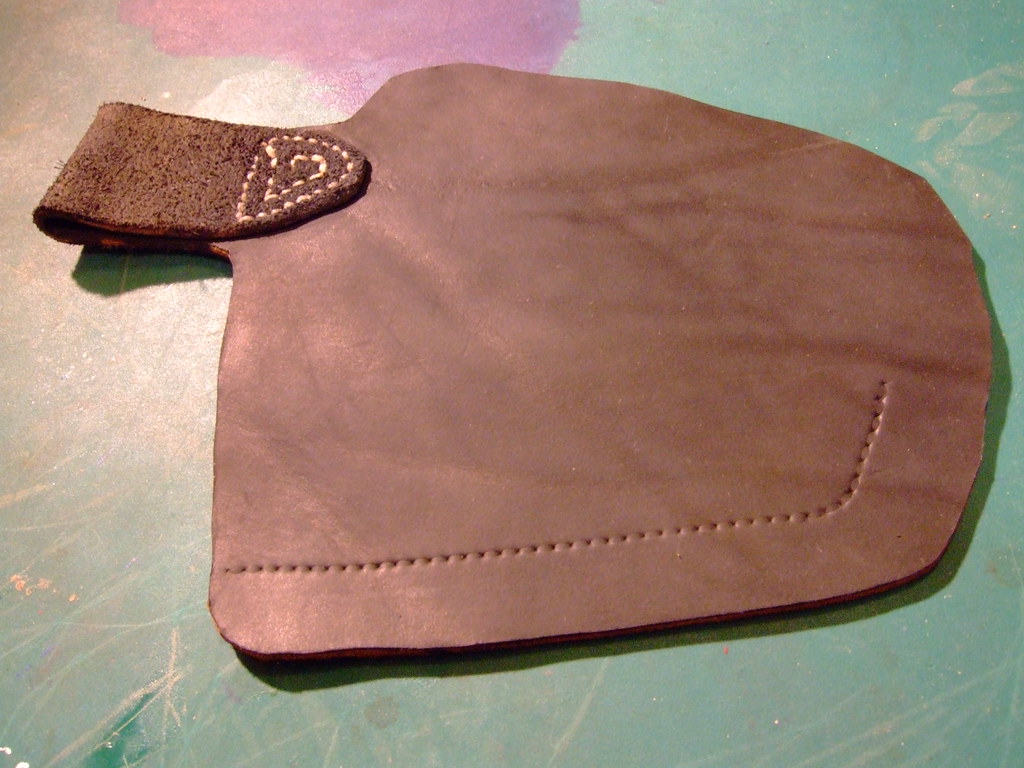
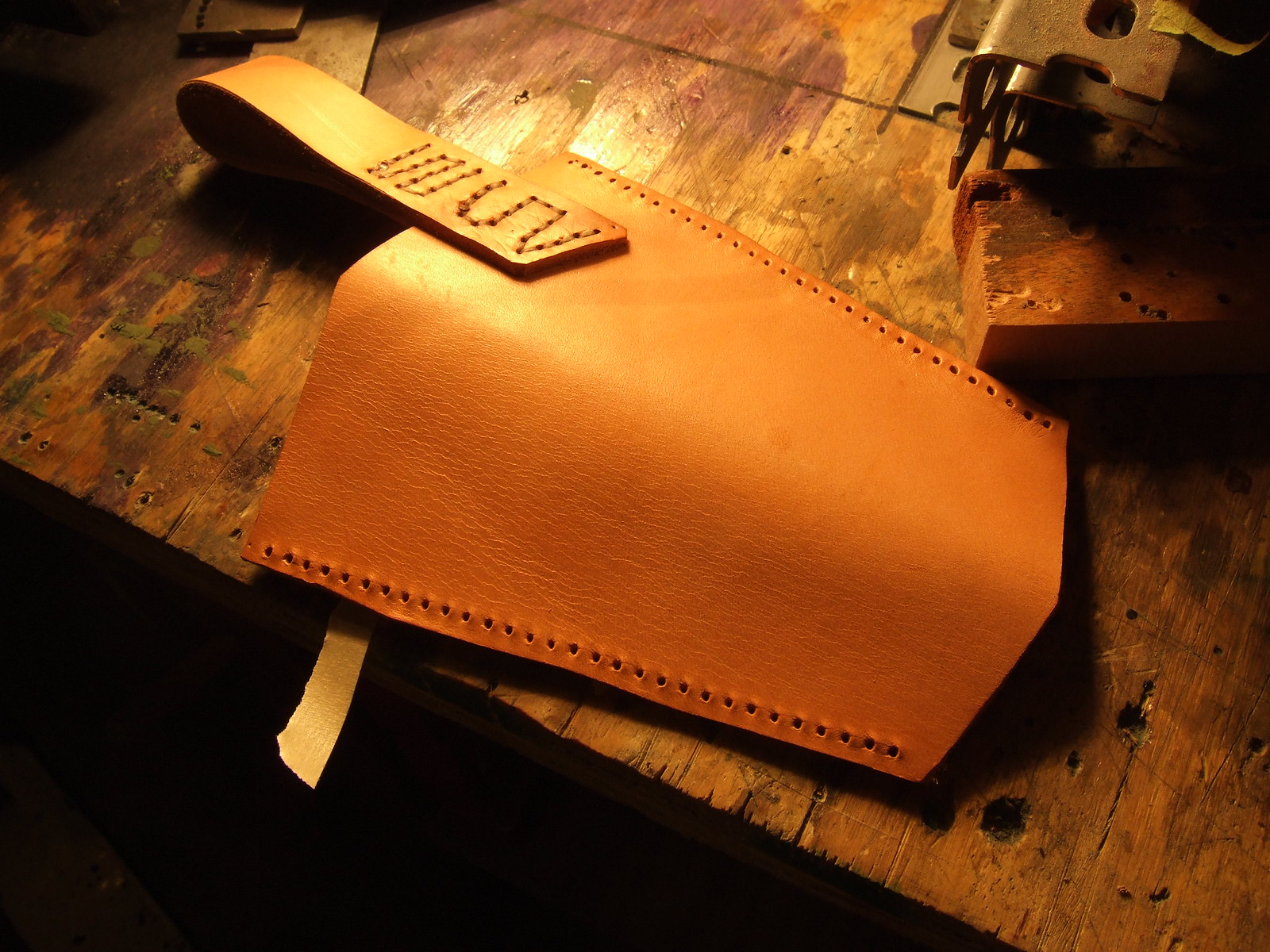
I am getting tired of this project. I tried to make a leather sheath, but it came out so ugly I don't even want to post pictures of it. I haven't decided what to do about that hairline crack on the left side of the handle.

I might keep the knife and do some field testing with it, I might give it to someone, I might sell it, but I think the hairline crack would diminish the value a lot.


8323547573_806aeb3c3e_b.jpg


8323544139_eb866af162_b.jpg


For now, it hangs in my kitchen.

Thanks everybody for your questions and feedback.
 
Progress:

I didn't want to keep that handle on there, since it had that crack in it. So I tore it off. As I was cutting and tearing off chunks of it, I could see that the crack went about 3-4 mm into the wood.

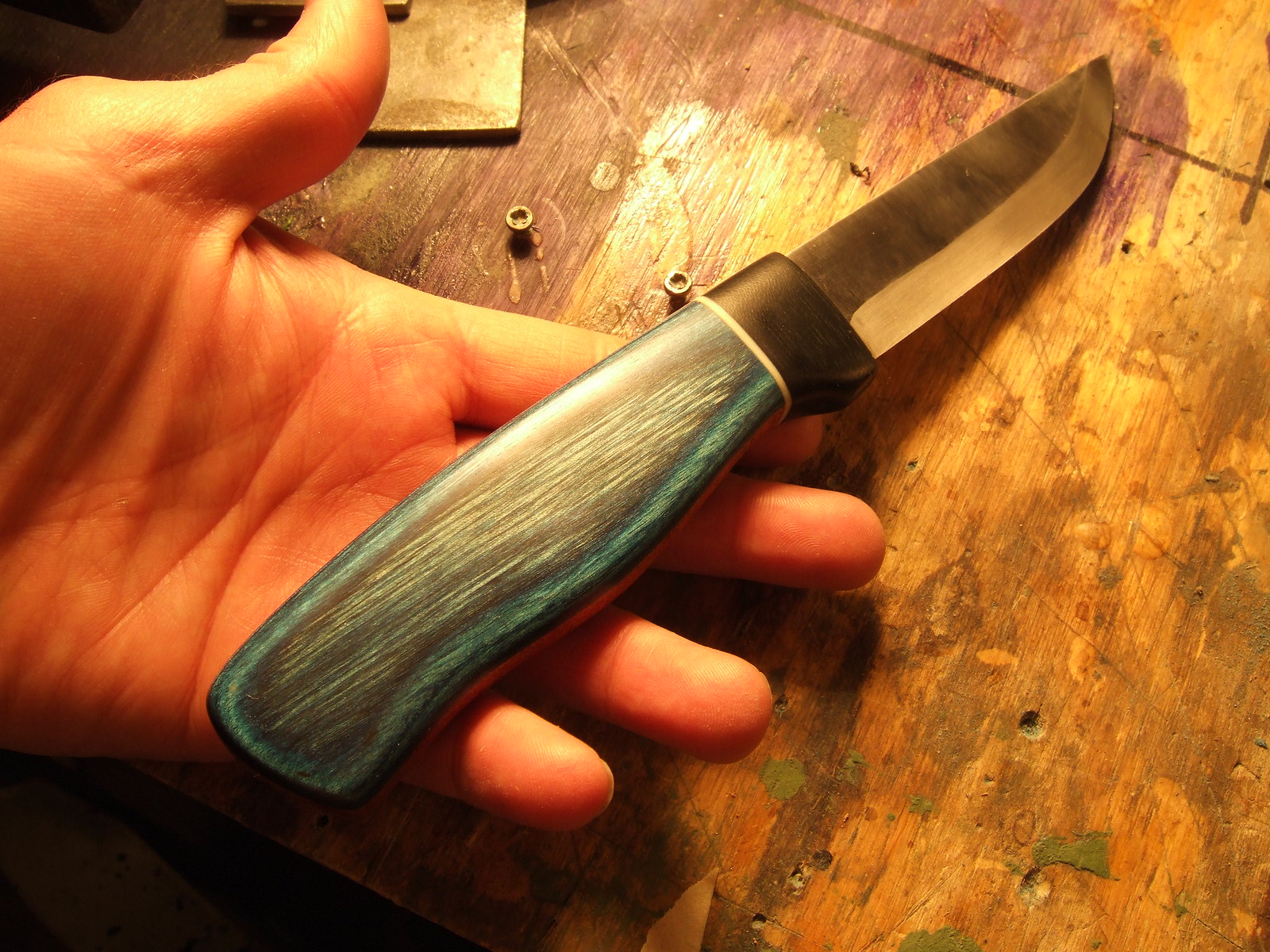
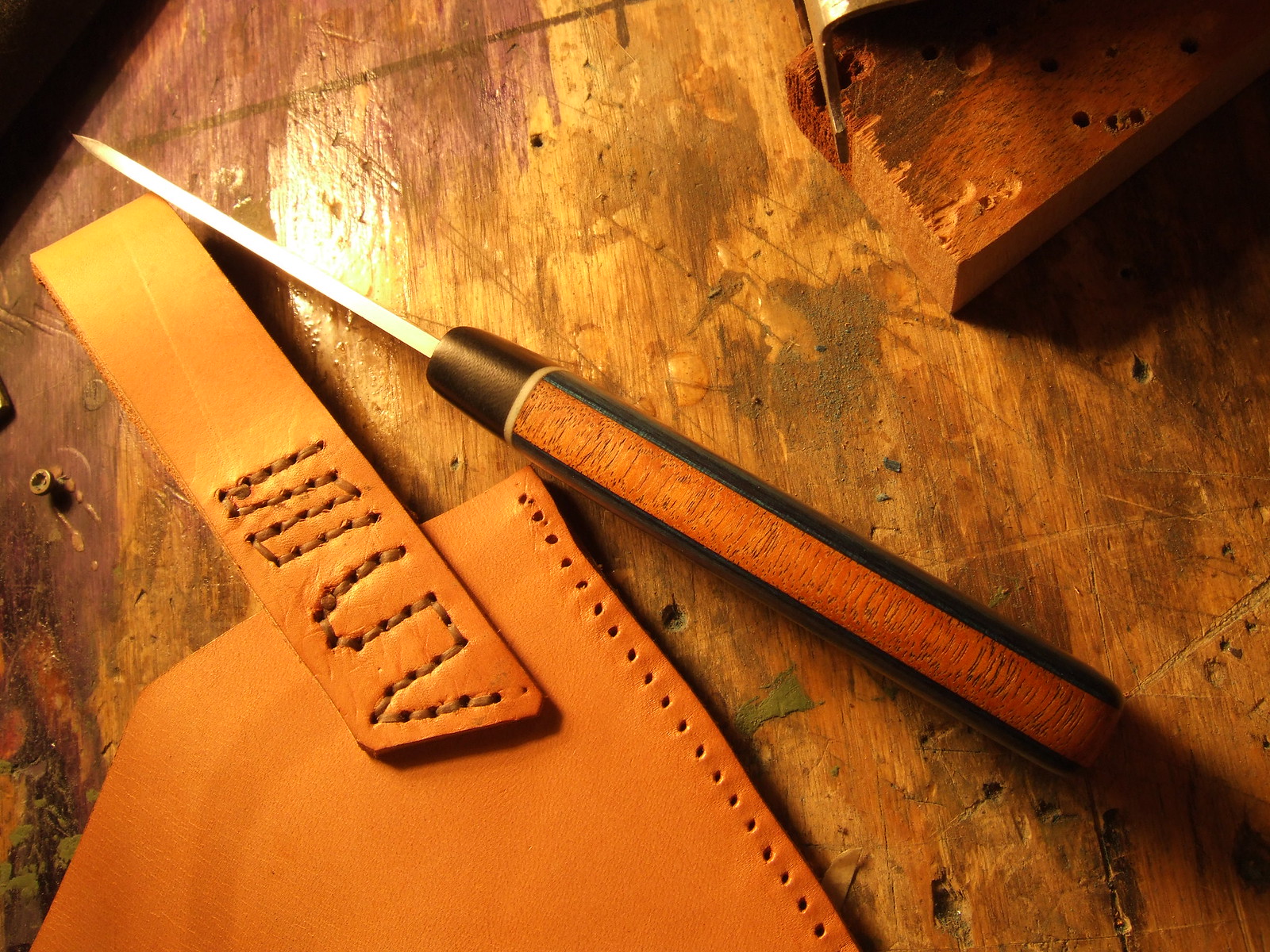
I scrounged around and found some handle materials: Stabilized mesquite and dymondwood. I kept the original micarta guard and g10 spacer. I am getting started on a new sheath.


8428016839_1409c93923_h.jpg


8429110114_3ab4d21aec_h.jpg


8429111344_325cde88ab_h.jpg


I might do some more contouring on the handle. Also, a lanyard hole would make it more visually interesting, even though I am not a big fan of lanyards.
 
Thanks, Grayzer.

My apologies to everybody for so many "disappeared" photos. I think I deleted them from my Flickr, and that made them disappear here.
 
Back
Top