W2 Hamon--Not!

Joined
Nov 20, 2008
Messages
10,188
I've done three knives from Aldo's W2, and can't get a good hamon. It comes out of the FC looking great, but I just can't get it to pop, even though I've etched, sanded, etched all the way to 2000 grit. I've had much better luck getting a great hamon from 1095. So, why is it I can see a good hamon coming out of the etch, but it vanishes once I start working the blade? Any ideas?
 
I may be wrong here, but I think Aldo's W-2 has a bit more manganese than say, the stuff Don Hanson uses. The more manganese, the less you are going to see a good hamon.

Maybe others will chime in with a better answer.

Robert
 
You may just have to adapt your polishing methods and abrasives to the different steel? IDK about 1095, but I've hamon polished W1 and W2, as well as quench line polishing on CruForge and 5160. The W1 and W2 were the closest in characteristics, as one might imagine, but I did treat them differently- but then, I treat almost every blade in it's own way.

What are you using? Flitz, loose abrasives, some other metal polish, combos of several things?

I think Aldo's W2 is the same specs as Don's?
 
I don't know if Aldo's W2 has the same specs as Don's. Judging from my results, I doubt it. But, here's the thing. I don't want to get into technique too much, as I have done plenty of hamon's, although they were on 1095. And, on the 1095, I could see the hamon start to pop at 400 grit. By the time I got to 1500 grit, it was usually a highly visible hamon. With the W2, it just isn't coming out, even when I sand up to 8000 grit with polishing papers. I was wondering if I need to soak the steel longer at or slightly above critical. I'm also noticing the clay isn't popping off when quenched (like it does on 1095), even though I know the steel is at the proper temp. I chalked it up to the Parks 50, which is a brand new oil for me.
 
After the foundation shaping, sand and work only by hand. You want some type of "paste producing" polishing technique. Do not sand/polish dry. Do not use a grinder or buffer.

Hand sand the blade to 1000 grit, and then etch with 10:1 FC or 100:1 nitric acid. Wear rubber gloves, and dab the etchant on with a cotton ball. "Rubbing" in the hamon with your finger tips. Rinse and take to 2000 grit. Repeat the etch. Take to 4000 grit and etch again. Take to 8000 grit, etch lightly, and polish very gently with Flitz. Don't rub the hamon any more than necessary. On a very finicky hamon, you can use 20:1 or even 50:1 FC. Warming the blade with a hair dryer can help.

More elaborate types of finishing methods and materials will give different results, and sometimes it requires some trial and error to pick which style to do. There are two main types of finishing ,which are chosen depending on how the hamon is formed and how it polishes - Hadori and Shashikomi. A simple way to differentiate which is which is to think of Hadori as "hardori" polish technique, and shashikomi as "softshikomi" polish technique. There isn't enough room in a simple post like this to explain the difference in more detail, and it is mostly a mater of experience and looking at the results to decide which to use. Usually you try hadori, and if the results don't work,try shashikomi.

Here are some final polishing (shiagi togi) abrasive/polish choices:
Wet-or-dry paper used with oil (Olive oil or choji oil work well). Start with 1000 grit, and work up to 8000 grit. Cut it into 1/2" squares ( keep them in a labeled zip-lok bag). This is sort of a poor-mans hazuya/jizuya stone.

Traditional Ha-zuya and Ji-zuya finger stones used with just enough water and polishing paste ( nugui).

Flitz - works surprisingly well, and leaves a shiny, but darker surface. Excellent for the ji. You can often use Flitz as nugui with ji-zuya stones.

Red Rouge ( iron oxide) in oil - deep dark luster. Use with a 22 caliber gun cleaning patch and your fingertip.
Chrome oxide powder in oil - usually brighter that rouge. Use as above.
Finely powdered magnetite in oil ( jitekou) - Use as above. Leaves a frostier surface equivalent to 1000-2000 grit.

Usually you have to polish above and below the hamon with different materials to get the detail to show.
Try making the ha bright by polishing with hazuya ( or other shiny method) right up to the hamon, and the ji darker with Flitz or rouge.
A trick for getting this effect is to polish the blade to 8000, and then go back and polish just the hamon with about 1000-2000 grit paper ( or jitekou) and then paint over the hamon with red fingernail polish or model enamel. Try and get the hamon covered exactly, including any wisps, with the polish. Then polish the ha with chrome/oil and the ji with Flitz or rouge/oil. Go right up to the enamel barrier. After the two surfaces are done, the top should be darker and the edge shiny. If that looks good, remove the nail polish with acetone, and use just a touch of Flitz or rouge/oil to blend in any harshness. Done right, this will leave a frosty hamon, a shining ha, and a darker ji. On some fake hamon swords, the same basic procedure is done, but there is no hamon there....just the frosted surface.

Some Google search targets for study:
Shitagi togi
Shiagi togi
Hybrid sword polish
Hadori
Sashikomi
Hadori vs sashikomi
Jitekou

 
You should be able to see your hamon activity straight out of the quench with a 110 grit belt clean up..Aldos original certs for his W2 Mn were 0.215, I think,Dons were about 0.22..Pretty mucn the same..His 1095 is about 0.40..
Less clay, lower temp and a good 8 minute soak has always worked for me..We just did a 1095 hunter with Aldos 1095 and it made a nice hamon..
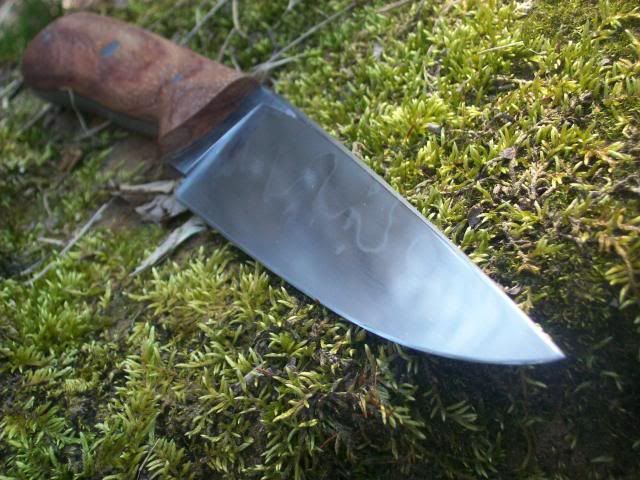
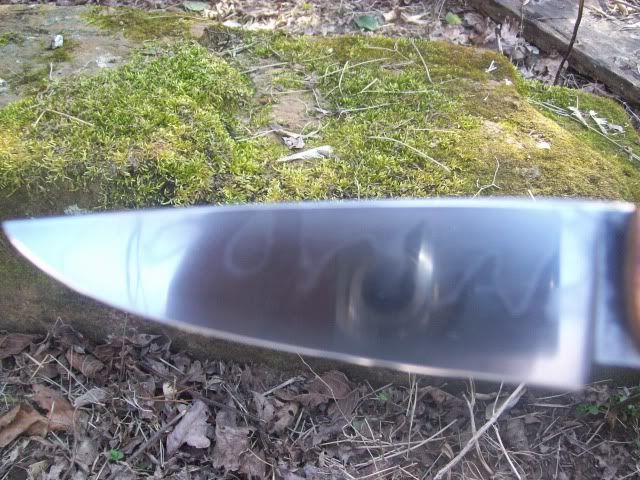
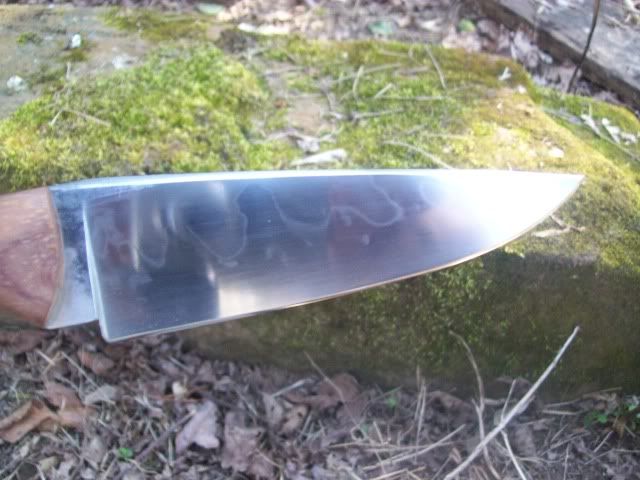
heres a W2 blade of Alsos stuff where the furnace cement was just dabbed on..The hamon follows the cement precisley..This is only a 600 grit polish with flitz..Just a working polish..
100_5366.jpg

100_5361.jpg

100_5360.jpg

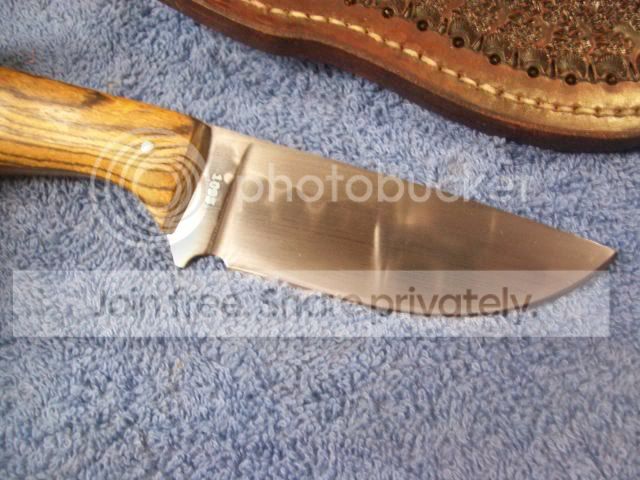
Then heres one with his 1095, again just a 600 grit working polish with flitz..

100_5413.jpg
 
I have been using both Aldo's W2 and some of Don's. I didnt notice much of a difference with the hamon between the two, but sometimes I hit it and sometimes I dont. For me it usually has more to do with being able to keep it hovering at right around 1460 or 1475, but not much more. If I go over 1500, it seems like the hamon doesn't pop as much.
 
The times I have used W-2 if the hamon is there you will see it even when your grinding with a 50 grit belt. I had bought some of the 5/8 W-2 in the round bar a couple years ago from Aldo and wasn't having good luck with it since I wasn't wanting to do a water quench. I traded it for some of his 1095. Problem solved.
 
Lower temps seems to be a key..I usually go for 1440*-1450* on W2 and 1086M...That W2 I posted above follwoed the clay to well..Now i make sure to "draw" the draw on instead of being so haphazard..Not that my hamons are anything special. I think they could be if I would take the time to be a real polish...
 
On mine,( Aldo's W2) i soak 10 minutes at 1450 and straight into #50. Have had pretty great luck with it so far. I do run the clay pretty thin 1/16th i think.
 
Thanks Guys,

I'll try the longer soak at 1450 as several folks mentioned that. When you see a good hamon on a W2 knife or sword it's pretty amazing. The fact is though, it's pretty darned hard making a sword, keeping the grind right, the sword straight, etc., only to not have the hamon turn out decent. I'm pretty tempted to go back to 1095, as I know how to work that steel and have always been able to get a good hamon.
 
Back
Top