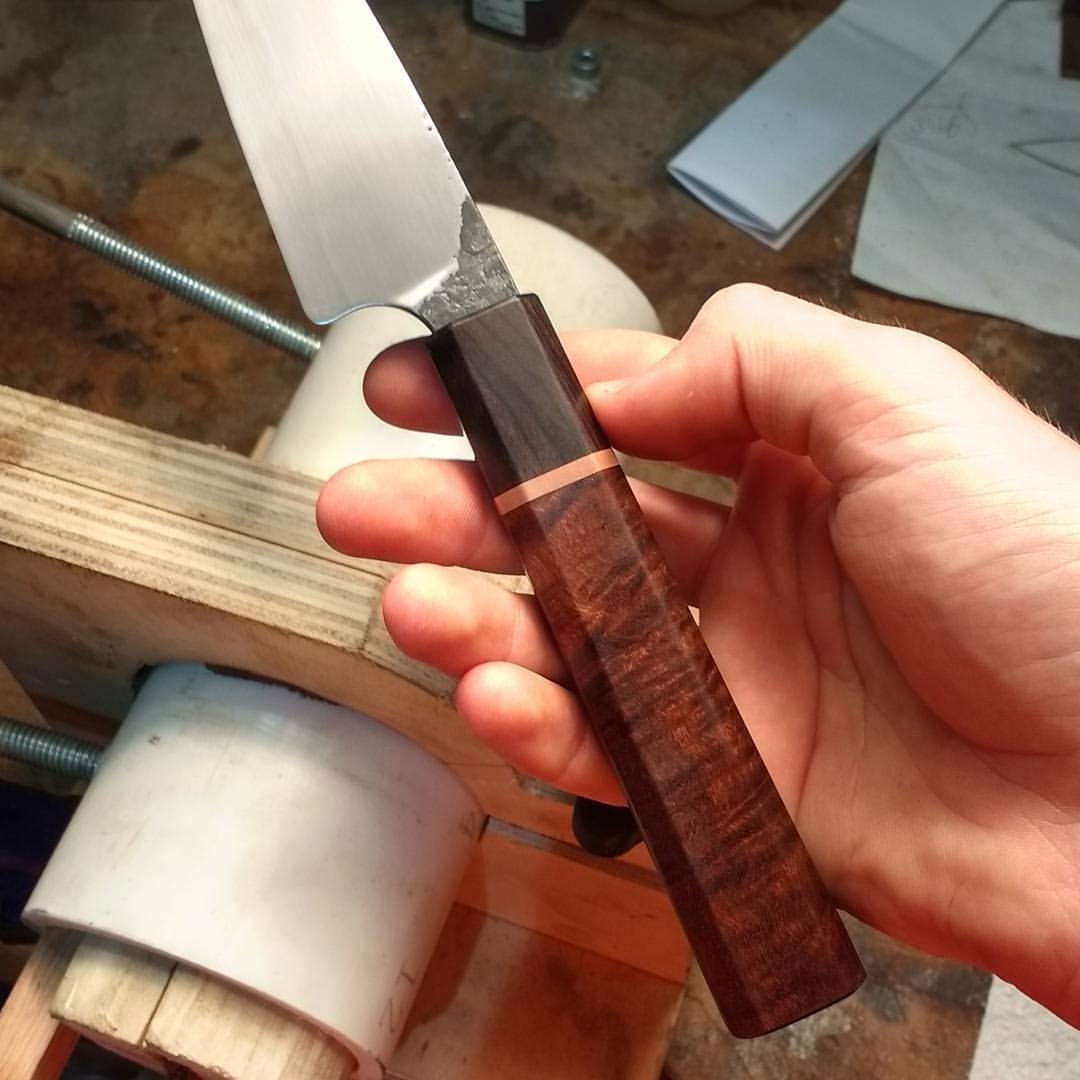
"Wa" do you think?

T.Saslow

Periodic Thinker
Joined
Jun 12, 2013
Messages
479
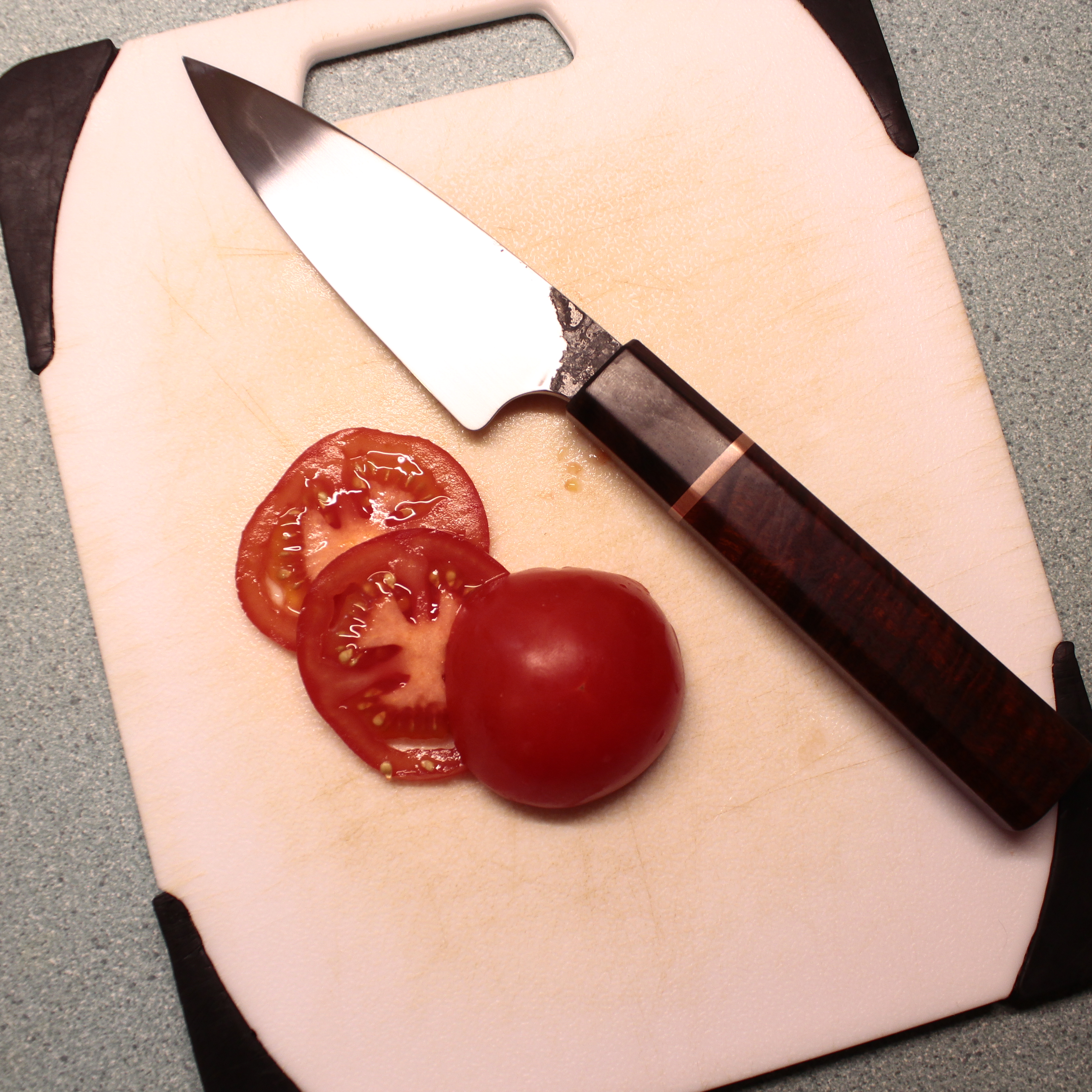
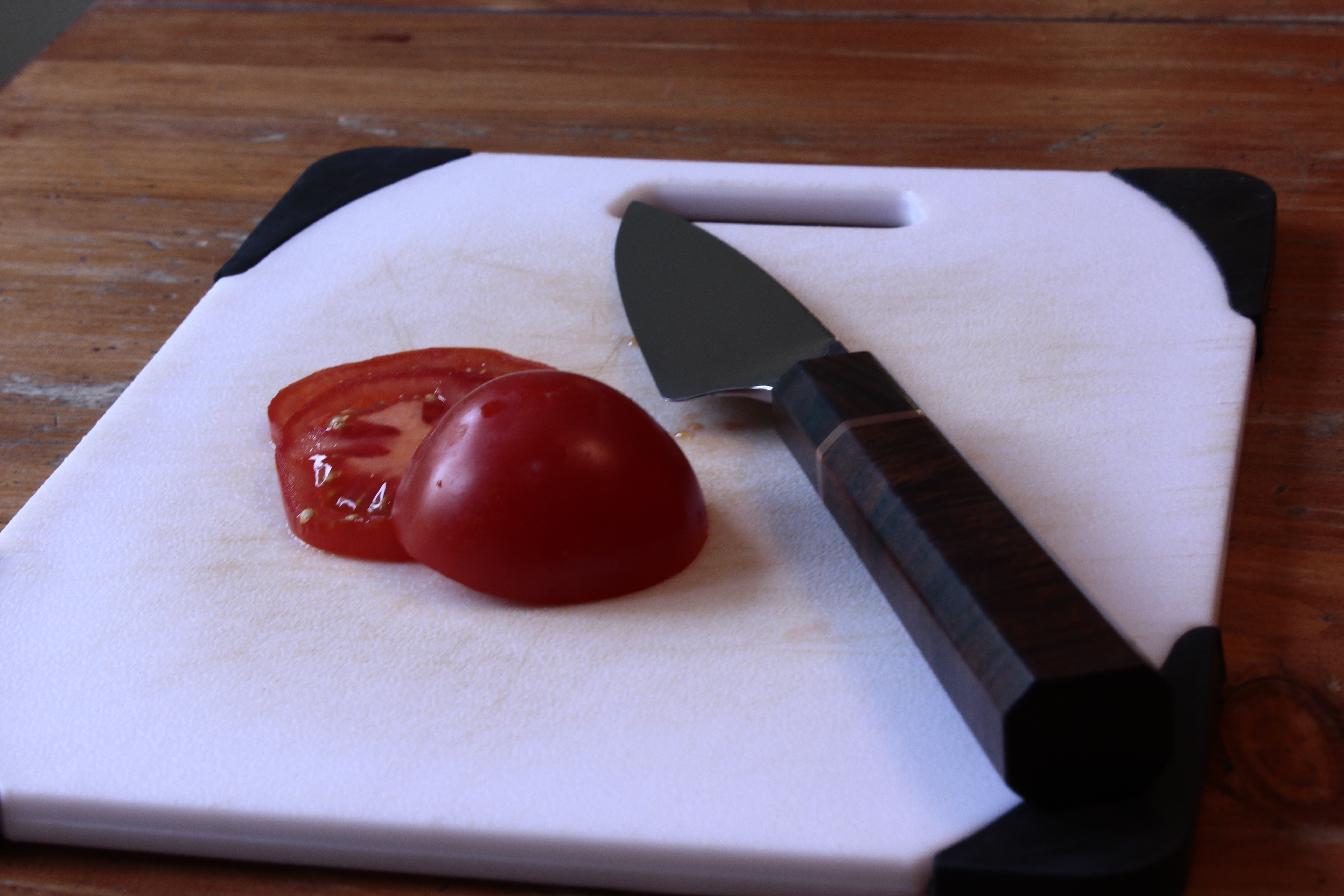
With the coming of summer vacation, I found a lot of free time in the shop and I decided to put more effort into improving on my knifemaking skills and trying new things. Well this one did both. I typically stick to modern EDC style knives and techniques, but on this knife I decided to try my hand at Japanese style kitchen cutlery. To be honest, I don't really know what to call it so I have been calling it a santoku; please correct me :eek:

I used Aldo's W2 hardened in Parks 50 and tempered to roughly 63 RC as suggested in the W2 heat treating thread in the stickies. This was forged from 1/4" stock which is also new for me (I have only forged a couple blades). I flat ground to .015" up to 600 grit and then hand sanded up the grits to 1200 which left me at .007" +/- a couple thou. Spine thickness at the ricasso is something like .157". There is a full distal taper so it has a fine tip, but a "robust" heel (the heel is still a freaking laser by my current standards).

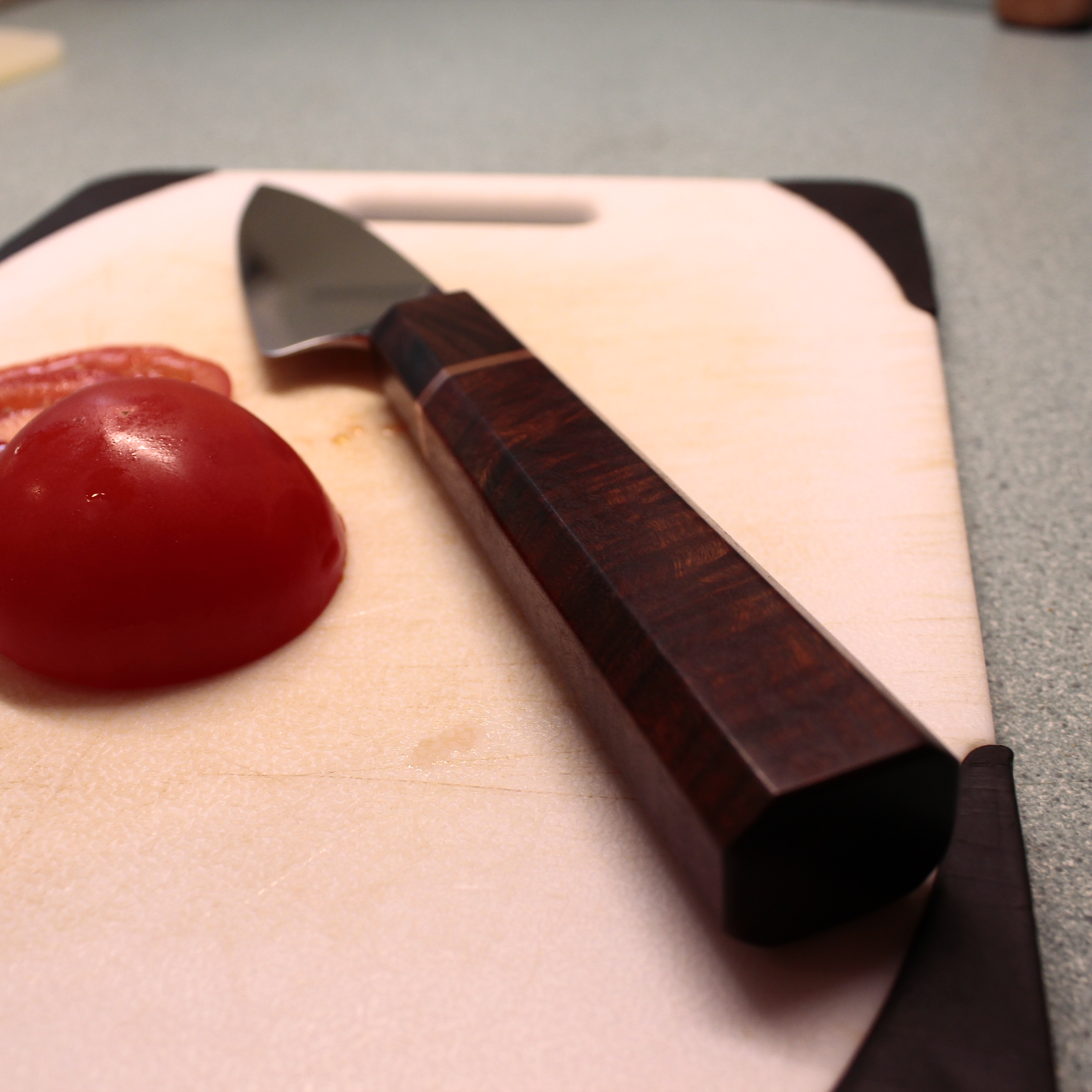
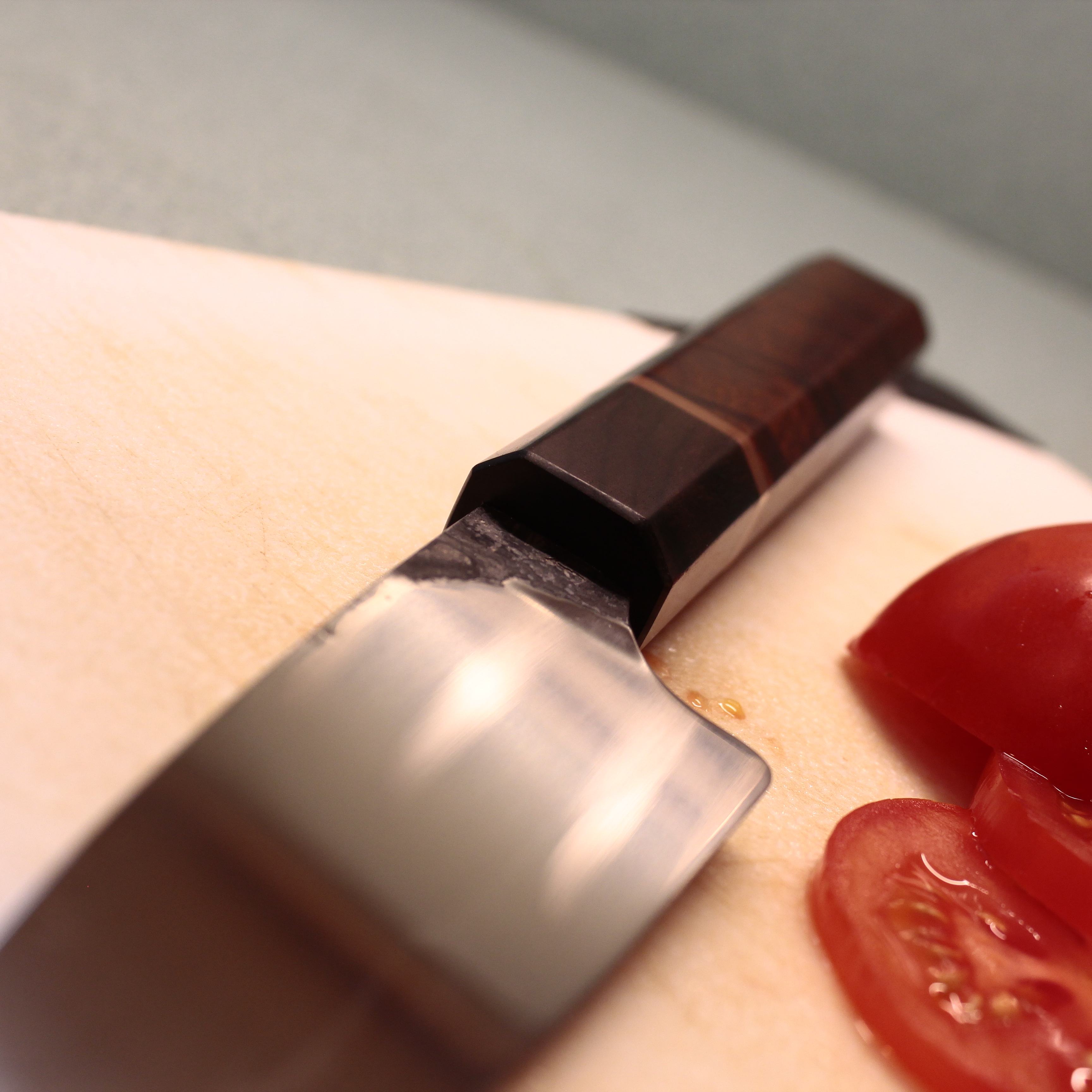
For the handle,I went for a Wa style which I really like the look of. It was constructed from African Blackwood and Australian Ringed Gidgee from Ben ( Greenberg Woods Greenberg Woods ). There is also an 1/8" copper spacer and two 1/16" locator pins running about .5" into either handle material. I burned in the tang and used G-Flex epoxy. There is a nice taper from back to front in both axis and everything is finished to 2000 grit with one coat of danish oil and then a coat of carnauba based wax (hand buffed and then a quick machine buffing w/o compound). I might put another coat of wax on...

So What do you guys think?
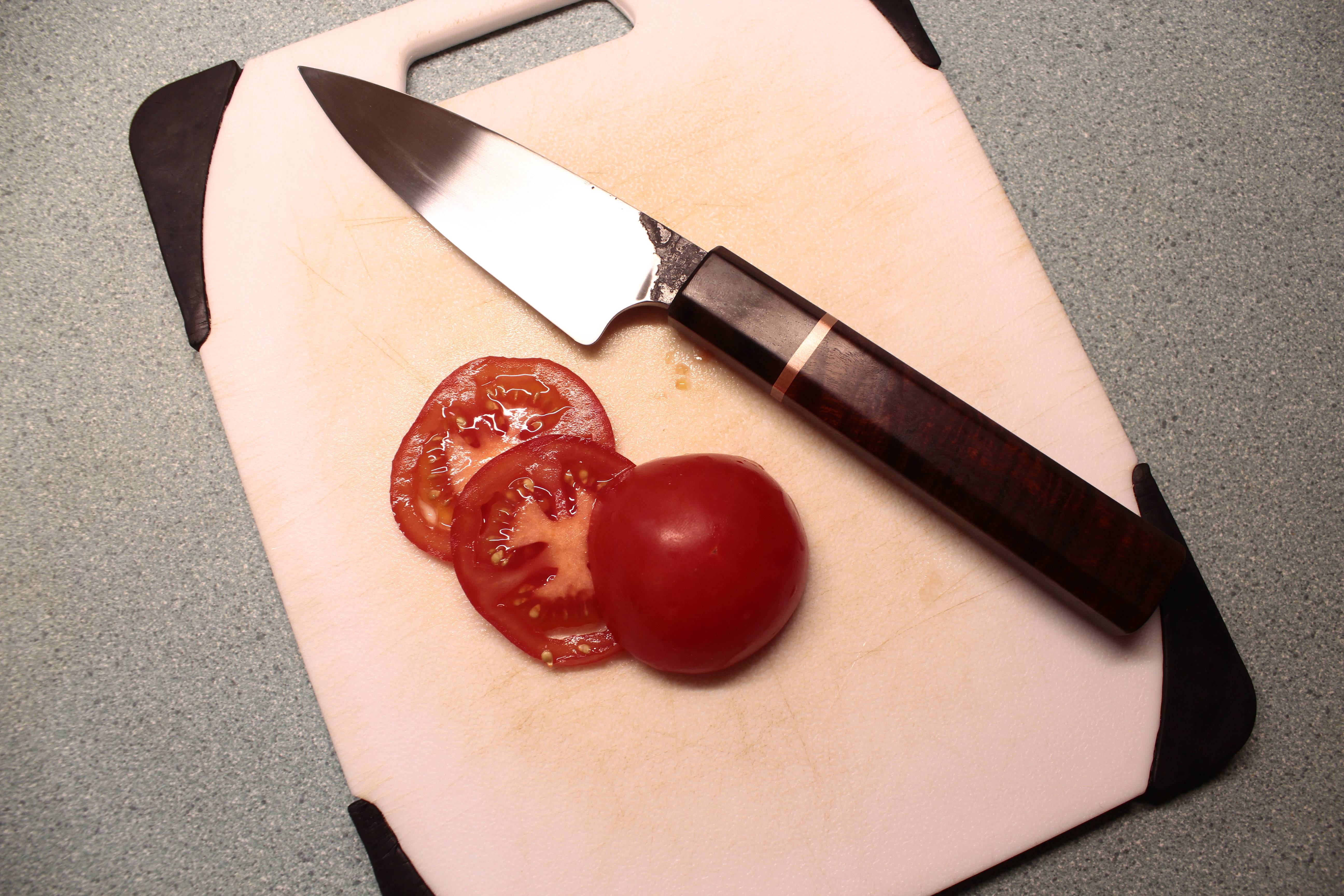
K63fUph.jpg


d48QSiH.jpg


ju1dvBn.jpg


9tQUp6s.jpg


G11AdNP.jpg


Wi7yfii.jpg


asO0ZZX.jpg


Thanks for looking,
-Tanner
 
Tanner,
I dont want to say how happy i am to see young guys making knives seeing as im a year or two older than you.

But I am happy to see young guys doing clean, classy work. The handle has very nice fit and finish, the use of African blackwood as a bolster adds a lot to the knife.

It looks clean. It looks polished. I find that to many young makers tilt to the Tacticrap with dyed burl handles, 1/4 inch steel and super death saber grinds for aggravated wound channel and what not.

You are doing a great job. The personally i would have used a slightly thinner handle, but thats a preference. You have a great sense of design, the lines look good. Keep it up, and please let me know if you ever need any more wood or advise.

Ben Greenberg
Greenberg Woods
 
1) Looks really good. I really like the clean handle, clean and refined blade, but with a little bit left on from the forge to show how you made it.
2) I think the blade is too thick for what it is. It is probably fine for meat or fish, but for most vegetables there is going to be a lot of wedging in the cut. I would take it down to about 1/16" or 3/32" at the most.
3) Santoku normally have a wider blade with a less pointy tip. I would call this a funayuki because of the triangular shape, but you could also call it a petty. See here for more information: http://www.zknives.com/knives/kitchen/misc/usetype/all/index.shtml

- Chris
 
Tanner,
I dont want to say how happy i am to see young guys making knives seeing as im a year or two older than you.

But I am happy to see young guys doing clean, classy work. The handle has very nice fit and finish, the use of African blackwood as a bolster adds a lot to the knife.

It looks clean. It looks polished. I find that to many young makers tilt to the Tacticrap with dyed burl handles, 1/4 inch steel and super death saber grinds for aggravated wound channel and what not.

You are doing a great job. The personally i would have used a slightly thinner handle, but thats a preference. You have a great sense of design, the lines look good. Keep it up, and please let me know if you ever need any more wood or advise.

Ben Greenberg
Greenberg Woods

Thanks Ben! I agree with you, It pains me to see beautiful knife designs that wood would suit perfectly with a gaudy synthetic material thrown on it that doesn't suit the design. Sometimes it has it's place, but I'll stick with wood on most of my knives :cool:

I can see what you mean by the handle looking a bit thick. I looked up Wa handle dimensions here on Bladeforums as well as a few kitchen forums and tried to base the overall length and taper off of the threads I found. I didn't quite pay as much attention to the thickness as I was doing the shaping, I was going more for feel and what looked proportionally correct. I may have missed that mark a little, but I guess the beauty of the Wa handle is the consistent taper from back to front which will allow for the user to adjust his/her grip easily. Speaking of his/her grip, the people I consulted with regarding the shaping of the handle were my parents and their reactions fell on two totally opposite sides of the spectrum. Dad disliked the straight and angular handle and thought it was a bit uncomfortable, but my mother really likes the feel of it and the octagonal shape because it registered well in her hand and didn't twist. I guess I'm a bit of a momma's boy.

1) Looks really good. I really like the clean handle, clean and refined blade, but with a little bit left on from the forge to show how you made it.
2) I think the blade is too thick for what it is. It is probably fine for meat or fish, but for most vegetables there is going to be a lot of wedging in the cut. I would take it down to about 1/16" or 3/32" at the most.
3) Santoku normally have a wider blade with a less pointy tip. I would call this a funayuki because of the triangular shape, but you could also call it a petty. See here for more information: http://www.zknives.com/knives/kitchen/misc/usetype/all/index.shtml

- Chris

Thank you Hesparus, I appreciate the insight. I agree with your observation that the steel was too thick. To be honest, forging a blade thinner than I did while keeping everything straight, symmetric, and clean would have been a huge undertaking given my experience level. In the past, I have only forged three blades and of those blades, not a single one was really forged to final thickness like this one. I just forged the profile and removed a ton of steel until I got the thickness I wanted. This knife was a step out of my comfort zone in that I tried forge in the profile, bevels, and overall thickness such that I could maintain the forged finish you commented on. Leaving the forged finish at the ricasso and north of the plunge line was part of the design and I did what I could to stay true to the design.

I think you're right in calling it a Funayuki; the blade shapes are very similar. Thanks for sharing that reference site, I'll make sure to use it in the future!

ETA: I measured the thickness at the spine right above the plunge line and it measured .136". Still too thick, but it's a bit better than the .157" at the back of the ricasso.
 
Last edited:
Looks pretty darn nice! Well done . I'm sure it will fit into the kitchen well if your Mom still spends time there.
Frank
 
Back
Top