
Howdy!
I hope I can refrain from boring you with too many inane questions. I lurked for a while before the forums because registered only, and I am just getting back into the garage for some work, so I decided to register.
Here's where I am with my knife making. I have ground several from barstock with mixed results. I have made or finished a couple of kitchen knives that are fine cutting instruments but I see lots of room for improvement. My poor grinding equipment (and low budget) makes grinding from barstock a real chore, so I moved into assembling pre-ground blanks from TKS. While much easier, I am quickly noticing some quality issues with these blanks, mostly rounded edges everywhere, but I am getting a lot of practice finishing handles. Some examples:
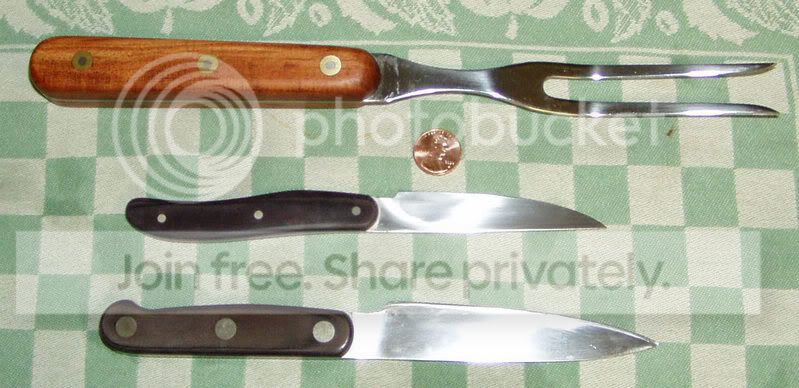
Top 440C BBQ fork from TKS, mesquite I cut and seasoned (2+ years), Loveless bolts
Middle, one of the ones below nearly complete
Bottom, 440C from barstock, basically a copy of a Heinkel 5 star, nickel silver rivits, HT by TKS
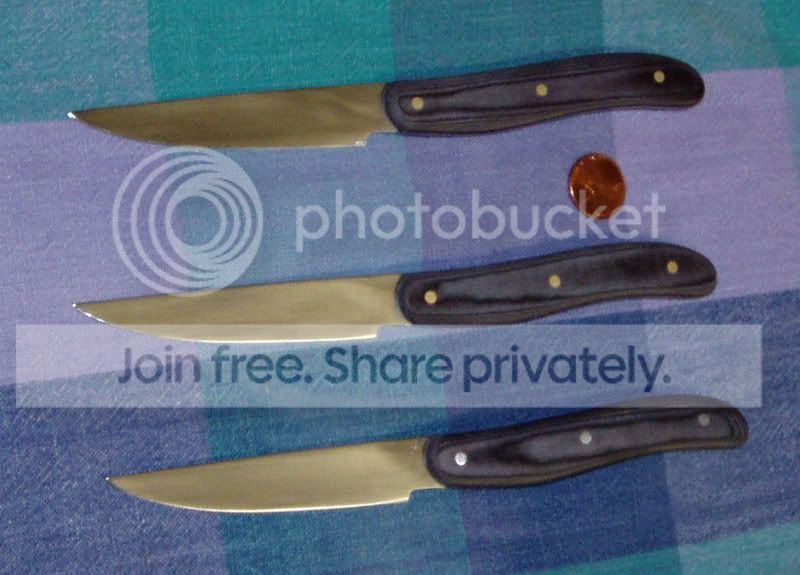
Mother's day gifts to my wife, mother, and Mother-in-Law
Blanks from TKS, cryo treated 440C, maroon linen micarta, nickel silver pins
So I have one problem thus far that I could use some advice with. In epoxying the slabs, the extra coming out the front is giving me trouble. With micarta I just wax the slabs and it peels right off. With wood though, the wax soaks in enough that the finish will not penetrate, leaving an ugly line. I can sand it down, but inevitably scratch the blade in doing so. Tape still leaves a small line to deal with.
Suggestions?
Gentle critiques of my work thus far?
Anyone with a good source for high quality blanks? While the ones I have gotten thus far from TKS are good working knives, the lack of 'crispness' is leaving me underwhelmed, as is the lack of top grade steel like ATS34 and above.
I hope I can refrain from boring you with too many inane questions. I lurked for a while before the forums because registered only, and I am just getting back into the garage for some work, so I decided to register.
Here's where I am with my knife making. I have ground several from barstock with mixed results. I have made or finished a couple of kitchen knives that are fine cutting instruments but I see lots of room for improvement. My poor grinding equipment (and low budget) makes grinding from barstock a real chore, so I moved into assembling pre-ground blanks from TKS. While much easier, I am quickly noticing some quality issues with these blanks, mostly rounded edges everywhere, but I am getting a lot of practice finishing handles. Some examples:
Top 440C BBQ fork from TKS, mesquite I cut and seasoned (2+ years), Loveless bolts
Middle, one of the ones below nearly complete
Bottom, 440C from barstock, basically a copy of a Heinkel 5 star, nickel silver rivits, HT by TKS
Mother's day gifts to my wife, mother, and Mother-in-Law
Blanks from TKS, cryo treated 440C, maroon linen micarta, nickel silver pins
So I have one problem thus far that I could use some advice with. In epoxying the slabs, the extra coming out the front is giving me trouble. With micarta I just wax the slabs and it peels right off. With wood though, the wax soaks in enough that the finish will not penetrate, leaving an ugly line. I can sand it down, but inevitably scratch the blade in doing so. Tape still leaves a small line to deal with.
Suggestions?
Gentle critiques of my work thus far?
Anyone with a good source for high quality blanks? While the ones I have gotten thus far from TKS are good working knives, the lack of 'crispness' is leaving me underwhelmed, as is the lack of top grade steel like ATS34 and above.


