
-
The BladeForums.com 2024 Traditional Knife is available! Price is $250 ea (shipped within CONUS).
Order here: https://www.bladeforums.com/help/2024-traditional/
You are using an out of date browser. It may not display this or other websites correctly.
You should upgrade or use an alternative browser.
You should upgrade or use an alternative browser.
Warped Blades
- Thread starter PEU
- Start date


- Joined
- Jul 22, 2014
- Messages
- 1,050
I have a cheap shop press that I use to straighten out all my steel blanks, either in bar form or after being profiled. It has made my life a lot easier.
Pictures!??!:thumbup:
14c28n is very soft in its annealed state.
You got a big batch, while i just have to fiddle with 1 blade, but i just straighten by hands on the ledge of the bench the most of the times.
A press still require shimming to overbend the blanks, a bottle jack should give power and precision... but i found it to be more quick setup doing it by hands...eventually i'm using a vise too.
You got a big batch, while i just have to fiddle with 1 blade, but i just straighten by hands on the ledge of the bench the most of the times.
A press still require shimming to overbend the blanks, a bottle jack should give power and precision... but i found it to be more quick setup doing it by hands...eventually i'm using a vise too.
Being a stainless you run the risk of "air quenching" it.
Even if the temperature is pretty low to snatch enough carbon from the Cr, some of it will still go into solution and will give you trouble grinding, not to mention the likelyhood of new warping induced by the uneven pseudo-austenitizing.
I suggest you to straighten cold since it's not a thick stock, but if you want to lower the yeld point try to stay under 500°C....but it's not worth the hassle imho.
If you are afraid of new warping in the final quench, run before a stress relieving under critical soak.
Even if the temperature is pretty low to snatch enough carbon from the Cr, some of it will still go into solution and will give you trouble grinding, not to mention the likelyhood of new warping induced by the uneven pseudo-austenitizing.
I suggest you to straighten cold since it's not a thick stock, but if you want to lower the yeld point try to stay under 500°C....but it's not worth the hassle imho.
If you are afraid of new warping in the final quench, run before a stress relieving under critical soak.

- Joined
- Jul 25, 2007
- Messages
- 1,380
I've straightened several thousand laser-cut blanks as follows. After a little practice I was able to do 50 per hour to within 0.010". Its really important to understand that there is no such thing as 'perfectly' straight - often I encounter comments about straightness that are devoid of an actual measurement.
You need some type of basic anvil (I used a surface-ground block of cast iron), a rubber mallet, and assorted pieces of shim material. You also need a flat reference (piece of granite, straight edge, etc) mounted at eye level, with a gentle backlight.
Place two shims on the anvil, spaced about 4" apart. You can glue them down if desired. Take a knife, place if on the flat reference and flip it so the belly (convex) is up. Look at the gap to get an idea of how much warp you need to remove. Now place the knife on the anvil such that it bridges the two shims and give it a few mallet blows in between the shims. Put it back on the flat reference and see what you accomplished. Continue to repeat this process, and you'll get a feel for it. A good trick is straighten in 3 steps: first, straighten one half of the knife; second, straighten the other half; and third, straighten the one remaining kink in the middle.
When you use thicker shims, or place the shims closer together, you increase the effect of each mallet blow. You can place an array of shims on the anvil to create several stations of varying aggressiveness.
For fine tuning, you can experiment with softer material, such as plastic or leather for the shims. In fact, you can lay a strip of leather down on the anvil, with the knife on top. When you strike the knife, the leather directly underneath the mallet will compress.
I prefer this method because it prevents overcompensation. You can remove a great deal of the warp by simply clamping a stack of knives together very tightly, with as many clamps as possible, and putting them in the oven at tempering temps.
You need some type of basic anvil (I used a surface-ground block of cast iron), a rubber mallet, and assorted pieces of shim material. You also need a flat reference (piece of granite, straight edge, etc) mounted at eye level, with a gentle backlight.
Place two shims on the anvil, spaced about 4" apart. You can glue them down if desired. Take a knife, place if on the flat reference and flip it so the belly (convex) is up. Look at the gap to get an idea of how much warp you need to remove. Now place the knife on the anvil such that it bridges the two shims and give it a few mallet blows in between the shims. Put it back on the flat reference and see what you accomplished. Continue to repeat this process, and you'll get a feel for it. A good trick is straighten in 3 steps: first, straighten one half of the knife; second, straighten the other half; and third, straighten the one remaining kink in the middle.
When you use thicker shims, or place the shims closer together, you increase the effect of each mallet blow. You can place an array of shims on the anvil to create several stations of varying aggressiveness.
For fine tuning, you can experiment with softer material, such as plastic or leather for the shims. In fact, you can lay a strip of leather down on the anvil, with the knife on top. When you strike the knife, the leather directly underneath the mallet will compress.
I prefer this method because it prevents overcompensation. You can remove a great deal of the warp by simply clamping a stack of knives together very tightly, with as many clamps as possible, and putting them in the oven at tempering temps.
What stezann says - 14C28N is as limber as a dishrag fresh out of the quench plates. Do the normal heat treat, then as the blade is moved from quench plates, just work it by hand - easy to bend and straighten. Some of those bends shown I would straighten before HT'ing. I've been amazed how easy 14C28N bends (and AEB-L also) even after it cools enough to hold in hand. It takes a few minutes to really "settle down" and not bend.
Ken H>
Ken H>

- Joined
- Jul 25, 2007
- Messages
- 1,380
Nope, water-jet will not bend your knives, because there is no heat. ( laser gives a lot of heat into material)
True, waterjet will not literally CAUSE a warp, but if the plate/sheet has internal stress (most coil products do, since they are annealed in coil state), waterjet will certainly produce parts that are warped. In other words, it is perfectly possible to put a flat plate of steel on a waterjet table, and end up with warped parts.
- Joined
- Dec 21, 2013
- Messages
- 42
Are you pre grinding them before heat treat? I use alot of aeb-l that has the same problem (waterjet cut) but during the plate quenching everything goings stright. If one is crazy bend I use a rubber dead blow and an anvil.

PEU
Gaucho Knifemaker
- Joined
- Aug 6, 2006
- Messages
- 1,176
Today I started unwarping the blades, using the "The Hammer of Thor" (a wooden mallet) and a 0.5kg (1.1lb) hammer, a piece of granite and patience I straightened to my best all the blades, now they are in the oven for stress relieving at 650C.
After I straightened the blades I took one of the larger ones and surface grinded one side, I took less than 0.1mm, when I released the magnet it warped a lot, even more than the pre straightening hammering began, so this confirmed that the steel needed stress relieving ASAP.
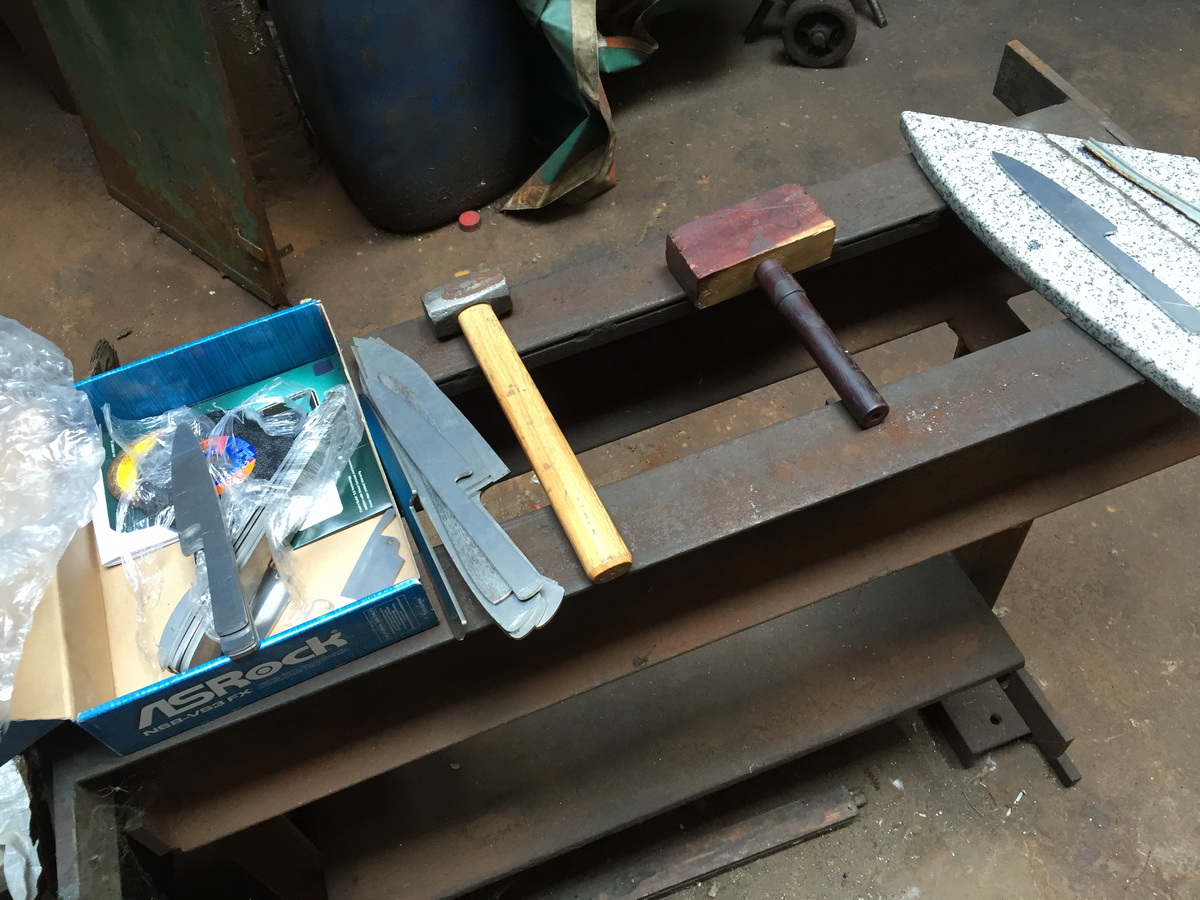
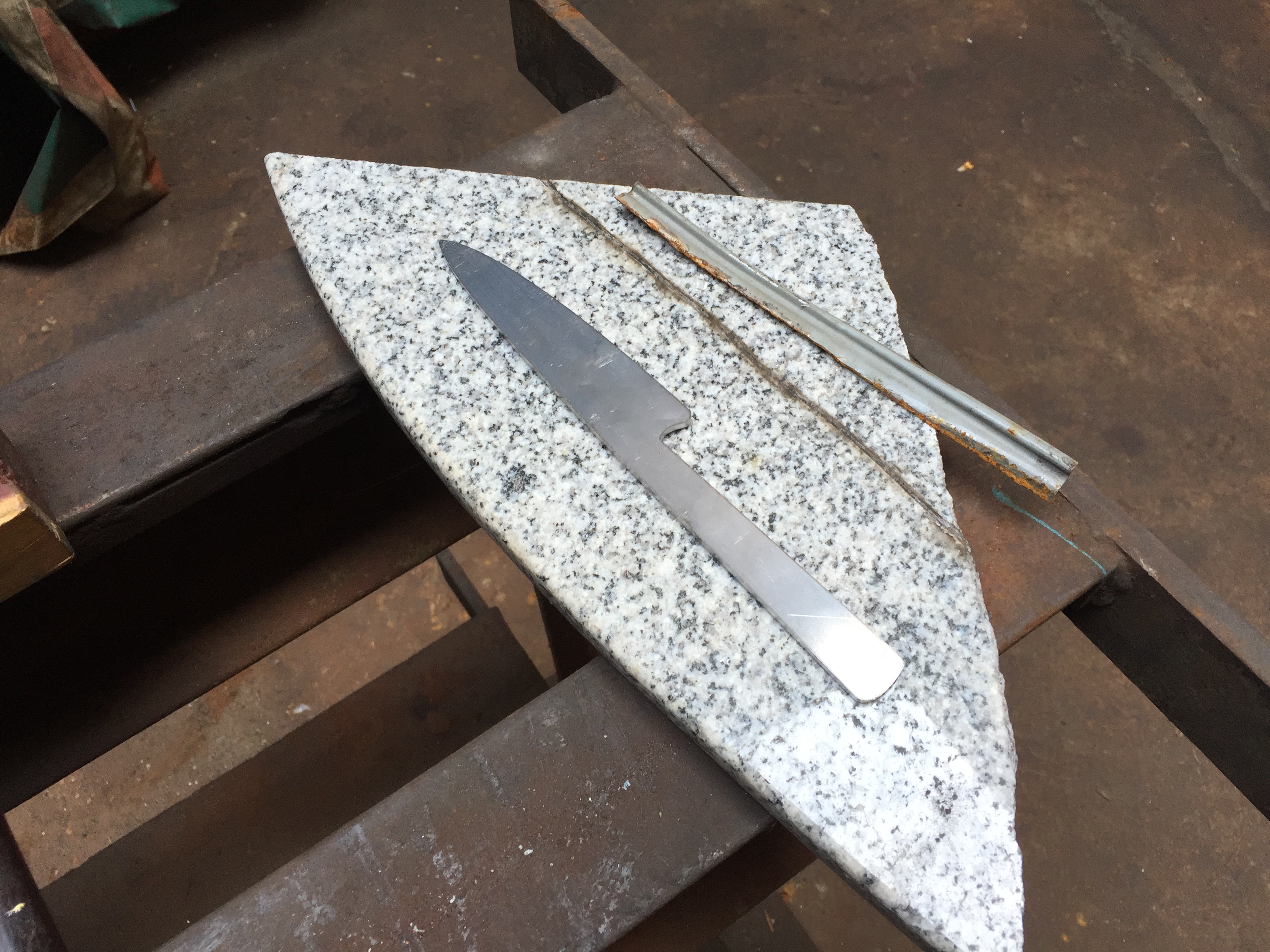
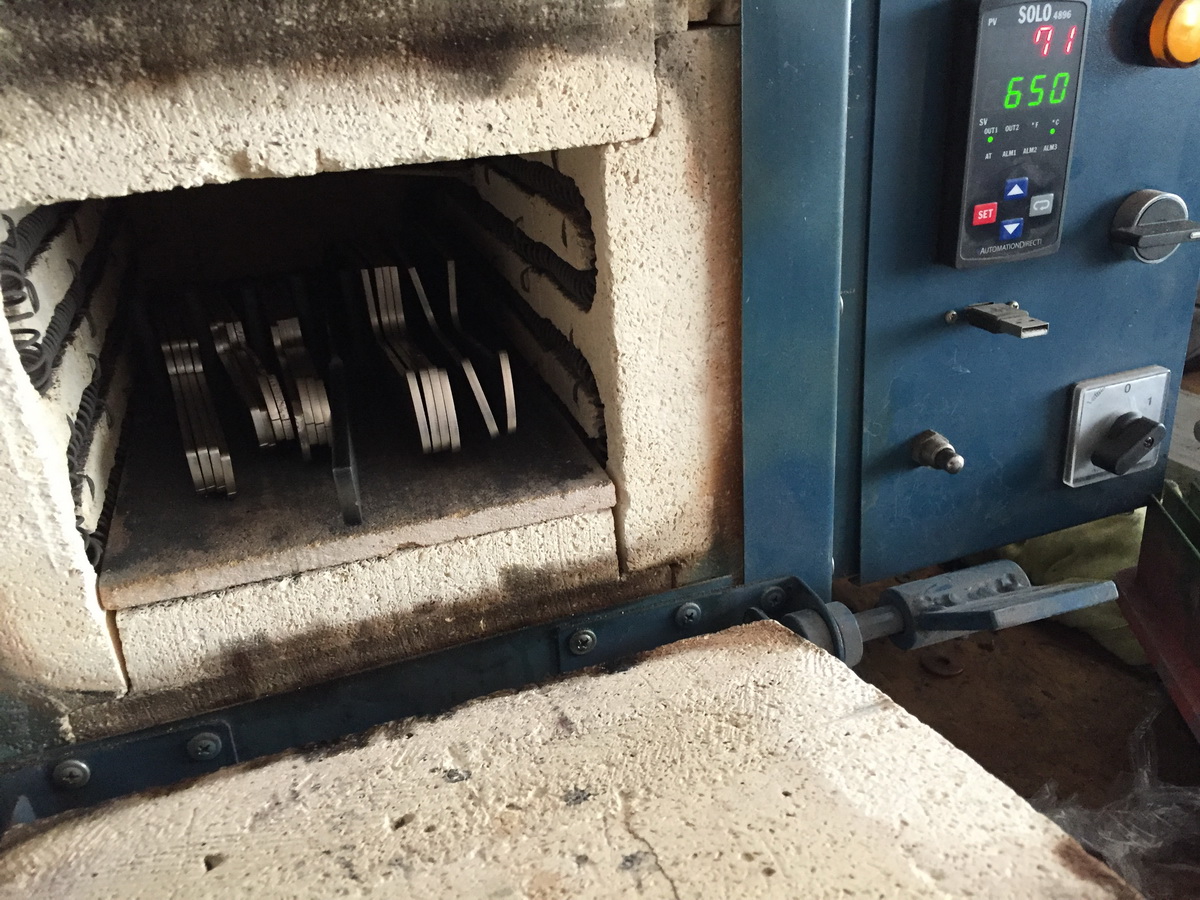
For comparation purposes, here is the before & after
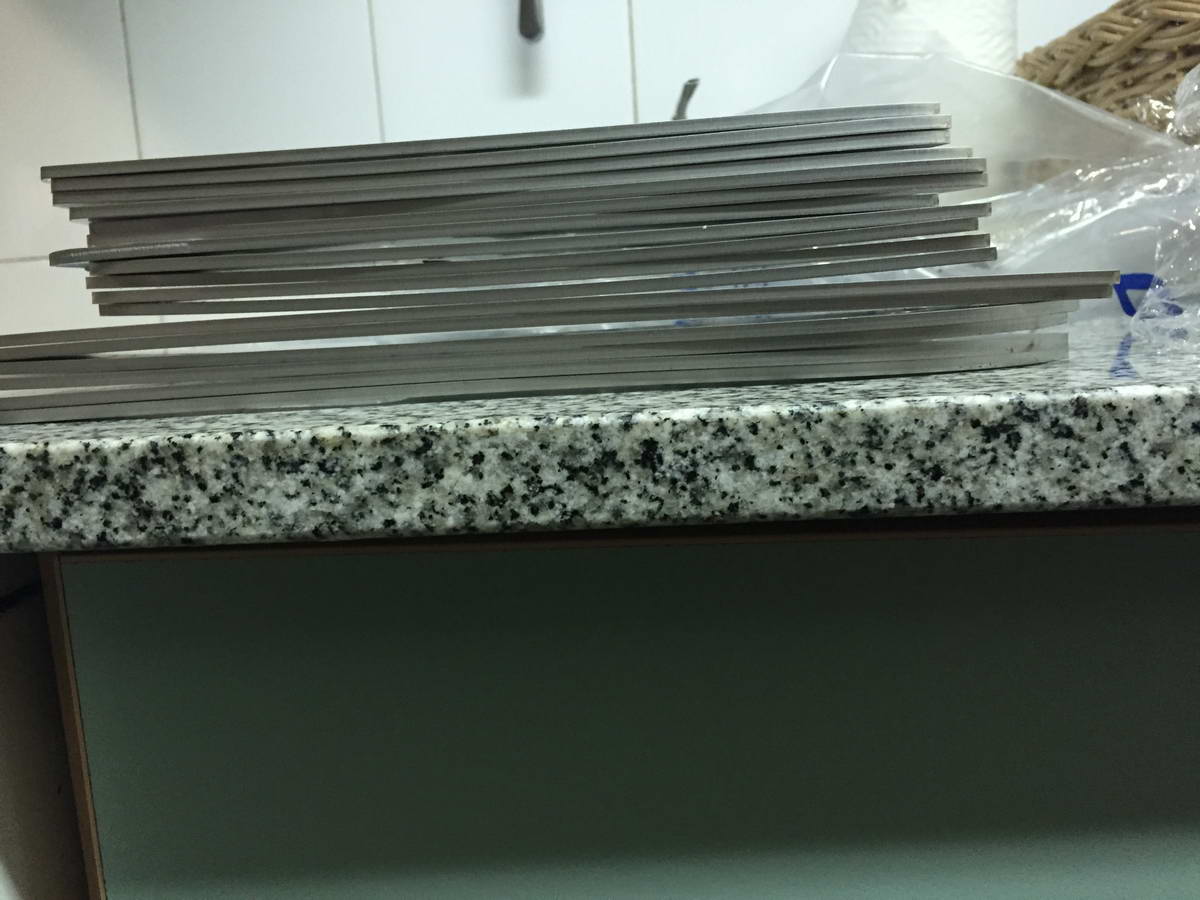
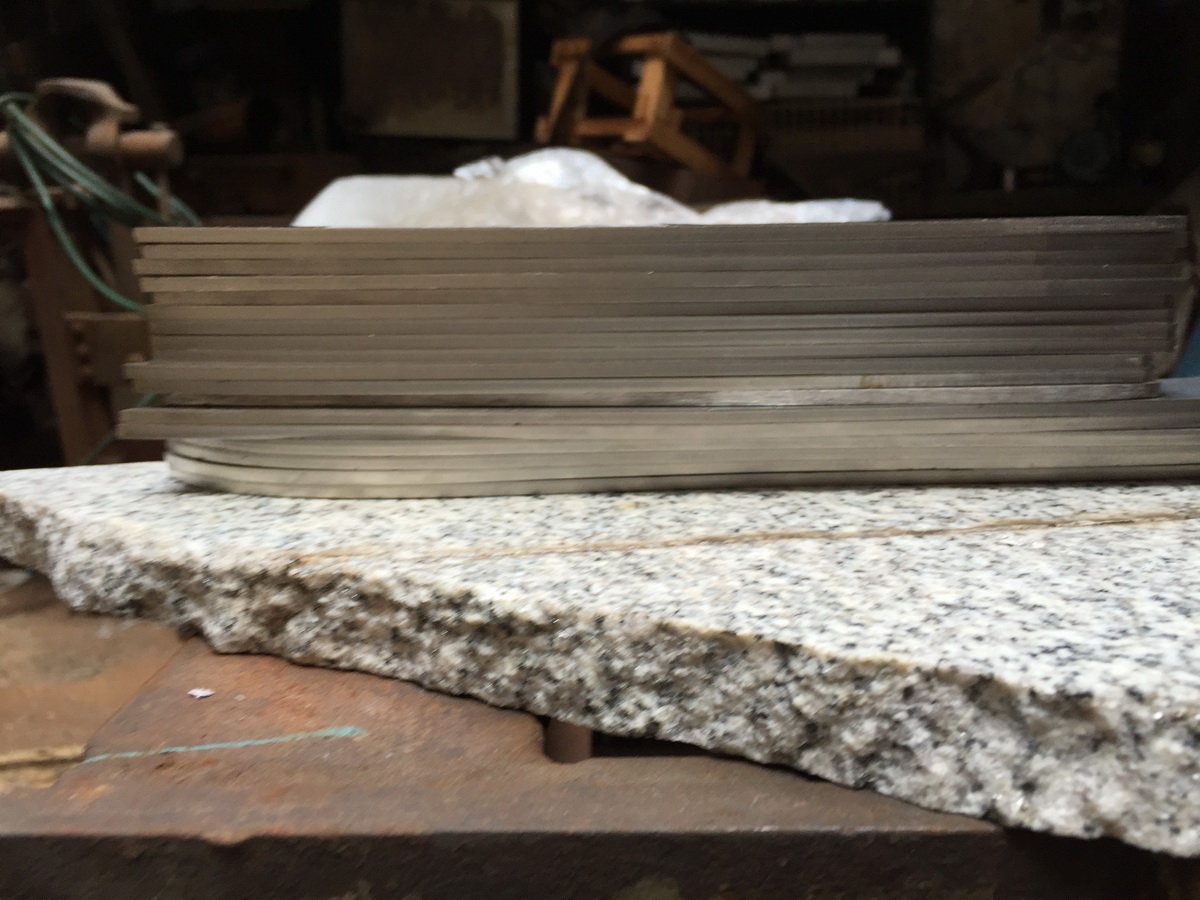
I'm sure the The Hammer of Thor had a lot to do in the straightening
Pablo
After I straightened the blades I took one of the larger ones and surface grinded one side, I took less than 0.1mm, when I released the magnet it warped a lot, even more than the pre straightening hammering began, so this confirmed that the steel needed stress relieving ASAP.
For comparation purposes, here is the before & after
I'm sure the The Hammer of Thor had a lot to do in the straightening
Pablo
- Joined
- Jul 22, 2014
- Messages
- 1,050
PEU is that a homemade kiln? Is for what is the usb type thing below the PID?
PEU
Gaucho Knifemaker
- Joined
- Aug 6, 2006
- Messages
- 1,176
Yes, I made the kiln, here is the WIP The USB port is provided via an RS-485-USB converter. It allows you to see the temperature curves, set up the controller, etc. I barely use nowadays...


Pablo
Pablo
PEU
Gaucho Knifemaker
- Joined
- Aug 6, 2006
- Messages
- 1,176
New batch received, same problem, this time I used metallurgy as the solution. Heated to 1650F (900C) the blades and then pressed the blades between aluminum sheets and a railroad on top, most came out straight as an arrow, some had to be reheated and the procedure repeated.
Even with this temperature the steel hardened a little, around 50RC, so now I'm doing an anneal cycle on the whole batch.
[video=youtube;_m-HucplC7Q]https://www.youtube.com/watch?v=_m-HucplC7Q[/video]
Pablo
Even with this temperature the steel hardened a little, around 50RC, so now I'm doing an anneal cycle on the whole batch.
[video=youtube;_m-HucplC7Q]https://www.youtube.com/watch?v=_m-HucplC7Q[/video]
Pablo