Weird forging press idea

Joined
Jun 11, 2006
Messages
8,651
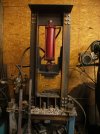
So most of you know I have been planning to build a big press for awhile. And some of you know my dark secret that I am still using a tiny mini press. Last month while at work I was thinking about press styles and there pros and cons, H vs C. So I started wondering if you could have the strength of an H press with a C press if you re distributed the fulcrum point. Well that went down a rabbit hole real quick and this "thing" was born. Salem named it the helve press but if I had to give it a letter I think I would call it the T press.

Any way I will try my best to discribe how it works. Like a normal C press it has its ram on the (left) forging side, we will call it the primary ram. The top of this ram is connected to a helve of sorts that pivots in the middle of the ibeam. The helve then connects to another ram on the (right) back side, we will call this the secondary ram. When you forge the load is transferred equally to both sides and the center of the ibeam where the helve pivots takes all the load. Becaus this is centred on the beam all the load is straight up for the most part. Now you might be asking why a secondary ram well my thought is you use the secondary ram to adjust the stroke of the primary. So you select your primary ram so when fully extended the dies have about a 1" gap When the helve is level. Then you adjust the secondary ram to open or close this gap. This allows you to accurately adjust your forged thickness on the fly and not need spacer blocks which just get in the way. Now I know hydraulic oil does compress but it's not very much at around .4% per 1000psi. And if you bump the secondary ram up in Diamater then the fluid will experance less total psi and have less compression. In the end we are talking around .01 compression with full primary ram tons. So am I just whacked and gone overboard?

Photo%20Jul%2022%2C%2010%2056%2044%20AM.jpg
 
BSC
But it might work. Fulcrum will need to be very heavy.
Hoss
 
Last edited:
inventive thinking, cool idea. people will enjoy the adjustable gap. maybe if you made the arm shaped like an arch (out of multiple plates with spacers between) instead of a square or tube it might flex less ? 500px-R7_Fig33 by john april, on Flickr
 
That's essentially how the punch side of a typical Scotchman ironworker works. The fulcrum idea anyway.
 
I've put some thought into off the wall press ideas as well, but I keep coming back to the H or C.

I think Karl and Hoss hit it on the head. The thing would have to be so much beefier than what a regular press already is that it would pretty much stop me there personally. I'm no engineer but I think you would loose a good amount of power going from a direct attached die to one that is on a pivot like that.

I applaud your out of the box thinking JT, just not sure this one is a winner.

-Clint
 
That's essentially how the punch side of a typical Scotchman ironworker works. The fulcrum idea anyway.

There are power hammers out there like that, I believe they are called helve hammers if my memory is right. I don't care for them because they are so much larger than a LG style hammer. And moving them sucks... I'm moving out of my shop and I own a forklift. Let me tell you its nice to have one, but man balancing a little power hammer base on forks is no bueno, I was just doing it today. I sure will be happy once all my tools are in the new shop.

-Clint
 
Don't try to reinvent the wheel unless you plan on making it round. :D
 
There are engineering issues. Mainly with the force distribution and the pivots. The pivots would have to be able to withstand the same force as the total powere of the press .... and still move. This isn't practical on a small press. Helve hammers use inertia, not hydraulic force.
Also, unless the smaller cylinder is as strong as the big one, it will act as a shock absorber and take up part of the force. If it is too much weaker, it will burst.

What you have is a C press. Just put the big cylinder on the top of the ram and it will work fine. Make the frame strong enough to take the force.
 
Fulcrum/pivot issues aside, you might using something like an appropriately sized screw jack on the secondary side, or even underneath the primary side (eliminating the pivot), though I haven't priced out 100+ ton motorized screw jacks lately, and I imagine they're probably a bit more costly than a simple cylinder.
 
Yup! It's weird! I'm not an engineer, but I think if it was that simple, it'd been done already. I'm ready to be proven wrong. I like that you are thinking all the time. It's an ADHD trait. One of the benefits of ADHD. :)
 
If I wasn't so thrilled with the press I have and I was inclined to build one after knowing what I know now, I would build one along these lines. Possibly just a bit wider in the open portion.
Self-contained, on wheels.
I think the first one is a bit over-built, but you get the idea.


At first glance I liked it, but after a few moments not so much.

If designed right, a press doesn't need to be over built or over complicated. This one below is one I built
15 years ago and has seen a bunch of use.The ram could use a re-due.

That said, I use power hammers 90% of the time now.

jh3.jpg
 
You're picking it up wrong.

You are correct and I misspoke. It was my surface grinder that I was picking up by the base. Its not as top heavy but still has a bit of pucker factor. Putting 18 hour days in on the house for the past three weeks has scrambled my brains...

I pick the hammer up at the top of the "C" by putting a 2x4 on the fork tine because the C is arched and the 2x4 kind of gets crushed to the shape of it. You can only use one tine and its still a bit sketchy. How do you recommend doing it?

Back on track, Don and Karl would you guys go to a C having used the H as long as you have? I just like the idea of not having to walk the work forward into the press if I don't have to. My only experience is with a C press and I liked being able to slide the work in from the side.

-Clint
 
You are correct and I misspoke. It was my surface grinder that I was picking up by the base. Its not as top heavy but still has a bit of pucker factor. Putting 18 hour days in on the house for the past three weeks has scrambled my brains...

I pick the hammer up at the top of the "C" by putting a 2x4 on the fork tine because the C is arched and the 2x4 kind of gets crushed to the shape of it. You can only use one tine and its still a bit sketchy. How do you recommend doing it?

Back on track, Don and Karl would you guys go to a C having used the H as long as you have? I just like the idea of not having to walk the work forward into the press if I don't have to. My only experience is with a C press and I liked being able to slide the work in from the side.

-Clint

I would rig it with a sling myself.
 
Back on track, Don and Karl would you guys go to a C having used the H as long as you have? I just like the idea of not having to walk the work forward into the press if I don't have to. My only experience is with a C press and I liked being able to slide the work in from the side.
I like the H style better. I started with a C frame, then changed over.
 
Back
Top