Well, I am making a knife. Slowly but surely.

Joined
Dec 22, 2012
Messages
157
Well, I decided I needed to make a real knife. One that is study and not just a slim razor blade. I am using an old carbon steel file. I have done everything up to; putting on an edge, tempering, and adding a handle. I haven't used any power tools at all. I used; a forge, hacksaw, and file (there were other tools for set-up but those were used to shape the knife).

webcam-toy-photo2.jpg

It isn't the best picture but it is the best I could do with my webcam. I made modified drop point with stick(?) tang. I'll post updates when I have time to work on it.
 
It's a lot of work making a file knife with no power tools.

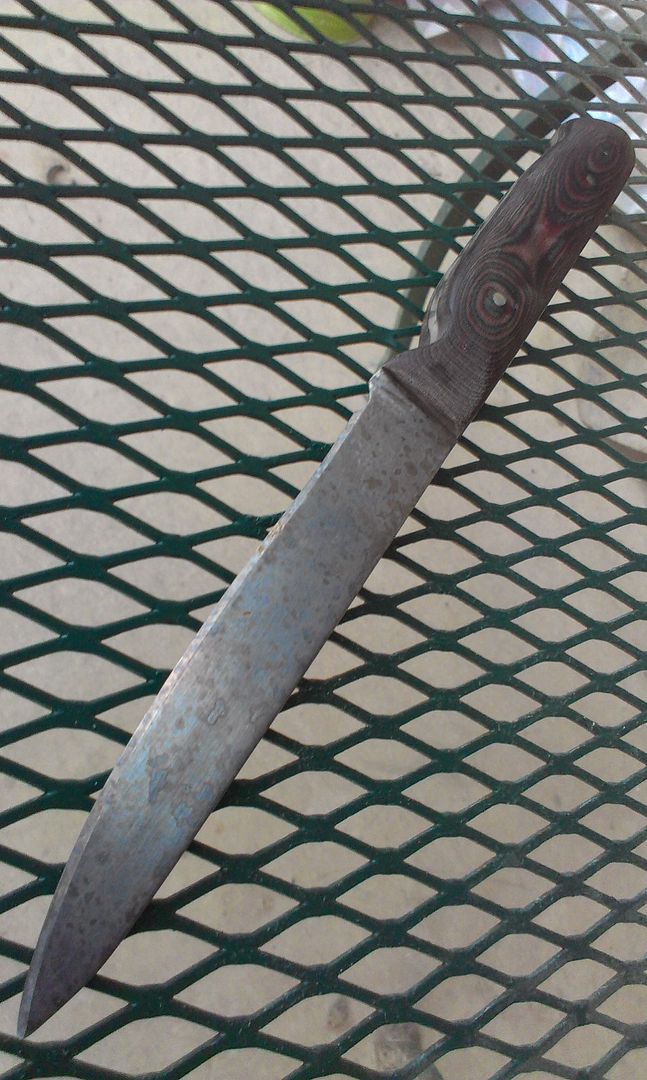
This was my first knife, about 8 years ago. It's a file knife made using crude tools and home made micarta. Don't think I even annealed it. :o

IMAG1911_zps6a2ebac1.jpg


IMAG1910_zpsd97281eb.jpg


About the only thing I'd recommend is putting a bit more belly into it. Depends on what you want, and what looks good to you though. Your blade shape reminds me a bit of a Sodbuster, and I find mine to be very useful.

Congrats, and let's see it when you're finished. :)
 
You will have to be sure to re heat treat it when you are done. Also, the knife appears to have no bevels right now. You will need those. A piece of steal with the bottom 1/4 inch sharpened isn't really a knife, it's just a sharpened piece of steel. Not trying to be negative, just trying to get you on the right track and not have you waste time on something that wont cut.
 
You will have to be sure to re heat treat it when you are done. Also, the knife appears to have no bevels right now. You will need those. A piece of steal with the bottom 1/4 inch sharpened isn't really a knife, it's just a sharpened piece of steel. Not trying to be negative, just trying to get you on the right track and not have you waste time on something that wont cut.
I haven't even put a bevel on the knife, just showing the cut out of what I did. I plan on putting on the edge, heatt treating, and putting on a Nordic style handle next weekend.
 
Great start Caleb! I used a file for my first knife as well. My only suggestion is to make sure you round out the shoulders where the blade meets the tang...I made the mistake of using right angles there and the knife ended up shearing off at the handle. Stress risers are the devil.

Strigamort,love the look...reminds me of some of my firsts. I still do my own Micarta. It's one of my favorite things to experiment with. D you use the straight polyester fiberglass resin or the clear epoxy?
 
Great start Caleb! I used a file for my first knife as well. My only suggestion is to make sure you round out the shoulders where the blade meets the tang...I made the mistake of using right angles there and the knife ended up shearing off at the handle. Stress risers are the devil.

Noted. What materials would you recommend for the handle? I planned on using leather and wood.
 
Leather and wood are great materials. I especially like the feel of waxed leather for sheaths. Most production knives that use wood use "stabilized wood" for their scales. That's a process where they use vacuum pressure to impregnate all the air space in the wood with a resin or epoxy. This makes it stronger and less susceptible to humidity so the wood doesn't swell, shrink or crack. The quick and dirty way to do it at home is with Minwax wood hardener. You can also use it to harden cord or leather or any other porous handle material by painting it on. If you want to get the best penetration for your handle scales you can heat the wood hardener in a pot (carefully) and make a pressurizing tool using a brake line bleeder and a mason jar. Place your scales in the jar, fill it to the top of the material and pump the handle until bubbles stop coming out of your workpiece. Youtube is a great resource for finding info on how to do home stabilization. Also check out homemade Micarta...it's one of the easiest and most versatile methods of creating your own specialized handle materials.
 
Carhold, thanks. I believe I used fiberglass resin with that. Me and my daughter use to make it together in my old shop. Miss those days.
 
You guys are super helpful, thanks so much. I am actually trying to make a puukko handle. I think homemade micarta would be a nice modern spin.
 
Not a problem...always glad to help others interested in the craft.

The fiberglass resin works just fine for most jobs. I believe the epoxy resin is a bit tougher (it's definitely more expensive) and it has the benefit of being crystal clear as opposed to the fiberglass resin, which is a bit murky and will darken whatever material you choose to use.

Since a puukko handle is basically a cylinder with a hidden tang you have a lot of options for the materials you suggested. I've seen some lovely ones done with the stacked washer method...either leather or wood or both even. That is a pretty simple process. If you want to go with a homebrew micarta you can either do a slab of it and then cut and fit it, or, if you're not planning on being able to disassemble it later, an easier method is to have your cloth substrate in long strips that you can just wind around the handle and have it dry right on the tang. If you go with that method I'd recommend a bolster to hide the messy looking end grain. There are a lot more methods for handle making than there are for cat-skinning, of which I have heard there are many.

Here's a nice handle using the washer method:

Puukko.jpg


And a nice one using a homebrew resin handle made of burlap and jute:

IMG_1242b.jpg


Both are from Survival Logic and are excellent examples.
 
Oh I dig that burlap. Almost looks like snake skin.

That was just wrapped around the handle and left to dry, then ground to shape?

That gives me some ideas. Any idea how long fiber resin stays stable? I still have a bunch from years ago, but I'll buy more if it's most likely toast.

Edit- Carhold, I've been looking for Survival Logic and can't seem to find anything on them. Got any links?
 
Last edited:
Different resins have different shelf lives...I know some of the polyester resins only have a life of three months after they've been opened. Some resins aren't UV stable and will deteriorate in sunlight without a topcoat, some are less corrosion resistant than others, it really depends on the application. Real Micarta is made with a phenolic resin and treated with heat and pressure that you just can't duplicate at home. The stuff is impervious to anything but methyl chloride. My advice is to test a bit of what you have and see if it still works, if not, go with a standard fiberglass resin at the local hardware store. If you want to spend a bit more, West Systems has a range of stuff to choose from and is excellent quality, just remember about shelf life and how much you're actually going to use.

There are so many ways to make your own composite materials at home, cloth, paper, rope, paracord, leather, wood...anything porous, though I find natural materials wick the resin better and are less likely to react poorly with the resin. I saw an awesome camo done with small triangular scraps of black, green and brown canvas all mixed up together and pressed in a mold. There's a man names Lars Tougaard in Denmark that creates some amazing composites from epoxy and aluminum foil. I tried to duplicate it at home and failed miserably, but it is gorgeous, here's a pic:

1331972261_wd148a-techstab.jpg


His website is techstab.com...he also does some amazing stabilized wood as well.

Here's the link for the first pic, with the makers name. Survival Logic is one of many resources for good bushcraft info.

http://www.survivalogic.com/2012/06/iisakki-jarvenpaa-aito-puukko.html

Here's a link for where you can find that makers knives:

http://www.ragweedforge.com/FinnishKnifeCatalog.html

And here is the link for the burlap and jute. The maker explains in the comments what type of resin and his method for finishing:

http://www.survivalogic.com/2012/09/pocket-puukko.html

Anyway, bit of an information rant there, always glad to share some info. One last pic for you guys. I recently did a knife for a hitchhiking buddy who is on his way to South America. We only had a week and only a couple hours a day to work on it so the finish isn't anywhere near what I'd like, but he wanted the quick and dirty version. This thing is tough as hell. The reason I'm showing is because of the sheath. I don't have the money or inclination to buy a kydex machine when you can get pretty good results with homemade composite. Please excuse the finish, but the sheath is only 4 layers of black jeans! I wrapped my blade in wax paper so the resin wouldn't stick to the knife and layed my resin soaked denim right around it to form to the blade. A couple stout sticks and a lead weight to hold down the edges. you can jump up and down on this and it'll flex instead of crack or shatter:

9646561_orig.jpg
 
Lots of excellent information there.

Thank you very much.

I'm absolutely going to put it to use. I'll also be linking to this thread as there is a gentleman in another thread that may be interested in the info as well.

:thumbup:
 
The more the merrier, glad to be of help. The handle wrap on the Alaskan Dude knife is one layer of regular wrap and a second with half hitches tied all along the bottom. Real quick-release for when he needs a makeshift spear.
 
Back
Top