
Westinghouse Ivory Micarta?

Joined
Dec 2, 1999
Messages
9,910
Hello,
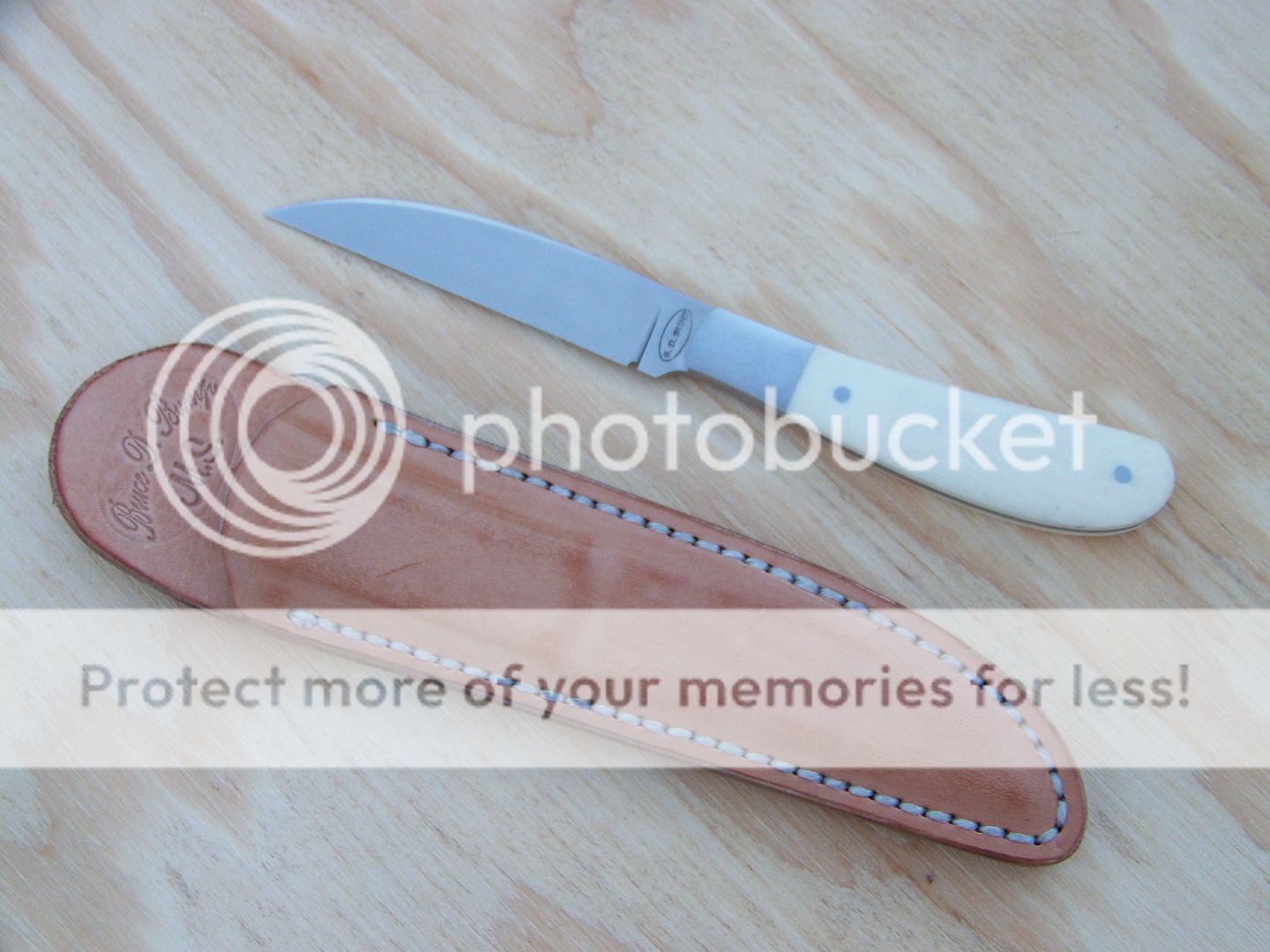
I bought a small sheet of what was said to be Westinghouse Micarta. It was dark like I remember from the old days but this doesnt have any layering at all. I used it on a couple knives and its very pretty. It will darken with enough time (several years) but is it really Westinghouse or was there other companies that made similar micarta?

Here is a desk knife. I want to make a slipjoint sometime

Edited, this knife is sold, I'm not advertising, I just want to know if this micarta is Westinghouse. Did they make it without the layering?
100_8032.jpg
 
Last edited:
Only place I had been able to find the old stuff was from Brad Vice. He got it I believe from the Bear plant.
 
"Old Yeller" is extremely desirable on just about anything. If you find some, grab it. Do not pass go, do not collect $200, and most definitely do not hesitate.
 
Don't know how much truth is in it but I read somewhere that it was made with some amount of asbestos. So be careful working with it, take all necessary precautions.

Edit: I am talking about "old yeller" micarta
 
The old yeller Westinghouse was definitely layered in tone (however, it was paper micarta, so it didn't have the texture layers of, say, linen micarta); all the pieces I've had have been colored throughout by age - even the blocks. This looks like what is now called "ivory" or more properly "bone" paper micarta -- some of the older stuff may have aged enough to show color, but in general it'll just show an offwhite shade and is fairly resistant to aging (nice, but not the old yeller Westinghouse). (BTW, I understand that most of the bone paper micarta now sold is NOS Westinghouse or International Paper material.) So paper micarta, yes - Westinghouse, quite possibly - the old beautifully aging antique ivory Westinghouse paper micarta, doubt it.
 
Last edited:
That's not a great photo (cell phone?), but I have a funny feeling you might be right. Everything I've seen lately has been pretty yellow also.
 
Hello,
I bought a small sheet of what was said to be Westinghouse Micarta. It was dark like I remember from the old days but this doesnt have any layering at all. I used it on a couple knives and its very pretty. It will darken with enough time (several years) but is it really Westinghouse or was there other companies that made similar micarta?

Here is a desk knife. I want to make a slipjoint sometime

Edited, this knife is sold, I'm not advertising, I just want to know if this micarta is Westinghouse. Did they make it without the layering?

Micarta was developed by Westinghouse.
AFAIK, the only materials officially labeled "Micarta" are from Westinghouse or currently from Norplex. Westinghouse sold off that division in ~1990. If your material says "Westinghouse" it likely was made before the sale.

Other companies may have made similar materials. But they could not be labeled as "Micarta".


.
 
knarfeng certainly is up on these products since much of his engineering career was in coatings & polymers. when working in the 60s for anaconda copper making electrical conductors we often used forming dies made from micarta. the only other material used in forming these cable conductors was a tough aluminum. this process certainly attests to the toughness of the early micartas. as a knife man i have to be honest & comment that personally i prefer tough woods ,bones, & horn materials for my knife handles.--dennis
 
Yeah, well, that and the fact that this is kind of a recurring discussion that comes up about once a year.:D
 
knarfeng certainly is up on these products since much of his engineering career was in coatings & polymers. when working in the 60s for anaconda copper making electrical conductors we often used forming dies made from micarta. the only other material used in forming these cable conductors was a tough aluminum. this process certainly attests to the toughness of the early micartas. as a knife man i have to be honest & comment that personally i prefer tough woods ,bones, & horn materials for my knife handles.--dennis


That is quite a testimony to the toughness. I love the micartas in my fixed blades, but vastly prefer natural in my pocketknives.
 
knarfeng certainly is up on these products since much of his engineering career was in coatings & polymers. when working in the 60s for anaconda copper making electrical conductors we often used forming dies made from micarta. the only other material used in forming these cable conductors was a tough aluminum. this process certainly attests to the toughness of the early micartas. as a knife man i have to be honest & comment that personally i prefer tough woods ,bones, & horn materials for my knife handles.--dennis

Tracking material manufacturer's is one of my jobs at work.
My company has been making aircraft parts since the '40s and in the past, non-structural material callouts were sometimes incomplete. We sometimes get spares orders for parts with very old engineering. In order to meet the engineering requirements I sometimes have to figure out what material is being called out by a 40-year old drawing, and then find out which company makes the same material today. It's cheaper than re-engineering the part.

The oldest engineering I've had to figure out was a 1958 drawing. For that one, we had to recreate a process that we had not performed since the '60's. It would have been cheaper to re-design the part, but the customer did not want us to do that.

In other words, "I am a professional. Don't try this at home.":D
 
How about I send you a small piece to look at, maybe you can tell?
Tracking material manufacturer's is one of my jobs at work.
My company has been making aircraft parts since the '40s and in the past, non-structural material callouts were sometimes incomplete. We sometimes get spares orders for parts with very old engineering. In order to meet the engineering requirements I sometimes have to figure out what material is being called out by a 40-year old drawing, and then find out which company makes the same material today. It's cheaper than re-engineering the part.

The oldest engineering I've had to figure out was a 1958 drawing. For that one, we had to recreate a process that we had not performed since the '60's. It would have been cheaper to re-design the part, but the customer did not want us to do that.

In other words, "I am a professional. Don't try this at home.":D
 
Only place I had been able to find the old stuff was from Brad Vice. He got it I believe from the Bear plant.

I got some from Brad too.Its the real deal with that cool layered look.I dont know if he still sells it or not.He had a half table full at a show,but that was 2 yrs ago.
 
Only place I had been able to find the old stuff was from Brad Vice. He got it I believe from the Bear plant.

Here is Mike's knife & I think when you see this stuff finished out,there is,no doubt

DSC04251.jpg


DSC04252.jpg


DSC04253.jpg


Most certain this is the yellow stuff,on this Menefee

DSC04246.jpg


-Vince
 
Another look at the stuff on this Hampton
DSCF1887-1.jpg


DSCF4529-1.jpg
 
I really like micarta as a handle material on both knives and for handgun grips! My favorite sixgun wares a pair of custom Lett's Micarta stocks! Hey Knarfeng we having another thing in common as I to work in an old aerostructure plant that has a rich history in Nashville going back to 1939!

 
Vince, I don't know you remember it or not, but, when I was finishing up that little SBJ that dark inclusion below the center pin on the mark side was giving me fits. I couldn't take enough off of it to clean it up and it was too late to start over. Seemed to me at the time that this was just another indicator of the age of the material and the process that was used at the time to make it.

Tony told me about one year that the Feds were confiscating items covered with the old Westinghouse stuff at one of the knife shows, thinking it was ivory. It can be finished up high enough that it can appear like ivory to your basic noob.

It is kinda irritating to spend the same amount of time finishing "plastic" as I would finishing ivory...just sayin :p
 
Vince, I don't know you remember it or not, but, when I was finishing up that little SBJ that dark inclusion below the center pin on the mark side was giving me fits. I couldn't take enough off of it to clean it up and it was too late to start over. Seemed to me at the time that this was just another indicator of the age of the material and the process that was used at the time to make it.

I recently had a conversation with a retired Westinghouse engineer who worked in the laminates division in the 1950-80 era. Among other things he shared the following:

- Some of the paper based Micarta had the paper bleached and some not. The unbleached paper tended to have specks in it. May explain your inclusion.

- The asbestos based material over time did not turn yellow but turned almost black with some greenish tint to it. The more UV light exposure the faster the color change. I showed him my Reese Bose Shadow Trapper and he said only testing could tell but it was most likely that.

He was surprised when I told him about the great demand for the old ivory paper based material that turns yellow and would have thought the asbestos based like the Reese knife I showed him would be in far greater demand. I concur with his thought that the blackish/green Micarta on the Trapper is the most appealing synthetic handle material I have encountered.
 
Back
Top