What am I doing wrong?

Joined
Dec 30, 2012
Messages
975
I have a high speed Dremel tool and a drill press and thought I'd like to put a "wave" in my Elmax blade knife. I got a 1/8th inch carbide drill bit and proceeded to start drilling. An hour later I've barely made a dent. Actually there's a little hole about 1/32nd of an inch deep or less. I started out with a slow drill speed and have been gradually raising it, using some oil as recommended to keep the bit from wearing, but I'm just not getting anywhere. Am I using the wrong tool? I want to keep the hole pretty small to preserve the aesthetics of the knife so didn't want to go bigger than 1/8th inch, but should I be using a drill bit at all, even carbide? Should I use a diamond bit?? This Elmax is TOUGH!
 
You need a drill press to do that effectively. You need to use down pressure. Is this a hardened piece of elmax in if so how are you going to handle making the blade tapers?
 
I'm not sure I can post the place where I bought the bit, but it was about $10. I'm using a small drill press but was sort of afraid to use a lot of downward pressure because I didn't want to run up too much heat. So I need more downward pressure. About how many rpms? I'm modifying a blade that has already been hardened and tapered. It's a ZT0561. The waved "notch" should be relatively small, but understand it will still work. Anyway thanks for the advice.
 
I'm not sure what you are trying to do but a dremmel on low speed is still really fast for drilling. You might try grinding the shape you need with a diamond burr. Make sure you wear safety glasses and a good dust mask
 
Use the drill press set on its very slowest speed. Secure the blade very well. Any movement and you will break the bit. You will build up less heat with the bit cutting than rubbing. Some light oil will help keep the temp down. You need to have the spot you are drilling square with the bit or it will cause the bit to slide sideways and snap. Carbide is extremely brittle and very easy to break.

My question is what is this wave thing and just where are you drilling the hole in the blade? You might be better off with a small burr.
 
A "$10 carbide drill" isn't very descriptive.
Is it of this style ?

Downward pressure is your friend in this case.

7743055-23.jpg


http://www.use-enco.com/CGI/INSRIT?PARTPG=INSRAR2&PMAKA=337-6495&PMPXNO=28079542


The carbide drills for masonry work are not really suited for this.
 
Last edited:
A "$10 carbide drill" isn't very descriptive.
Is it of this style ?

Downward pressure is your friend in this case.

7743055-23.jpg


http://www.use-enco.com/CGI/INSRIT?PARTPG=INSRAR2&PMAKA=337-6495&PMPXNO=28079542

I used a bit like this ↑ to ream out a hole in cpm d2 (61rc). Run the bit SLOW... with lots of cutting fluid. I reamed a .200" hole to .250" and it took about 20-30 mins. It will be a while for you, since your starting out a new hole and not reaming one. Quality bits make a BIG difference.
 
A "$10 carbide drill" isn't very descriptive.
Is it of this style ?

Downward pressure is your friend in this case.

7743055-23.jpg


http://www.use-enco.com/CGI/INSRIT?PARTPG=INSRAR2&PMAKA=337-6495&PMPXNO=28079542


The carbide drills for masonry work are not really suited for this.

Hey 1-10 I was curious, the machinist at work told me to use that type of drill to get a snapped easy out drilled out and to use them very fast with short burst and high pressure. Different then say your standard style drill bits. It worked pretty good.
 
I've used it to drill a hardened blade if I forgot to put holes in before HT, although Elmax is a better steel than what I've used.


Before that I tried to use a carbide tipped masonry drill, but didn't have the green grinding wheel to put a proper edge on it.
All I did was heat it up to the point the silver solder melted let go and the carbide edge fell out.
 
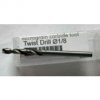
Here's a picture of the bit I'm using.

1-8-drill-carbide.jpg

It's described as "Drill Bit Carbide solid micrograin 1/8" x 2""
 
My question is what is this wave thing and just where are you drilling the hole in the blade? You might be better off with a small burr.

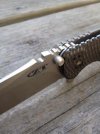
Here's a picture of essentially what I'm trying to do, though my notch might be in a slightly different place. A "wave" is a patented device invented by Ernie Emerson that allows the knife to be opened as it's being removed from the pocket rather than after it's out of the pocket. I have a friend in the marines and was modifying it this way because I thought it might save his life some day.

photo4.jpg
 
Hey 1-10 I was curious, the machinist at work told me to use that type of drill to get a snapped easy out drilled out and to use them very fast with short burst and high pressure. Different then say your standard style drill bits. It worked pretty good.

I went ahead and ordered one of these spade bits since the standard bit I have was just getting nowhere. So the way I use this is short bursts at high speed?
 
I went ahead and ordered one of these spade bits since the standard bit I have was just getting nowhere. So the way I use this is short bursts at high speed?

Thats what I did. I could be wrong as the machinist I talked to may or may not be very knowledgable. He has been working in a shipyard for quiet some time. I had about a 5/8" diameter bolt that was broken off flush with a mount and I tried drilling and easy outing it but the easy out broke off flush with the bolt. These things are very hard steel. I used one of those spade bits to drill this out (about half an inch worth). I did use a little cutting oil. It worked pretty good.

Not saying it was easy though, I was down there for some time. Plus all I had was a 18v dewalt so that didnt help at all.
 
The only drilling I do in hardened steel is using a #54 solid carbide bit to drill the detent hole in a folder blade. It can be hard to get the drill to bite, I use a higher speed than normal, and use shorter periods of drilling (4-5 seconds) with a fair amount of pressure. I don't use a cutting oil. I do break bits from time to time.

Also, how are you putting this "wave" into the spine? Drilling a hole, then cutting a slot into it from the spine to open it, or just drilling a hole close enough to the spine that the drill will open the notch out? Because if you are planning the latter, an interrupted cut like that is a sure way to break your carbide bit...

Maybe you need to think more about using abrasives or other alternatives to do this job. A carbide rod saw might work, the kind mounted in a hacksaw frame to make unidirectional cuts in ceramic tile. Or, a cutting wheel arbor in your drill press, with the blade held in a drill press vise, fed lightly into the cutting wheel by hand, much like cutting lock bars in folding knives. You'd have to cool the work off quite often, though.
 
Last edited:
The only drilling I do in hardened steel is using a #54 solid carbide bit to drill the detent hole in a folder blade. It can be hard to get the drill to bite, I use a higher speed than normal, and use shorter periods of drilling (4-5 seconds) with a fair amount of pressure. I don't use a cutting oil. I do break bits from time to time.

Also, how are you putting this "wave" into the spine? Drilling a hole, then cutting a slot into it from the spine to open it, or just drilling a hole close enough to the spine that the drill will open the notch out? Because if you are planning the latter, an interrupted cut like that is a sure way to break your carbide bit...

Maybe you need to think more about using abrasives or other alternatives to do this job. A carbide rod saw might work, the kind mounted in a hacksaw frame to make unidirectional cuts in ceramic tile. Or, a cutting wheel arbor in your drill press, with the blade held in a drill press vise, fed lightly into the cutting wheel by hand, much like cutting lock bars in folding knives. You'd have to cool the work off quite often, though.

I expect to do a bit of opening, but not much. Some grinding as well, but the hole itself should almost break the spine. I can re-orient the press/milling table to accommodate different grinding angles. It's a Vanda-Lay milling table with X, Y, and Z adjustment and a drill press attachment.
 
Get some round diamond files. The wave will be rough but functional. You can use some good silicon carbide sand paper for finishing.
 
Get some round diamond files. The wave will be rough but functional. You can use some good silicon carbide sand paper for finishing.

Well, functional is better than non-functional, but I would like to avoid completely spoiling the aesthetics. I've seen some reasonably nice implementations of the wave on a ZT 56x.
 
Back
Top