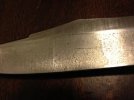
What caused this?

Joined
May 24, 2008
Messages
745
I had to re-heat treat this because I was afraid I got it too hot when I tried to solder the guard the first time. It came out with this weird pattern on it.

It's 1095. I heat treated it in my evenheat and quenched in parks 50. I normalized it twice before I hardened.
 

Attachments
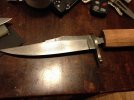
  • photo-25.jpg
    photo-25.jpg
    64.8 KB · Views: 168
  • photo-24.jpg
    photo-24.jpg
    57.4 KB · Views: 235
Last edited:
It could be some sort of alloy banding - aka Wootz.

Or it could be a surface effect. Sand it down and give it a quick etch in FC to see if it is in the steel or on the steel.
 
It could be some sort of alloy banding - aka Wootz.

Or it could be a surface effect. Sand it down and give it a quick etch in FC to see if it is in the steel or on the steel.

Thanks. I'll try that.

If its in the steel, does that mean its ruined?
 
Did you clean up the blade any after you re heat treated it? I have one 1095 blade I did several years ago that has a strange pattern in it. I like it since it is so different.
 
I did some stock removal blades last week. It was the first time in a long time that I ground out a complete knife. The problem was that I realized that I had not normalized them, myself. When I forge, the normalizations are my done after the hammer work and before I grind/file. Once it is 90%finished, I heat treat with a single full quench. On this last stock removal blade, I was 90% done, but couldn't, in good conscience overlook the benefit and security of normalizing cycles. I gave it two cycles(1550F and 1450F) then hit it with a 1475F, 10min soak before quenching in HQ-K. I have never seen that much decarb on my blades! It had to have been .005" over the entire surface. It was the fist time I had such excessive decarb and it showed itself in the same pattern you have in the pics. Start sanding, brother.
 
I hope I didn't miss lead. Thanks for catching that Rick. Kevin did address the surface texture of hypereutectoid steel in the 1084 heat treat thread. I had remembered that because the same surface texture problem came up with a 1084 blade I did a few years ago, didn't notice the reference to hypereutectoid.

Quote: Kevin
I often get phone calls from makers wondering what they did wrong with a hypereutectoid steel that has extra carbide forming elements. They get an odd damascus like pattern all over the blade. I tell them to soak longer or raise the temperature before the quench to dissolve those extra carbides and alloy banding and the problem will go away.
 
wow, I thought I would be set with an oven and some good quench oil....guess not.
I don't think 1095 is that daunting of a steel to work with... you just need to know its quirks. Some basic temperature control and familiarity with the characteristics of 1095 can land you a great blade. Everything else is just icing on the cake. Take it however far you want. Have fun.

1084 is a wonderful forging steel. Great performance, with the added bonus of a straight forward heat treat.
 
Last edited:
Just to clarify
10XX is the AISI designation for what we call simple carbon steels. 1005, 1045, 1084, and 1095 are all 10XX steels. The 10 means the steel is nonresulfurized with a max of 1% manganese, and the XX digits are the carbon percentage.
 
Thanks for all the help guys. There is a lot more to knife making than I ever thought. Two years ago I thought that I would be making great knives in no time with a drill press, a bench grinder, and a little bit of practice. I was wrong.
 
Thanks for all the help guys. There is a lot more to knife making than I ever thought. Two years ago I thought that I would be making great knives in no time with a drill press, a bench grinder, and a little bit of practice. I was wrong.
Welcome to the addiction!!!
 
Back
Top