
-
The BladeForums.com 2024 Traditional Knife is available! Price is $250 ea (shipped within CONUS).
Order here: https://www.bladeforums.com/help/2024-traditional/
You are using an out of date browser. It may not display this or other websites correctly.
You should upgrade or use an alternative browser.
You should upgrade or use an alternative browser.
What did I do wrong?
- Thread starter AlaskanHunter
- Start date


- Joined
- Nov 23, 2013
- Messages
- 306
Wow! Thank you all for teaching me. The more I learn about blades and metallurgy, the more I realize that I know nothing. It's like barely understanding a drop of rain while standing on the edge of the Pacific Ocean.
Thank you for teaching this ignorant young wannabe bladesmith!
Sent from my iPhone using Tapatalk
Thank you for teaching this ignorant young wannabe bladesmith!
Sent from my iPhone using Tapatalk

- Joined
- Jul 21, 2001
- Messages
- 2,869
It appears that the blade broke where the stress would have been greatest, where the handle met the blade.
The number one rule passed down to me personally by Bill Moran, one of those who used "cobbled up heat treats" was to never - ever harden the tang. This is a perfect example of the reason for this rule.
The grain does look too coarse.
I congratulate you for testing your knives and suggest you go ahead and test what is left of the blade and see for yourself how strong and tough it is, there are lessons still waiting your attention.
The number one rule passed down to me personally by Bill Moran, one of those who used "cobbled up heat treats" was to never - ever harden the tang. This is a perfect example of the reason for this rule.
The grain does look too coarse.
I congratulate you for testing your knives and suggest you go ahead and test what is left of the blade and see for yourself how strong and tough it is, there are lessons still waiting your attention.
Last edited:
If the steps prior to tempering were all done correctly, a temper of 500 F. would put the blade at aprox. 55-56 Rc. That's more like the hardness of blades in the early frontier days of America. We've come a long way since then with better steels and better processes. A big chopper of 1084 with proper edge geometry should perform well in the 59-60 Rc. range. Some guys push the number up there even higher and do well.
As I said earlier....probably not a tempering problem and I'm curious why people think they need to go to 500 F. with 1084?
You mean like, when Ike was President?


- Joined
- Dec 21, 2006
- Messages
- 3,158
500F temper for 1084 yields 55-56. For 59, I would shoot for 425F. http://www.bladeforums.com/forums/showthread.php/1064818-what-should-I-temper-1084-at
- Joined
- Nov 23, 2013
- Messages
- 306
Ok, I'll do that and report the results.I congratulate you for testing your knives and suggest you go ahead and test what is left of the blade and see for yourself how strong and tough it is, there are lessons still waiting your attention.

- Joined
- Apr 14, 2006
- Messages
- 3,816
We learn from our mistakes, at least hopefully. Sometimes it takes a few screw ups before we get it. Normalizing for instance. Many do not think that it is necessary for ground blades. I have found that it does help significantly but your experience may vary. We need to remember also that the steel companies test a larger cross section than we normally use. It can make a difference in the final result. Testing is the only way to accomplish this. Sometimes destructive testing.
Alaska Hunter you did a destructive test by accident. You need to learn what you need to do to change the result. You are doing the right thing listening to all the input. Take what you can use and apply it. We just need to remember to have fun at this or it just becomes work.
Alaska Hunter you did a destructive test by accident. You need to learn what you need to do to change the result. You are doing the right thing listening to all the input. Take what you can use and apply it. We just need to remember to have fun at this or it just becomes work.
- Joined
- Nov 23, 2013
- Messages
- 306
I put a duck tape "handle" on it and used it to cut 18 rose stems (for my wife on our first anniversary). Razor sharp all the way- nothing really learned here, but it held a shaving sharp edge for all 18, cutting cleanly through with no difficulty or ragged edges.
Then I battoned the blade through seasoned spruce. One inch of the tip snapped off almost immediately, second or third blow. The edge showed no damage, and split the wood as easily as possible with so little length remaining. I inserted the end of the remaining blade into a crack in the spruce log and bent it to roughly 20 degrees. It sprang back perfectly, and there was no visible damage from it.
Since I'm seeing damage on the tip and tang- the two parts with the least mass, I'm thinking that this points to overheating?
What are your thoughts? Am I chasing rabbits, or barking up the right tree? Anything else I should do to test this blade? Is there anything else that I can learn from this while I'm destroying the "prettiest" blade I've made yet?
Sent from my iPhone using Tapatalk
Then I battoned the blade through seasoned spruce. One inch of the tip snapped off almost immediately, second or third blow. The edge showed no damage, and split the wood as easily as possible with so little length remaining. I inserted the end of the remaining blade into a crack in the spruce log and bent it to roughly 20 degrees. It sprang back perfectly, and there was no visible damage from it.
Since I'm seeing damage on the tip and tang- the two parts with the least mass, I'm thinking that this points to overheating?
What are your thoughts? Am I chasing rabbits, or barking up the right tree? Anything else I should do to test this blade? Is there anything else that I can learn from this while I'm destroying the "prettiest" blade I've made yet?
Sent from my iPhone using Tapatalk
- Joined
- Nov 23, 2013
- Messages
- 306
Can't convince the pictures to load. Guess I'll try again later.
Finally!


Sent from my iPhone using Tapatalk
Finally!
Sent from my iPhone using Tapatalk
Last edited:
- Joined
- Apr 14, 2006
- Messages
- 3,816
Grain growth is HUGE. Yes it was over heated and not thermal cycled/normalized. Should look closer to this.
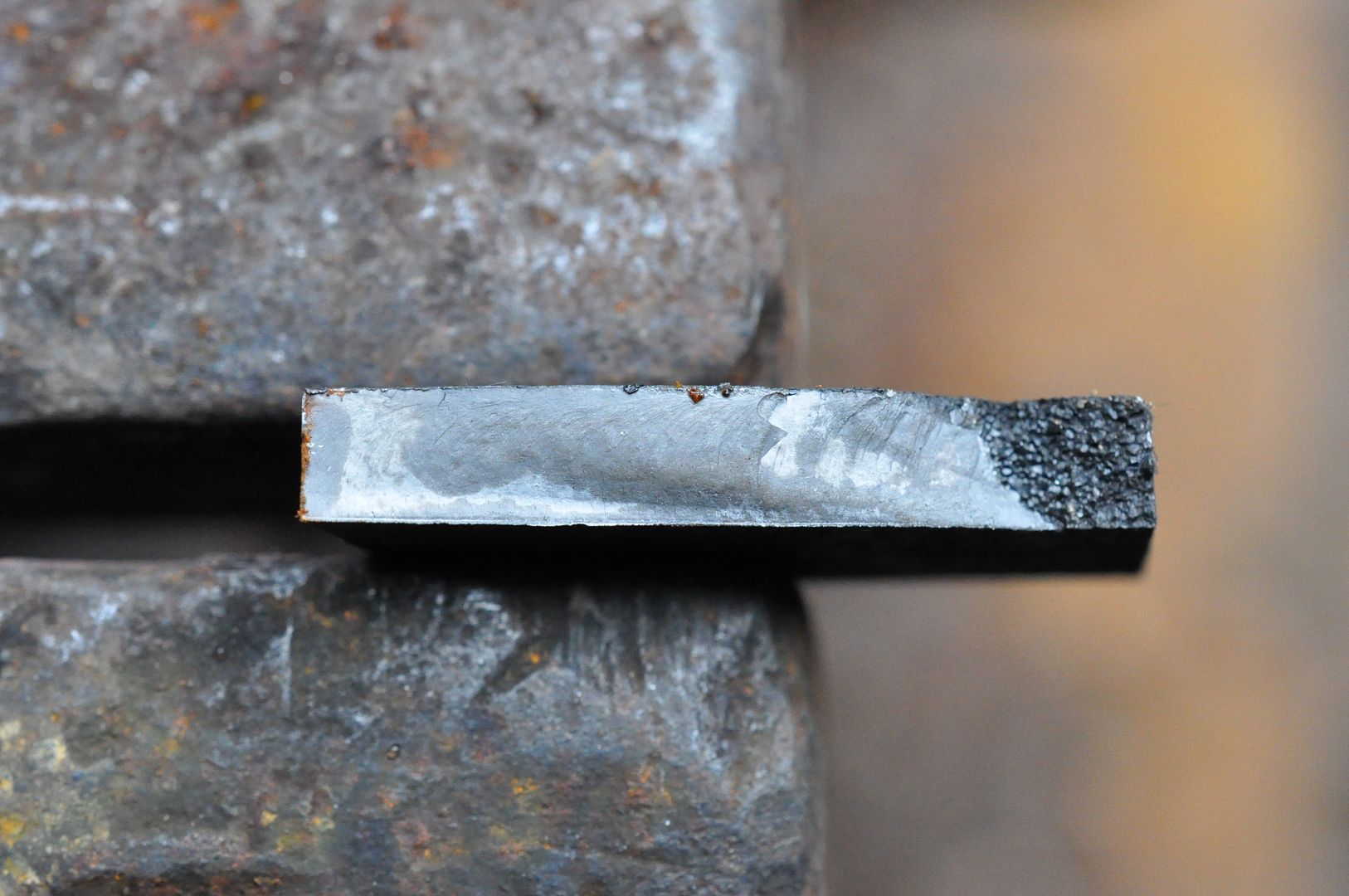
You can actually see excessive grain growth on the edge remaining from when this steel actually cracked. I then did normalizing cycles reducing the grain size to what you see here. The grain will actually be even smaller when quenched properly.
You really need to do this when forging and I really recommend it as part of any heat treat process. At least 2 cycles preferably 3. You have done good trying to figure it out and I think are there. Now make another one even prettier and with a better heat treat.
You can actually see excessive grain growth on the edge remaining from when this steel actually cracked. I then did normalizing cycles reducing the grain size to what you see here. The grain will actually be even smaller when quenched properly.
You really need to do this when forging and I really recommend it as part of any heat treat process. At least 2 cycles preferably 3. You have done good trying to figure it out and I think are there. Now make another one even prettier and with a better heat treat.
Last edited:
- Joined
- Apr 14, 2006
- Messages
- 3,816
That was O-1. I had forged a blade to shape and when I went to straighten after it cooled and before grinding it broke. I then decided to try the normalizing cycles to see exactly what happened to the grain. I use a salt pot and on this one IIRC 4 steps down from 1625, 100f drop with each. On the last cycle I did a sub critical heat and quench in room temp oil. Here is the thread I did a few years ago. http://www.bladeforums.com/forums/showthread.php/1040743-Grain-Size-and-Normalizing-WITH-UPDATED-GRAIN-SHOTS
ETA. I went back a re-read what I had done in that post. Not quite what I remembered but still very close. Instead of re-writing my previous posts go read the older one. There is also one floating around talking even more in depth about the normalizing process. Much more recent than mine.
ETA. I went back a re-read what I had done in that post. Not quite what I remembered but still very close. Instead of re-writing my previous posts go read the older one. There is also one floating around talking even more in depth about the normalizing process. Much more recent than mine.
Last edited:

- Joined
- Jun 11, 2006
- Messages
- 8,651
That's some HUGE grain you got there. The grain should be a fine gray color with out visible individual grains. When done right your edge retention will go up as will toughness. Just tested a 52100 forged fillet knife the other day. We filleted 7 fish and still a hair shaving sharp edge along the entire edge that was used. So keep up the good work and learn as you go.
- Joined
- Jul 21, 2001
- Messages
- 2,869
One more test I would do is put the remaining blade about 1" into a vice, take a piece of pipe and put it over the duct tape and see how much flex you can get out of the remaining blade. You feel that only the tip and proximal aspects of the blade may have been overheated, this will test your theory when you can see the grain in the center of what remains of your blade. For safety I would wear gloves, safety glasses and remember to pull the blade to you, do not try to push it. When pushing a blade away from you it is easy to fall into the blade when it breaks.

BluntCut MetalWorks
Knifemaker / Craftsman / Service Provider
- Joined
- Apr 28, 2012
- Messages
- 3,476
Break a drill bit and try to get your ht to produce a broken surface looks close or better than it.
My ht produces what I called 'interlocking' lattice in ultra fine grain matrix. It's very difficult to take picture to capture surface depth from a head-on view.
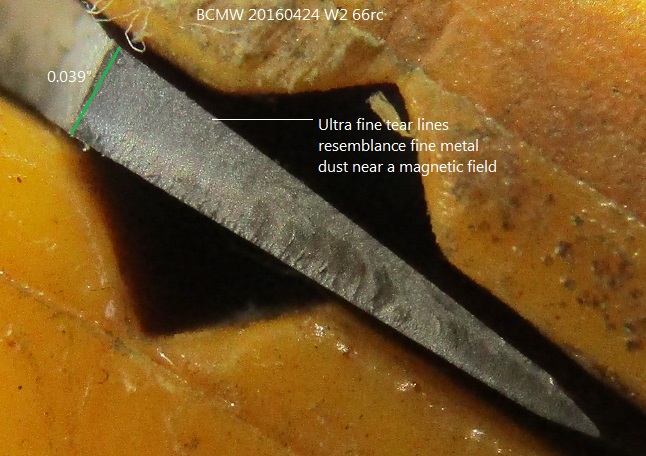
When looking at broken surface:
Lumpy spheroid shape = large grain
Glass smooth = fine grain but high in plate martensite %
Teared lines = fine grain and low plate mart% (i.e. good) *note: lath is offset lattice
Like fine cloth teared or fine metal dust in magenetic field = ultra fine grain + very low plate mart% + interlocking lattice.
My ht produces what I called 'interlocking' lattice in ultra fine grain matrix. It's very difficult to take picture to capture surface depth from a head-on view.
When looking at broken surface:
Lumpy spheroid shape = large grain
Glass smooth = fine grain but high in plate martensite %
Teared lines = fine grain and low plate mart% (i.e. good) *note: lath is offset lattice
Like fine cloth teared or fine metal dust in magenetic field = ultra fine grain + very low plate mart% + interlocking lattice.