What Did You Sharpen Today?

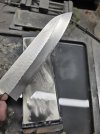
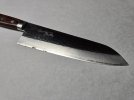
Had this chipped up blade come in today.
1000024554.jpg
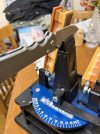
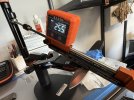
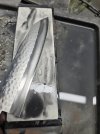
Thinning is always tough because the factory usually uses a large wheel to grind the primary bevel. SG 320 made pretty quick work of it.
1000024556.jpg1000024557.jpg

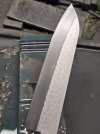
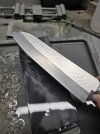
Final finish for the primary bevel with the Tsushima black stone.
1000024559.jpg
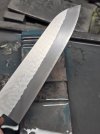
Then a little Wicked Wax to protect it after finishing with a Nakayama stone.
1000024564.jpg1000024565.jpg
 
Did a small batch of kitchen knives for one of my resturant customers. I’ve been using Naniwa Chosera stones for a while but switched it up and decided to go with my Shapton Glass stones again. Still dont know what I like better but the glass stones did seem to do better.

View attachment 3221825
Second from the top was a 70/30 grind so I flipped it around for a face view.
View attachment 3221824
Hand held right ?
Takes a lot of skill !

70 / 30 grind
Please explain .
I am thinking it is a ""single bevel"" / sort of chisel grind .
But both sides sharpened . Seems like in layman at home hobby dude lingo it would be like 5 degrees 12 degrees respectively .
Clearly I need some education here .
thanks .
 
That first image of the broken into (more than chipped) blade breaks my heart .
my first thoughts were :
who ever did that needs to swing for it .
knives this great should require a driver's licence before they can be bought . Hunter's safety , Boy Scouts knife merit badge SOMETHING ! ! !
 
Hand held right ?
Takes a lot of skill !


Please explain .
I am thinking it is a ""single bevel"" / sort of chisel grind .
But both sides sharpened . Seems like in layman at home hobby dude lingo it would be like 5 degrees 12 degrees respectively .
Clearly I need some education here .
thanks .
Yes, all done by hand with various waterstones, synthetic and Natural.

The 70/30 or sometimes called the 90/10 Japanese knifes is an asymmetric grind both to the body of the blade and edge. The numbers refer to the amount of sharpeneing you do to each side. Both sides are sharpened at the same angle but one side gets most of the sharpening. The blade is also flat on the backside (no angle involved) and either slightly convex on the front or flat ground at a shallow angle.
 
Last edited:
WHAT ?
not going to baton it through any chicken bones ? ? ?
that was a very bad joke . SORRY .
I'm still highly disturbed from the original first image .
Lol, the behind the edge thickness is only 0.010in

Very thin with a high hardness, probably 60-62 range. The first image is a lot more common with these knives than you think, slicing thick or tough foods, hitting bone, or putting lateral load on the edge in the process will easily cause a blowout/chip.
 
Yes, all done by hand with various waterstones, synthetic and Natural.

The 70/30 or sometimes called the 90/10 Japanese knifes is an asymmetric grind both to the body of the blade and edge. The numbers refer to the amount of sharpeneing you do to each side. Both sides are sharpened at the same angle but one side gets most of the sharpening. The blade is also flat on the backside (no angle involved) and either slightly convex on the front or flat ground at a shallow angle.
I thought most folks changed the angle to reduce steer and knives came that way?
 
I thought most folks changed the angle to reduce steer and knives came that way?
The asymmetry of the blade and makes it cut better than most V ground knives, at least in my experience. It would probably steer if the bevels were off angle but I sharpen as evenly as possible. Lots of J-knives come with obtuse angles, the factory edges are often bad examples and the reason its recommend for a new knife to be professionally sharpened.

Some traditional knives like the Yanagi, usuba and deba often dont come sharp and require sharpening right out of the box.
 
The asymmetry of the blade and makes it cut better than most V ground knives, at least in my experience. It would probably steer if the bevels were off angle but I sharpen as evenly as possible. Lots of J-knives come with obtuse angles, the factory edges are often bad examples and the reason its recommend for a new knife to be professionally sharpened.

Some traditional knives like the Yanagi, usuba and deba often dont come sharp and require sharpening right out of the box.
Different schools of thoughts on it for sure and it seems like most Japanese knives (like gyuto's) are no longer right or left hand biased.
Kind of a shame but knife owners can do some things to suit themselves.

The theory behind the angle change is that a right-handed knife will drift to the left in the cut and the more obtuse angle on the offside will help correct it.
 
Did a Shun for a local chef. The shop is closed today and I was just there getting caught up. Since I had a little time I decided to use my supercharged, kitbashed Pioneer. I used the Matrix stones 80, 250, 450 & 950, then the Green Brick, Chocera 3k, 5k & 10k. Finished up with the EP polymer strop with StroppyStuff 0.5 micron. The edge was insane! That polymer strop is fast becoming my "secret weapon" for stupid sharp edges.😎
 
I'm spending my Sunday evening working through a stack of circular saw blades.o_O😅
Carbide tipped?
I remember back in the day when we would get saw blades sharpened it was always done on automated machines.
When the carbide tipped blades came out, we considered saw blades disposable. Perhaps diamond grinding tech was slower to catch up or something, but I don't remember ever get them resharpened.
Carbide blades really hurt the little sharpening shops that relied on them saw blades.
 
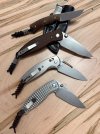
I laid back the chisel-edge on an Emerson A100 154CM up to 800 CBN / strop, then I took a brand new, fresh out of the box, TRM Bulldog Magnacut to 4000 grit CBN / strop. FWIW, TRM puts out some amazing Magnacut. Got too hot in the garage so I ties a couple lanyards ;) Have fun…
1783527393139.jpeg

1783527450384.jpeg
 
Carbide tipped?
I remember back in the day when we would get saw blades sharpened it was always done on automated machines.
When the carbide tipped blades came out, we considered saw blades disposable. Perhaps diamond grinding tech was slower to catch up or something, but I don't remember ever get them resharpened.
Carbide blades really hurt the little sharpening shops that relied on them saw blades.
Yeah, I use a machine with diamond wheels.
 
Today I did a couple batches of kitchen knives for some regular customers, and fixed a Japanese nakiri for a local line cook. It was chipped and had a break/crack perpendicular to the edge and around 3mm long/deep. Oddly enough I was very similar damage to a nakiri I fixed a few weeks ago. Anyway, I ground it out, thinned it a bit and sharpened it and it looks pretty close to new again.
 
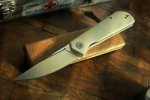
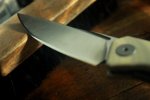
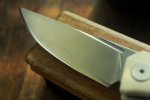
Finished polishing off and blending this shoulderless convex.. it's a huge upgrade performance wise. Been super impressed with this K110 steel's edge retention. Still have no idea how to properly photograph a convex but here's my shot:

crisp2.jpg
crisp1.jpg

crisp3.jpg
 
Back
Top