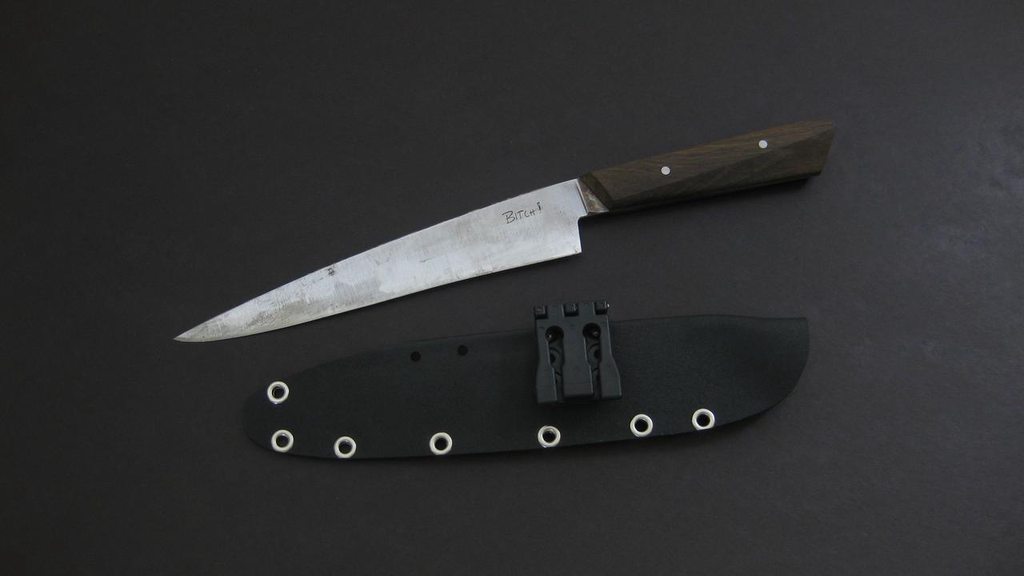
What do you do with botched knives?

Joined
Feb 4, 2015
Messages
122
The learning process for me is involving some ruined blanks - they could still make perfectly functional knives, but with irreparable cosmetic goofs - in the bevels and plunge lines especially. It wouldn't take much to finish them up and forgo all the cosmetic hand pollishing and have a good solid cosmetic "2nd." It must happen to most everyone - so what do you do with them? I don't want to waste them, but what does that do to your reputation if you let those go out for cheap or even freebies?
 
While I haven't had too many so far, I usually just end up finishing them without a handle to use as a shop knife or testing them to breaking point depending on how goofed up they are.
 
I throw them against the wall and scream cuss words at them. Lol

Seriously though, if they can't be salvaged I set them aside and work on something that isn't messed up. At some point I'll do something with them. Either re profile them to make a smaller knife or a sanding bar. Just make sure what type of steel it is.
 
I've never had one.... but I have a large collection of "patterns". Larry Lehman
 
In the past, I would put them in a drawer and leave them. Then, when I got better at grinding, I pulled some of them back out and the mistakes that I thought was irreversible, turned out to be pretty easy to fix. Now....there are some that are still sitting in the drawer, knives that I tried but are still to advanced for my skill level, but just like the others, when I get better I will pull them out and finish them.

-Adam
 
Most knives can be fixed with enough work. Often all that is needed is a change of style or shape. Ones that don't seem worth it become shop knives and garden knives. I have a few kitchen knives that didn't pass muster, but are perfectly functional.


Nearly every failure beyond a catastrophic HT failure can be repaired with time and effort. The key to making it easier is to inspect things and not proceed further until the current situation is dealt with. Going too fast and rushing to finish a blade is the WORST method of knifemaking there is. It pretty much guarantees a poor blade. I read people saying they made the blade yesterday, or they want to finish the entire knife this weekend...and then they get upset when people point out all the poor finishing and errors in the build. Beter to take two weeks and get a good knife that to crank it out in two days and not be willing to show it to anyone.

By far, the biggest cosmetic error is in grinding and sanding. Gouges and grooves from the belt sander and mis aligned plunges are the first problem new makers face. These can be eliminated by doing the bulk of the work by hand with files and sandpaper on your first several knives. Even after you start using a grinder, clean up the plunge with a file and flatten the bevels with a sanding block.
The most common flaw that is seen on many knives is scratches and lines on the blade. This is almost always caused by not completely sanding out grinding lines and scratches from the coarser grits. You oaten don't see them until you get to a 400 grit or higher, and then suddenly they seem to appear. You need to go back to the lower grit and completely sand them out. Start back at 120 grit and work the bevel until it is gone. If that takes three sheets of sandpaper and two hours, it is worth it. Go up the grits only as soon as it is time. People using a 1/4 sheet of paper and being ready to go to the next grit in a few minutes are just asking for problems. I cut up a sheet of sandpaper into eight pieces and use every piece before I go to the next grit. If needed, I cut up a second sheet before I move up. Spraying the blade and abrasive with Windex or dipping in soapy water is a really good idea when hand sanding. It shows the scratch lines much clearer and makes the sanding more efficient. With some breaks to let your hands/fingers rest, a blade can easily be sanded out in an afternoon. The difference between a blade with four hours of hand sanding and one with fifteen minutes is amazing.
TIP - wash the blade and your hands off and clean everything before moving to the next grit. Toss the paper towels you have been using, too. You don't want anything with a stray coarser grit putting a mar on the next sanding and polishing steps.


I will give an example of a failure I had just this past week that was rescued.
I water quenched a clay coated blade of Hitachi white. It looked good after tempering, and I proceeded to do the sanding and finishing to establish the hamon. At about 800 grit, I noticed three minute micro-cracks near the tip. One on the spine side and two about 1" back along the edge. They only went about 2-3mm deep, and could not be felt on the edge with a fingernail. I could have finished it as a shop/car knife, but I set it aside and waited a day before picking it up again to look with a fresh mind. I realized that adding a small drop to the point and taking some of the belly out of the edge would remove the offending areas. Ten minutes of careful grinding with plenty of dipping in water ended up with a better blade shape than I started with. Going back and reworking the tip at 120 grit on the grinder took care of the fatter edge I had created, and it was ready to start back up the sanding and polishing grits. At about 1000 grit, I spotted a few grind lines next to the newly shaped tip area. I sighed and went back to 120 grit for the whole blade again. It took well over an hour to get back to 800 grit, but when it reached 4000 grit a few hours later, it was nice. The hamon was slightly lessened by the extra metal removal, but it showed well and the blade was not detracted by scratches or cracks.

So, in one sense I wasted more than a days work, and in the other I saved a $400 blade..... and will be proud of it.....which was worth more?
 
Use them normally, then abuse them abnormally! Cut a lot of whatever you designed them for to see if your edge geometry works the way you want it to, and how long the edge stays nice and sharp. Grind the edge thinner and thinner and keener and keener until it just falls apart when you use it - then you'll know how thin/acute you can go. Cut stuff you wouldn't normally cut to see how much abuse they'll take. Pry things with them. Break them on purpose to get a peek at the grain structure. Pound them through 2x4's and concrete just because it's fun.

It's not a mistake, it's a testing prototype/R&D piece. :)
 
They are added to the Bucket of Woe. Later they are broken and tossed into the Pond of Despair. Sometimes they are reborn as much smaller knives.
 
Wind chimes. Not really. But it's a good idea. Like Adam suggested, I put them aside. Later, when your skills develop, you can re-profile them or fix the mistakes. The ones I don't have an answer for yet just stay in the jar. I don't worry too much about fixing them as I'm always moving onto something new, not looking back. I don't add knives to my junk jars anymore. Most screw ups are things I can correct right away now. Others I avoid altogether because I have learned those lessons the hard way already. Now the mistakes I make are mostly the occasional unforced errors due to not double checking a detail before I begin a task or from being tired. One thing beginners should know is that there is often much more meat on a blade than you realize. There is a lot of room for correcting errors. Many mistakes can be minimized by controlling your enthusiasm. Don't work any faster than it takes to do careful, deliberate work. You will learn faster. Don't work when you are distracted or tired. There is no rush at this stage. Come back when you have a clear head.

I have a bucket of woe but I don't have a Pond of Despair. I gotta get me one of those! :)
 
I have accumulations of these less than fortunate blades that end up being re-purposed as tools to spread tar, pry bars and other non knife related tasks. Others less lucky were tested to the point of failure. The lucky ones ended up in the kitchen drawer tool box and behind the seat of the truck used for cutting things I'd rather not do with the good ones. Some went back to the grinder reborn and sold.
 
Wind chimes. Not really. But it's a good idea. Like Adam suggested, I put them aside. Later, when your skills develop, you can re-profile them or fix the mistakes. The ones I don't have an answer for yet just stay in the jar. I don't worry too much about fixing them as I'm always moving onto something new, not looking back. I don't add knives to my junk jars anymore. Most screw ups are things I can correct right away now. Others I avoid altogether because I have learned those lessons the hard way already. Now the mistakes I make are mostly the occasional unforced errors due to not double checking a detail before I begin a task or from being tired. One thing beginners should know is that there is often much more meat on a blade than you realize. There is a lot of room for correcting errors. Many mistakes can be minimized by controlling your enthusiasm. Don't work any faster than it takes to do careful, deliberate work. You will learn faster. Don't work when you are distracted or tired. There is no rush at this stage. Come back when you have a clear head.

I have a bucket of woe but I don't have a Pond of Despair. I gotta get me one of those! :)

Wind chimes?!? When a storm comes and those blades get to thrashing around, people are going to die:)!!!
 
Lot's of really good suggestions here - I'm glad I asked. The best takaway is that very little of it is really a waste. James Terrio's suggestion to finish them as designated R+D prototypes is especially good. I don't know that I could really bring myself to abuse a nice finished knife, but I'd have no problem with cutting an oil drum in half with a "utility finished" 2nd and a hammer.

Thanks for the responses.
 
Last edited:
This is where I came up with the term, Design Modification, or DM's for short:D
Well I was going for this big Bowie knife with a 8" blade and ended up with a 4" Paring knife for the kitchen:)

Seriously, Every maker that's been at this for a few years has a bucket of them in the shop.
Sometimes I test with massive cutting and abuse. Others times they sit in the bucket until I have an idea and a DM happens!:)

So don't be in a hurry to destroy or throw out your Oh Shit!:grumpy: blades. They don't eat, don't take up to much room and someday they can be reborn!
 
This:

FWPVWX5h.jpg


and then I give them to friends or abuse the living hell out of them.
 
A wise man once said... "Within every 10 inch bowie is a 4 inch skinner."
 
I make smaller knives our of them. Which explains why all of my knives end up being pocket fixed blades. and if I screw up the finish then it gets a nice patina or etch to cover it and nobody knows.
 
One can be put in the bottom of your hunting pack, in your car, leave one at work. Never know when you need a blade.
 
Back
Top