What flow rate, will affect my quench?

Fred.Rowe

Knifemaker / Craftsman / Service Provider
Joined
May 2, 2004
Messages
6,848
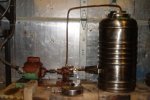
I built a pump system to circulate the oil in my quenching set up.

The vessel being used is a 10"X30" Airvoid tank that holds 5 gallons of Tough Quench.

The intake, rest, 4 inches above the bottom of the tank, it runs through a screened hydraulic pump and returns at the top of the tank.

I measured the flow rate when the quench oil was at 140fh. The volume is 1.5 gallons a minute.

Is this a high enough rate of flow, to have a positive effect on the quenching process.
Will this move a measurable amount of heat from the blade and give me a more consistent result?

I would appreciate some input on this. Fred
doggon_jpg+028.jpg
 
Last edited:
bttt


Looking for some feed back on this.

Fred
 
Actually this was part of a discussion (or side discussion) up at Ashokan this year. Unless you're mass producing, oil circulation seems to be unnecessary. I think Kevin Cashen was part of the conversation and as I remember it was said (can't remember by who) that it can actually be detrimental depending on how the oil was engineered. Quench oils are engineered to certain specifications and the introduction of any stimulation actually affects how they encase the blade steel and cool at a faster rate than what you may desire and / or what they are engineered to provide.
 
Fred,

I just looked in the books I have and the only thing I find is rates of cooling in relation to 65F still water. The "Severity of Quench" tables that show change in cooling rate related to amount of aggitation (circulation) don't say anything about what the rate of movement is that relates to the verbal catagories of none, mild, moderate, good, strong, violent. I did find one graph of cooling in water of various temps. at various rates of movement and the units were meters per second... like 4 and 10.

The "Severity of Quench" tables for oil at none, mild, moderate aggitation/circulation
None = 0.25 to 0.30
Mild = 0.30 to 0.35
Mod. = 0.35 to 0.40

Water at 65F and no movement is the base and it is referenced as 1.00. Aggitation does not effect oil quenches as much as it does other quenchants.

None of this is much help. There have been a number of discussions on quench aggitation at SFI in the metallurgy sub-forum... if you haven't been there already.

Mike
 
I can't help you with the numbers but the point is to break up the vapor barrier because the vapor barrier retards cooling.
 
Depends on steel and oil. Like mentioned some steels benefit from a slower quench others from faster.
 
I don't have any numbers ,either. But I like a circulation pump in a large tank.

I would change the direction of the flow in your setup,and have the jet centered in the bottom (J-tube at the bottom,intake at the top). That way the oil circulates in a stream straight up and accelerates the breakdown of the vapor jacket. It would also aid in convection. The way you have it, it is trying to swim against the current, which could cause some issues, maybe. Another advantage of a pump is the ability to run the oil through a cooler (transmission cooler radiator and fan) to keep the climb in temp down on multiple quenching. Waiting for 5 gallons of oil to cool on its own can take some time.
Stacy
 
I appreciate the feed back guys.

Its time to do some experimenting and see what comes of it.


We are putting together some billets to dry weld, on Saturday and will be

trying out the new quench tank, set up, to boot.

The feed back on this forum is unequaled. It makes the journey a pleasure.

Fred
 
Fred,

I posted this in another active thread here:

"Mete" talked about doing a whirlpool agitation either here or on KN or SFI (under "Robert C."). Sounded like quenching near the wall with edge into the flow was what he did or thought would work well.

Sorry... I can't find the link to it.


A thing Stacy just said reminded me of a discussion on Sword Forum in the met. section. A fair amount of input on flow and direction and ideas on doing it. I still can't remember where "Mete's" description of circulation is.

Mike
 
Hello Fred,

I've been thinking about adding circulation in my tank as well to aid in reducing vapor jacket. Would like very much to hear the results of your test and see any pics if you have any.

Thanks, Eric
 
Actually this was part of a discussion (or side discussion) up at Ashokan this year. Unless you're mass producing, oil circulation seems to be unnecessary. I think Kevin Cashen was part of the conversation and as I remember it was said (can't remember by who) that it can actually be detrimental depending on how the oil was engineered. Quench oils are engineered to certain specifications and the introduction of any stimulation actually affects how they encase the blade steel and cool at a faster rate than what you may desire and / or what they are engineered to provide.

I may have been present for the coversation but it wasn't me that said the part about agitiation being unnecessary or even detrimental. A good agitation of the quenchant is always beneficial with the only limitations being how fast you want things to cool. You do have to be careful as to what apparatus you use to agitate with however. Using a bubbling system for instance would not help much with ellimanting vapors and oxidation, and copper based piping can increase the rate at which some oils will degrade.
 
I may have been present for the coversation but it wasn't me that said the part about agitiation being unnecessary or even detrimental. A good agitation of the quenchant is always beneficial with the only limitations being how fast you want things to cool. You do have to be careful as to what apparatus you use to agitate with however. Using a bubbling system for instance would not help much with ellimanting vapors and oxidation, and copper based piping can increase the rate at which some oils will degrade.
Actually I think it was...dang, his name escapes me...Mangioli? The Cold Steel rep. Anyway, he was talking about how the vapor jacket needed to be in place to prevent it from cooling too fast in some instances. As you said, depends on how fast you want it to cool.
 
There is a short piece in Heat Treaters Guide in the quenching section titled Ultrasonic Quenching.

"Ultrasonic agitation substantially increases quench severity but the cracking and distortion that can be caused by oil, water, or brine quenchants often are eliminated. Reductions in distortion and cracking are often accompanied by an increase in hardness."

It seems like this could be an advantage for water quenchers (maybe using slower oil instead) and low temp salt users getting low hardenibility steels down below the nose fast enough using a marquench.

Seems, though, if this were viable, someone serious would be doing it... so why not?

Mike
 
I would also think that moving the oil on the surface would not be to good of an idea. Depending on the speed of the surface oil you could actually cause a void. Pushing up from the bottom would probaly be better since if I remember the hydrolics leatures correctly it would push the vapor barriers up and away from the edge of the knife, but it has been a long time since I had those. :)
 
I left out the main characteristic of ultrasonic agitation of the quench is it totally defeats the vapor barrier and that is what causes most, if not all, of the increase in severity.

I still think it might be usful and don't know why some knife folks haven't used it.

Mike
 
Here is a pic of the quench circulating setup I built.


It circulates out the bottom and back into the top of the reservoir.
When the quench oil was heated to 140fh, while the oil was moving through the pump, the temp of the oil coming into the top dropped around 5 degrees. Which was less than I thought.
When the heat source was removed the temperature dropped off fairly fast.

I have considered the idea of reversing the flow by coming out the top and into the bottom of the tank, but I have questions about doing this.
It seems to me, that because the tank is 30 inches tall and the quenching will take place mostly in the top 10 inches of the canister, I believe that introducing the oil at the top where it will be in proximity to the blade being quenched makes more since.
If it comes up from the bottom and into the neck of the vessel, there would be little room for the heated oil to move.
If the idea is to breakup the vapor envelope, around the blade, as it moves past the pearlite nose, having the oil come into the top will allow me to place the nozzle quite close to the blade, which should result in the vapor envelope breaking up fairly fast.
Since the time frame is 1.5 seconds or less to pass the pearlite nose, for the steels I use, I think having the oil at the top makes more sense.

This is my take on it, give me yours.

I appreciate any and all feedback,
Fred


doggon.jpg 026343.jpg
 
Actually I think it was...dang, his name escapes me...Mangioli? The Cold Steel rep. Anyway, he was talking about how the vapor jacket needed to be in place to prevent it from cooling too fast in some instances. As you said, depends on how fast you want it to cool.

I think you might mean Dan Marangi?
 
I think that after we talked yesterday about it that you have it set up the best way to break up the vapor jacket the quickest. If the oil was cycling out the top and in the bottom the tube pulling from the top would have to be in so far that the top couple of inches would be hardly disturbed.
Cool setup, looks like a still though
May have to try your hand at a still next:)
 
The best quench tank I worked with in a laboratory was a very large one with a centrally located pipe of about 6" Dia IIRC and the oil flowed upward at a good flow rate .I don't know the numbers though.
With a tall tank like you have I'd prefer an upward flow.
 
Back
Top