What handheld GPS?

Joined
Sep 21, 2005
Messages
495
I've been looking into picking up a handheld GPS for the past few weeks and am pretty overwhelmed by all of the choices. This will be my first, so I'm definately a noob when it comes to GPS. What do you guys have and use? What do you like/dislike? Any suggestions on specific brands to avoid or seek out?

The geocaching thread made me wonder why I never thought to ask you guys here.
Thanks in advance!

-Joe
 
Right now, I have the Garmin GPS-MAP 60Cx...
Take a look at the Garmin colorado 400 series (t=topo map, i=inland lakes, c=sea maps). They're not exactly cheap, but they have very interesting features for geocaching (mainly direct geocaching.com GPX support).
 
I use a Garmin GPS Map 60cx for a number of years and I've used it hardcore on the street and in the wild. It has performed very well. Now I've upgraded to the 60CXs and am even more impressed. But for my longer term bag or wilderness training I use the Vista HCx because it is smaller, & lighterweight.

I would say I'm a power user and use just about every function to their full potential and find these two units work extremely well. Of course I have some primative and map/compass skills as my backups - and I keep them current.

I've done some Geocaching and the 60 worked extremely well for this application. I'm a Garmin dealer so I can order whatever unit I want...and I would reorder either the 60CXs or Vista again in a heartbeat - but that is what works best for my needs.
 
Last edited:
Go with the garmin 60-CSx (60-Cx + barometric altimeter and electronic compass). I love mine, even though it is sick at the moment.
 
I personally don't need the "s" in the 60CSx (barometer, compass)...but to each is own.

You get a pretty good approximation of the altitude with the satellite signals, and you know your bearing if you move fast enough (normal walk).
 
And, the compass uses the batteries pretty fast. But, I'm a "bells and whistles" kind of guy.

Definitely don't skimp on the removeable SD card. The maps are huge and you'll be swapping them out all the time with just the intermal memory of the 60C.
 
I have a DeLorme Earthmate PN-20. It has worked well for me. The feature I like best is that I can download detailed topographic maps and aerial photos to my handheld GPS. I use it in my field work (geologist). Companion mapping software allows me to plot the locations of photos I take in the field.
 
Garmin etrex HCX Vista gets my vote.
I have one and love it.
Advantages
1. Battery life and type (25 hours) 2 AA batteries common battery globally
2. Weight and size (5.5 oz (156 g) with batteries,4.2" x 2.2" x 1.2"
3. Can run 100% off of 20 watt solar cell with no batteries (in the event of total battery failure or in a country with no access to power or batteries)
4. Price Less than $200
5. Waterproof to 3 feet
6. Maps (supports Street,Topo,and boat maps with routing) (you can load tons of maps with it but there is a two gig limit or 2000 maps per micro SD card)
7. Super quick sensing receiver, it will lock on quickly and works indoors and under heavy, heavy tree canopy
8. Barometric altimeter
9. Electronic compass
10. Geocaching mode
11. Bright Color screen

It's one of the best all around survival GPS that I found and add Sanyo Enloop batteries and you'll be set. (Enloop batteries have a 1 year storage with holding their charge)

Watch this video when it goes into the GPS http://www.scrapyardknives.com/ubbthreads/showflat.php?Cat=0&Number=178898&an=0&page=0#Post178898


cf-lg.jpg


https://buy.garmin.com/shop/shop.do?cID=145&pID=8703#
 
Last edited:
Well, it looks like the 60CSX might get the nod. I'm going to try and find both the Vista and 60 locally to lay hands on them and see how the feel.

Thanks for the input guys!
 
I personally don't need the "s" in the 60CSx (barometer, compass)...but to each is own.

I used to think that too, but picture yourself in a survival situation. You've injured your leg(s), you're mind is not working on all cylinders so you're a bit confused, and are struggling - maybe even crawling or dragging yourself - to find your way back to your vehicle, campsite, or other key place. The electronic compass allows the GPS to always point to your destination. Simple. Even if it needs re-calibration, its just a matter of rotating it slowly until it is calibrated..
 
Very true, kenk. I always have a small kit with me, though, and it contains a compass (among many other things) Hey! That makes me think of this:
- What do you bring with you when you go geocaching? I'll certainly put a picture and a description of what I have with me later...
 
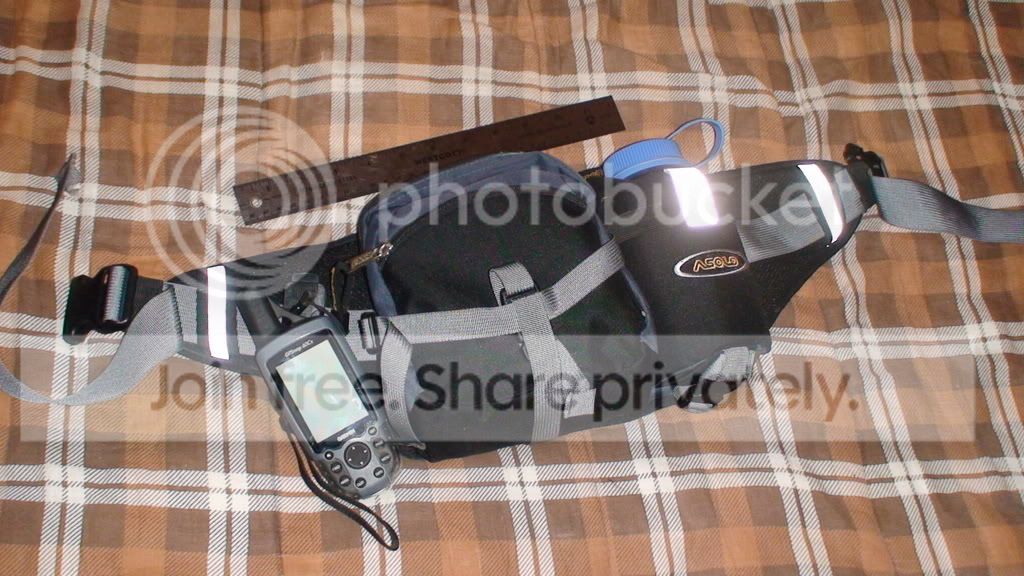
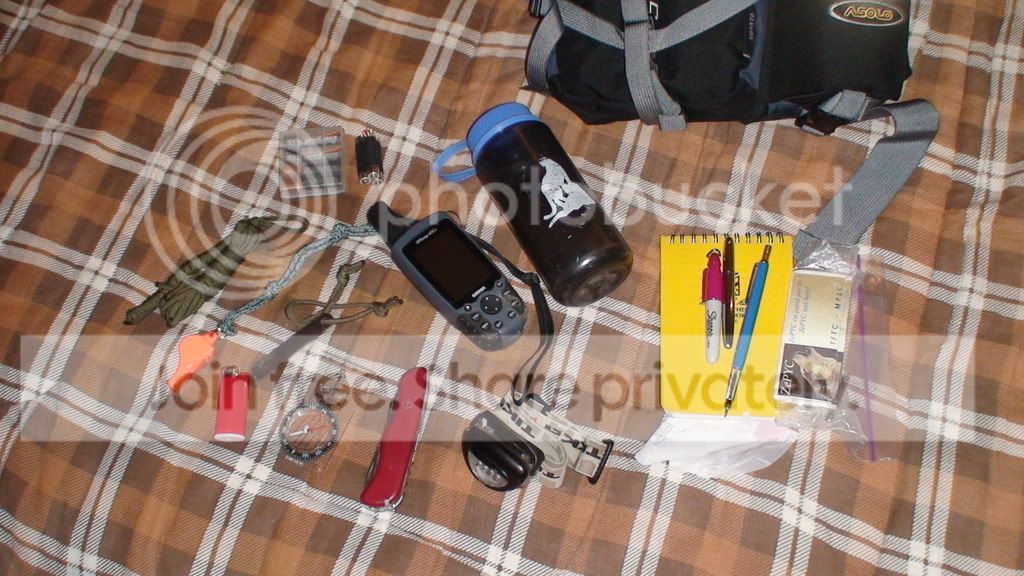
OK...here's the "geocaching" kit I always have with me...

GeocachingKit.jpg


Content.jpg


Description of the content:
- Garmin GPSMAP 60Cx, loaded with topo & roads of all east North America
- 2 sets of spare AA batteries (for GPSr)
- Nalgene bottle
- Waterproof notepad, fisher pen, pencil, sharpie, "Geocaching labels"
- Plastic bag (mainly to bring back any trash I may find)
- Petzl head lamp (with spare batteries)
- Victorinox "Rucksack" knife :D
- Sylva compass
- Bic lighter & firesteel/striker
- Fox40 whistle
- Paracord

Also, an important safety feature not shown in the above picture is my cell phone :o

What do you, fellow geocachers, bring along?
 
Another vote for the 60CX, been using mine for about 2 years. If I did it over again I'd go for the CsX.

Win
 
i have a 60cx as well. its a good gps but i've only had it for a little while.

i own a mac so sometimes its a pain to get things going but i can get it to work after a reset and swap into my bootcamp partition.

the maps are a little pricey though so keep that in mind.

its not like a car gps that has streets preloaded, you'll probably have to get topos or street maps for it if you plan on using it in city i believe.

cheers
 
What do you, fellow geocachers, bring along?

Your kit practically duplicates mine; including 60CSx, SAK, para-cord. That is my minimum if I am off-road at all + walking stick - the urban hides usually only require GPSr & writing instrument.:)
 
No matter what kind of GPS you all end up getting/using, make sure you also pack a spare set of batteries!!

This weekend I was out in the field, turned on my GPS, and about 2 minutes later I got the low batteries warning - and I'd left the spares in my tent. The good news is that it had enough juice to do what I needed it to do, but still, it was pretty dumb of me not to have extras in my daypack.
 
Back
Top