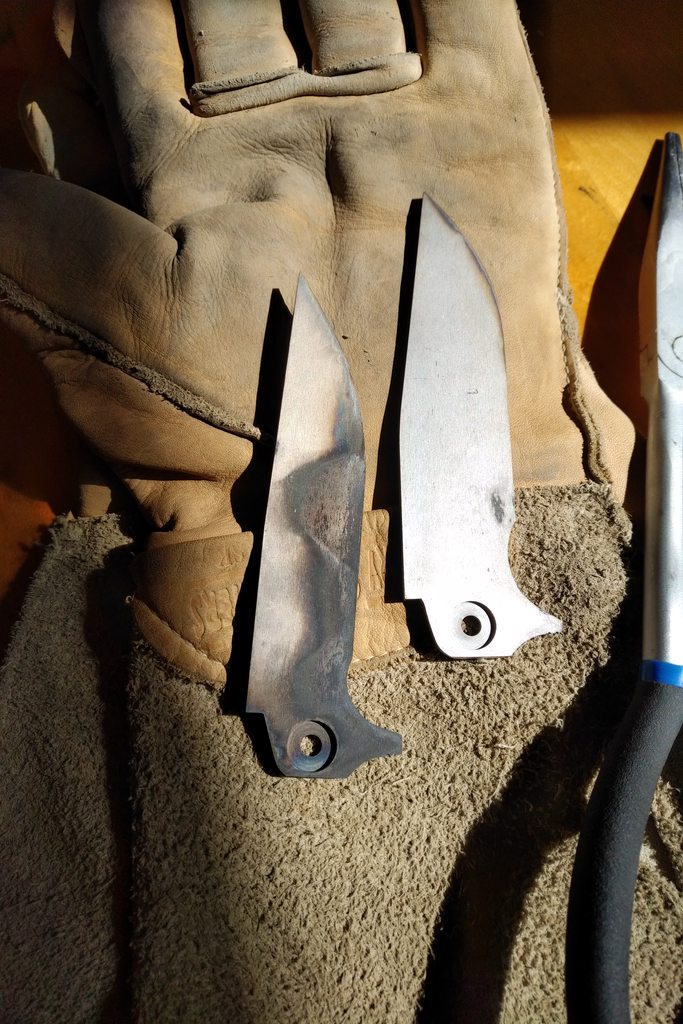
What happened here?

Joined
Feb 10, 2013
Messages
1,019
I was heat treating these folder blades in the same packet and one is looking a lot different than the other. They were tip to tip in the packet, spine down. I held the foil up to the light and couldn't see any pin holes. If it was from air, maybe the fold on the foil? I double fold every seam.

WDixGt5h.jpg
 
I have had that happen to me, though I think my packet had a leak. never had it happen to one and not the other in the same packet though. That's odd.
 
I'm betting a tiny leak in the fold. Was the fold along the edge? If you have seen pictures of pin holes in foil it normally makes a single dark spot one the blade where the hole is. As the oventemp cycles the air in the foil expands and contracts a very tiny amount. This will end up sucking in tiny amounts of oxygen in through the hole. Depending on the size of the hole it might just be a tiny spot on the blade or a large spot.
 
Think about this harder fellas... An air leak in the packet could NOT allow enough oxygen in to have combusted the blade. You are looking at burnt steel.

There HAD to be a chemical reaction that produced oxygen.

What did you use to clean the foil? Or the blade?

There is more to it than an open seal. Something (peroxide?/atomic hydrogen?) was IN that steel to allow it to ignite.

1500 degrees at LEAST!
 
Think about this harder fellas... An air leak in the packet could NOT allow enough oxygen in to have combusted the blade. You are looking at burnt steel.

There HAD to be a chemical reaction that produced oxygen.

What did you use to clean the foil? Or the blade?

There is more to it than an open seal. Something (peroxide?/atomic hydrogen?) was IN that steel to allow it to ignite.

1500 degrees at LEAST!

What? How many stainless blades have you heat treated?

I think its a leak as others have said. I've had pin hole leaks that are more dot like as JT described and localized to where the leak was. So if you had those in the packet tip to tip I could see one blade having the color change and not the other.

-Clint
 
Sir, I agree that there had to be a failure in the packet. 100%
There also (IMHO) had to be something that allowed the temp to rise to over 1500*f.

Residual solvent? Porous steel? Impurities?

I've been welding, and smelting since I was 13 (48 years). Steel takes an oxidizer to ignite. Especially when it is basically enclosed, and the oxygen is flooded out with carbon monoxides.

Yes sir, experience can not be replaced with speculation. ABSOLUTELY not!
I am hoping to bring some chemistry into this post where reactions are caused by SOMETHING, and perhaps between your experience, and my input a real cause/cure can be discovered, and avoided later on.
Just trying to help.
 
Sir, I agree that there had to be a failure in the packet. 100%
There also (IMHO) had to be something that allowed the temp to rise to over 1500*f.

Residual solvent? Porous steel? Impurities?

I've been welding, and smelting since I was 13 (48 years). Steel takes an oxidizer to ignite. Especially when it is basically enclosed, and the oxygen is flooded out with carbon monoxides.

Yes sir, experience can not be replaced with speculation. ABSOLUTELY not!
I am hoping to bring some chemistry into this post where reactions are caused by SOMETHING, and perhaps between your experience, and my input a real cause/cure can be discovered, and avoided later on.
Just trying to help.

an electric oven is not a sealed environment and does not produce CO2. there is something that brought the steel to well past 1500, its called the oven it was in...
 
No worries, we all start somewhere and I am no expert in metallurgy by any means. But I have heat treated a number of stainless blades in the manner the OP describes.

The answer in my eyes is as I stated above, a leak in the foil. My guess is the OP, like most, does not use gas in the furnace which is why he is using foil. The oxygen exists in the furnace without the presence of an inert gas to shield the work. This is where the foil comes in. For air hardening stainless which is probably what the OP is heat treating much of it requires you reach temperatures close to 2000F and at that temperature a small hole in your foil will cause oxidation and the colors the OP has in his photos. So to really answer your question, if the OP did not use foil both blades would probably be colored and pitted among other things, without the addition of anything else in the furnace.

I reckon anyone who has heat treated a couple dozen stainless knives using foil has experienced this at one time or another, I know I have.

And no need for Sir, I'm neither British nor have I been knighted. As far as I know anyway.

-Clint
 
Thanks for the replies gentlemen. It is/was S35VN at 2000F for 15 minutes. Next question.....has that blade sustained damage to the point of being unusable?
 
an electric oven is not a sealed environment and does not produce CO2. there is something that brought the steel to well past 1500, its called the oven it was in...

CO is monoxide... CO2 is Dioxide.
The packet itself is a sealed environment (to a degree). CO will flood the oxygen out UNLESS there is an oxidizer.

I mean no disrespect to anyone. I am learning just as everyone here has had to do.

Ps. Sir is how I approach everyone that I do not know. Maybe there was a Knight in your family... ;)
 
1. Did you use the high temp foil?
2. Did you stick wood or paper into the packet to eat up the oxygen?
 
CO is monoxide... CO2 is Dioxide.
The packet itself is a sealed environment (to a degree). CO will flood the oxygen out UNLESS there is an oxidizer.

I mean no disrespect to anyone. I am learning just as everyone here has had to do.

Ps. Sir is how I approach everyone that I do not know. Maybe there was a Knight in your family... ;)

If you would actually like to learn about heat treating stainless steel blades, might I suggest reading the stickies at the top of the shoptalk page? Otherwise you are adding confusion and misinformation to this post.
 
CO is monoxide... CO2 is Dioxide.
The packet itself is a sealed environment (to a degree). CO will flood the oxygen out UNLESS there is an oxidizer.


I mean no disrespect to anyone. I am learning just as everyone here has had to do.

Ps. Sir is how I approach everyone that I do not know. Maybe there was a Knight in your family... ;)

My point is that "basically closed" is not closed. I've actually heat treated many stainless blades in foil packets so I know from actual experience that even a tiny hole in the packet will allow this to happen. You don't need to theorize, you just need to read.
 
1. Did you use the high temp foil?
2. Did you stick wood or paper into the packet to eat up the oxygen?
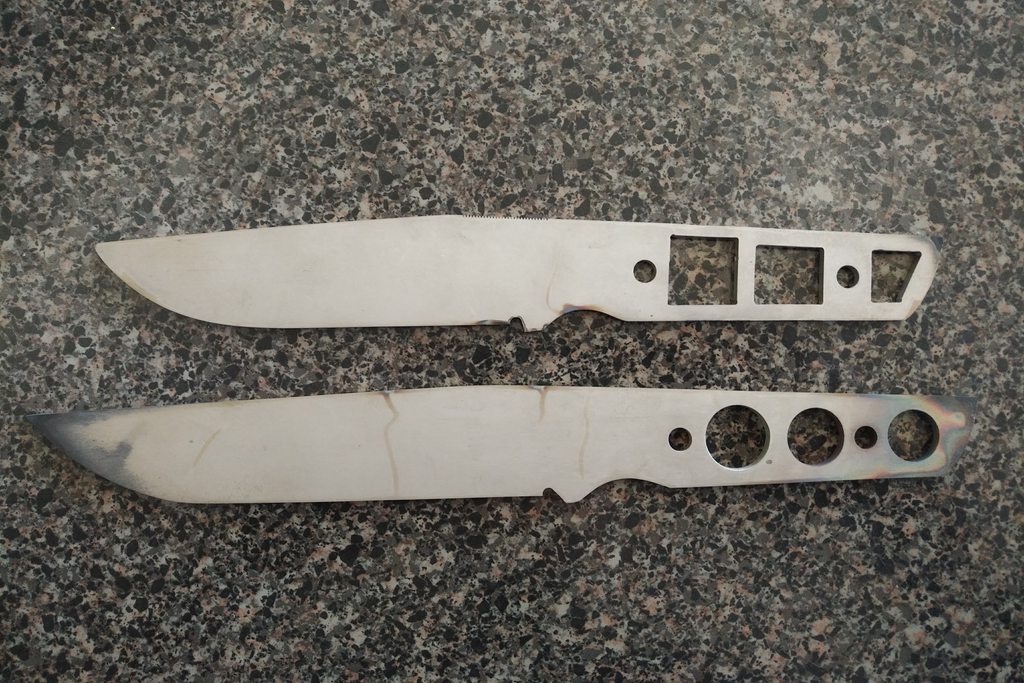
I always use high temp foil and I did not put anything in the foil with the blades. I heat treated these two knives (both S35VN) at the same time in their own packets. All the blades were washed with soap and water, dried and wiped down with rubbing alcohol and paper towels prior to heat treat. I was wearing latex gloves at the time to eliminate getting any oils from my hands on the blades or foil.

LCmMV0sh.jpg


As the discoloration appears where there are sharp edges/points, I will assume it is a slight amount of oxygen entering the packet that is causing the discoloration. These will have removable handle scales just in case anyone is wondering why they look the way they do.
 
It's probably just from oil or shit that was on whatever you were handing it with when you put the blades in the packet, something you laid it on, whatever.

It's nothing to be concerned about. Mine never come out completely clean. Were you expecting to not have to clean anything up after HT?
 
I would ditch the Rubbing Alcohol and get DeNatured Alcohol....Rubbing alcohol always feels oily after it drys and I have always thought that since it was for Rubbing maybe a drop of oil is added for skin lubrication?!
 
It's probably just from oil or shit that was on whatever you were handing it with when you put the blades in the packet, something you laid it on, whatever.

It's nothing to be concerned about. Mine never come out completely clean. Were you expecting to not have to clean anything up after HT?
They were cleaned while I was wearing latex gloves and put on clean paper towels. These folders are running on bearings and tight tolerances. When I counter bored the bearing pockets I made allowance for surface grinding 2 thousandths off after heat treat. If I have to grind off 5 thousandths (or whatever amount) I will have to adjust the stand offs accordingly. If I can avoid that in the future, that is a good thing.
 
Well if it's not that, then it's as the others said. Of course, you have to look at the whole process though, if there was any lay-out fluid or anything inside a hole or somewhere, it could have caused it, something could have been on the foil. Even just residual air in the packet.

I usually fold my packet edges 3 times, and press them, but even still, it's pretty easy to see where they'd leak at the corners where the sides and top meet.

I'm not aware of any HT method that is 100% clean, and fool-proof. Even salt pots, which are about the cleanest option, require minimal cleanup afterward. Maybe you'll figure it out, all I'm saying is that, even when I've had stuff, surface ground, cleaned extensively, and nice neat well folded seams on my packets, I've had discoloration. I attribute it to either micro contaminants or residual air, problem is, if you put something in to burn out any residual air, tends to discolor more.

 
I doubt you'd have to take much off. As long as it hardened (one piece of A2 that looked like that didn't reach full hardnessfor some reason, still haven't really figured that one out) it's generally just a surface finish in my experience. I'd be fairly confident in a thou or two cleaning it up
 
Back
Top