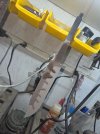
what happened in my hamon?

CWendling

Knifemaker / Craftsman / Service Provider
Joined
Sep 10, 2005
Messages
528
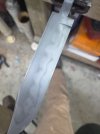
Probably 10 etchs in now. 1095, I brought to 1450 for a 5min approx soak and quenched in parks. Etched 4:1 ferric 2 min each etch. The upper dark area is pretty much exactly where clay was (hamon 1800), and there's clearly a transition line below that. Why did that happen? Soaked too long? Not long enough?
 

Attachments

  • 672626704_10237767753346023_3446838633631016106_n.jpg
    672626704_10237767753346023_3446838633631016106_n.jpg
    81.9 KB · Views: 4
Im not unhappy with it at all. Just trying to see if i did something right (or wrong) to cause the dark where clayed and then the lower transition line. I think every other hamon ive done, the darker transition line followed pretty close to the clay. Here is what it looked like clayed. I just didnt expect to have a solid line like that so much lower. Id have expected that if i didnt clay any 'fingers' i guess id call them. Just trying to learn and improve
To answer the other questions. Edge was taken to about .030 pre HT and all was ground to 220. I use anti-scale, so not a lot taken off the flats post HT, bevels probably .010ish or a little more off post HT to get to about .010 edge. I typically go to 400 on grinder, then hand sand to 2500. Then i started the etching. I went tonight and got some lemon juice and vinegar. Im gonna do some rubbing in/etching with those to see if anything else turns up.
 

Attachments

  • 20260408_152029.jpg
    20260408_152029.jpg
    126.8 KB · Views: 4
Looks like the second lower, darker line is along the transition where your fingers of clay reached out to.....Looks awesome to me.. Different. In a good way..👌....Test the hardness in the different locations if possible🤔???
 
when you grind (or forge) bevels in the hamon likes to do fun things since there’s a difference in cooling rate in the quench from the material thickness and a degree of autohamon sets in.

Also fun fact almost all japanese blades pre 18th century did not have designed hamons with the clay work it was typically laid near flat and whatever pattern came out was typically caused by a mix of forging geometry and forging technique of the school (this was pre laminate construction most swords of this era just consolidated the steels with the various carbon content into a single billet and tried to homogenize it as much as possible) + a bit of luck. The intricate clay designs came later around the 18th cen from guys trying to replicate those older swords. Laminate construction would also come later.


this site is a neat resource for stuff like this
www.ksky.ne.jp/~sumie99/yakiire.html
 
How thick is the spine on this one? I’ve only gotten this effect when I have a thick spine, wide flat grind, and the “fingers” on my clay layout aren’t too close to each other. Also etching a lot helps show it, once or twice I just couldn’t get the upper section of the hamon to show enough though despite more etching. I’m sure temps and soak also play into it but I haven’t done enough to narrow that down yet. I use Aldo’s low Mn 1075.

Looks really good by the way, excellent hamon, I love it
 
Back
Top