me and my brother have been making knives out of saw's, file's and lawnmower blades, we never had any problems heat treating, we finally bought some 1095, we had the same set up small wood fire and motor oil for quenching, after hardening the blade it cracked on us, any idea on what went wrong???

-
The BladeForums.com 2024 Traditional Knife is available! Price is $250 ea (shipped within CONUS).
Order here: https://www.bladeforums.com/help/2024-traditional/
You are using an out of date browser. It may not display this or other websites correctly.
You should upgrade or use an alternative browser.
You should upgrade or use an alternative browser.
What Happened??
- Thread starter B.B.M
- Start date

- Joined
- Aug 6, 2007
- Messages
- 5,060
What didi you do to the blade after you hardened it? Did it crack after it was hardened? Was there a dark section in the break?
- Joined
- Aug 6, 2007
- Messages
- 5,060
Was it just sitting there, and cracked? WHat is the dimensions of the blade?

- Joined
- Oct 1, 2007
- Messages
- 2,401
I am by far an expert but 1095 is not the right steel for this type of heat treating. 1095 requires a controlled soak for a specific time. If you are going to do it the way you are then get you some 1080 or 1084 or 1075. Check the for sale section for Aldo and he can hook you up. There is a very good sticky at the top of this section by Kevin Cashen that goes into serious depth about 1095 as well as the other steels mentioned here. Hope this helps you out.
Last edited:

- Joined
- Nov 20, 2008
- Messages
- 1,855
The blade was likely severely overheated. Especially since it hardened in motor oil, which is not likely to happen if quenched at the proper hardening temperature of around 1475 - 1500 F.
If you want to use 1095 you'll have to learn how to better judge your temps, keep the blades edges a little thicker and use a proper quench oil or an interrupted quench with a brine. Be prepared for a good number of cracked blades and/or blades that don't harden at all while you get it all figured out. Most important is blade temp when quenching and proper - fast quenchant.
If you want to use 1095 you'll have to learn how to better judge your temps, keep the blades edges a little thicker and use a proper quench oil or an interrupted quench with a brine. Be prepared for a good number of cracked blades and/or blades that don't harden at all while you get it all figured out. Most important is blade temp when quenching and proper - fast quenchant.

Nathan the Machinist
KnifeMaker / Machinist / Evil Genius
Moderator
Knifemaker / Craftsman / Service Provider
- Joined
- Feb 13, 2007
- Messages
- 19,522
That is kind of odd for 1095 to crack in oil. I agree with the sentiment that motor oil is too slow for 1095, but that certainly doesn't explain cracking. If you've had plenty of success with other similar steel such as files, I have to expect you must be at least in the ball park with your temperature.
It is possible there is a problem with the steel. If it came from a bar, I'd check that bar for a flaw by cutting off a section and putting it in a vice parallel to your crack and hammering it over. If there is an inclusion, it will probably show up.
Depending on the heat history of your steel, it may need to be normalized a couple times for grain refinement before being ready for heat treat.
You're going to want a faster oil for 1095, though that is not related to cracking.
It is possible there is a problem with the steel. If it came from a bar, I'd check that bar for a flaw by cutting off a section and putting it in a vice parallel to your crack and hammering it over. If there is an inclusion, it will probably show up.
Depending on the heat history of your steel, it may need to be normalized a couple times for grain refinement before being ready for heat treat.
You're going to want a faster oil for 1095, though that is not related to cracking.
me and my brother have been making knives out of saw's, file's and lawnmower blades, we never had any problems heat treating, we finally bought some 1095, we had the same set up small wood fire and motor oil for quenching, after hardening the blade it cracked on us, any idea on what went wrong???
Did you sharpen the blade before heat treating it ??
Richard

- Joined
- Oct 2, 2006
- Messages
- 3,238
please describe your process from the time the steel arrived including whom the manufacturer of the steel was (Admiral for instance is known for carbide banding in their 1095. Right now we do not know if you forged or ground it, whether you stuck it in coals at the bottom of your "small wood fire" or made charcoal of your wood and used it in a controlled manner in a forge, or whether you used a kiln and your wood fire was for the hot dogs
The more we know of your process the more likely we are to be able to help you
-Page
The more we know of your process the more likely we are to be able to help you
-Page
we bought the steel from jantzsupply, i used stock removal to shape it (bench grinder) and beveled it on a lowes belt sander. after that we built a small wood fire and let it burn down to coals. we heated the fire with a hair dryer. i used a magnet on a stick to test it once non- magnetic i immediately quenched it in motor oil. after that i started to clean it up for tempering and noticed the crack.
i know we're pretty low tech here but we have made serveral knives out of file's, lawnmower blades and saw blades. and have really put them through the test. it was pretty cold out ( for alabama anyway) late 40's and the oil had set out in the shop all night. my brother thought that maybe the oil should have been heated before quench? also what kind of oil should we use for 1095?
thanks for all the info. we really appreciate it.
Ben
i know we're pretty low tech here but we have made serveral knives out of file's, lawnmower blades and saw blades. and have really put them through the test. it was pretty cold out ( for alabama anyway) late 40's and the oil had set out in the shop all night. my brother thought that maybe the oil should have been heated before quench? also what kind of oil should we use for 1095?
thanks for all the info. we really appreciate it.
Ben
Nathan the Machinist
KnifeMaker / Machinist / Evil Genius
Moderator
Knifemaker / Craftsman / Service Provider
- Joined
- Feb 13, 2007
- Messages
- 19,522
Not exactly the perfect set up - but you got to work with what you got...
The magnet will stop attracting around 1400. 1095 needs a short soak at more like 1500. So you'll want to bring it up another shade and try and hold it a minute without overheating anywhere. Most folks use a muffle of some sort. Go slow and approach it carefully.
1095 requires the fastest quench of about anything out there. Brine is frequently used. Motor oil is a slow and uneven quench, and also tends to be stinky and leave a lot of burnt on crud, so I seriously dislike it. I recommend the fast quench oil from McMaster. A gallon is something like $20 and I guaranty your knives will improve. If you don't want to use a real quench oil, you want to use something very thin, such as 120 degree thin mineral oil. Agitate very vigorously - though not side to side.
None of these recommendations will affect the cracking. I don't know what happened there. Perhaps some kind of a stress riser such as a deep scratch or too long a delay getting into temper.
The magnet will stop attracting around 1400. 1095 needs a short soak at more like 1500. So you'll want to bring it up another shade and try and hold it a minute without overheating anywhere. Most folks use a muffle of some sort. Go slow and approach it carefully.
1095 requires the fastest quench of about anything out there. Brine is frequently used. Motor oil is a slow and uneven quench, and also tends to be stinky and leave a lot of burnt on crud, so I seriously dislike it. I recommend the fast quench oil from McMaster. A gallon is something like $20 and I guaranty your knives will improve. If you don't want to use a real quench oil, you want to use something very thin, such as 120 degree thin mineral oil. Agitate very vigorously - though not side to side.
None of these recommendations will affect the cracking. I don't know what happened there. Perhaps some kind of a stress riser such as a deep scratch or too long a delay getting into temper.

oldschool45
Gold Member
- Joined
- Oct 15, 2007
- Messages
- 1,243
Ben,
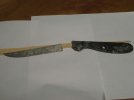
Did your snap look something like this?
This is a 1/8 thick 1095 blade (steel bought from Jantz) heated in a wood fire with a gas lawn blower and quenched in McMaster Carr 11 second oil. 2 things I think contributed to this; 1) I cut the shoulder of my plunge a little too deep as that is exactly where it snapped and 2) I was flex testing it before I tempered it when it snapped. It snapped in my hands without using a whole lot of force 5 pounds of lateral force maybe. If I had dropped it onto a hard surface it may have broke. I think you may have made the same mistakes I did. The next time I mess with 1/8 or thinner stock I wont be grinding any bevels first as I had too much warping this last go around.
Ray
Did your snap look something like this?
This is a 1/8 thick 1095 blade (steel bought from Jantz) heated in a wood fire with a gas lawn blower and quenched in McMaster Carr 11 second oil. 2 things I think contributed to this; 1) I cut the shoulder of my plunge a little too deep as that is exactly where it snapped and 2) I was flex testing it before I tempered it when it snapped. It snapped in my hands without using a whole lot of force 5 pounds of lateral force maybe. If I had dropped it onto a hard surface it may have broke. I think you may have made the same mistakes I did. The next time I mess with 1/8 or thinner stock I wont be grinding any bevels first as I had too much warping this last go around.
Ray
Attachments
- Joined
- Oct 2, 2006
- Messages
- 3,238
we bought the steel from jantzsupply, i used stock removal to shape it (bench grinder) and beveled it on a lowes belt sander. after that we built a small wood fire and let it burn down to coals. we heated the fire with a hair dryer. i used a magnet on a stick to test it once non- magnetic i immediately quenched it in motor oil. after that i started to clean it up for tempering and noticed the crack.
i know we're pretty low tech here but we have made serveral knives out of file's, lawnmower blades and saw blades. and have really put them through the test. it was pretty cold out ( for alabama anyway) late 40's and the oil had set out in the shop all night. my brother thought that maybe the oil should have been heated before quench? also what kind of oil should we use for 1095?
thanks for all the info. we really appreciate it.
Ben
Ok, first, you do not have a good enough setup to even think of using 1095. The stuff is finicky (Read Kevin's sticky on Hypereutechtoid steels)
1060, 1070, 1080 and best of all 1084 should be your steels of choice right now until you ave a more consistant heat treating setup.
Do not quench in motor oil. It is slow acting and flares up violently and dangerously. If you are not going to use a real quench oil I would reccomend Olive Oil at 130 f. I have used it for years, and while it will not work as well as a real quench oil, it works reasonably well and it does not flash violently like motor oil, transmission fluid etc. Your bench grinder profiling might have put all sorts of microscopic jagged nicks in the blade which lead to stress risers which start cracks. Any unevenness in the heating will cause you problems, hot spots from overblowing momentarily any area will cause grain growth, and in extreme cases will cause the metal to burn in spots
-Page
thanks for all the info, i'm going to try it again tomorrow with the 1095 and experiment around with it, but i think we'll end up trying some 1084, where would be a good place to buy 1084? i googled it but didn't come up with anything. also how good is 1084 steel? i've never owned a knife with it.
Ben
Ben

- Joined
- Jan 6, 2005
- Messages
- 9,680
You can get 1075/1080 at Admiral Steel for a fair price. I would shy away from 1095. If you don't have access to an engineered quench oil... at least use something like canola or peanut oil. they have a higher flashpoint. Heat the oil to 120-140F. It will give a more efficient quench.
Rick
Rick

- Joined
- Oct 30, 2002
- Messages
- 3,974
Look in the "For Sale: Knifemaking Supplies etc." section here on the forum and find the thread entitled: "The 1084 has arrived." Send a message to Aldo and see if he's got some left (I believe he does). It's some really nice steel to work with. Not too tempermental, and it makes a great blade.
--nathan
--nathan
we harden two knives today, and they did not crack. we changed oil and also heated the oil. we watched the temp more carefully, i think we my have over heated the first one. we have one tempered and waiting for the second one to finish after that we're going to give them a through test and see how they came out. i appreciate all the info and advice that you guys gave out. thanks a lot. i'm going to keep on till i get it right